
Xiaomi to add Sei crypto wallets to smartphones outside China and the US
Layer-1 blockchain Sei has announced that it is developing crypto wallets that will be pre-installed into future Xiaomi smartphones sold outside the US and China.
Sei said the forthcoming app will let users access wallets and decentralized applications with their Google or Xiaomi IDs. It will also support peer-to-peer transfers and consumer payments.

The initial rollout will target regions where Xiaomi holds a large mobile market share and where crypto adoption is already established, including Europe, Latin America, Southeast Asia and Africa.
Chinese electronics manufacturer Xiaomi held 13% of the global smartphone market share in 2024 and ranks among the world’s top three manufacturers, according to market researcher International Data Corporation.
Sei claimed that it is also working with Xiaomi to enable stablecoin payments for products across the company’s electronics catalogue, with an initial rollout planned for Hong Kong and the European Union by the second quarter of 2026.
Other tech and blockchain firms have pursued similar initiatives as mobile devices become a key distribution channel for digital assets.
Samsung has offered hardware-secured crypto wallets on its Galaxy smartphones since 2019, supporting Ether and select tokens. Solana introduced its crypto-native Saga phone in 2023 and recently launched the second-generation device Seeker.
Bhutan launches gold token on Solana
Bhutan has introduced TER, a gold-backed token issued through the Gelephu Mindfulness City special administrative region.
The city said each TER token represents physical gold and is issued on Solana. Matrixdock, a digital asset infrastructure company, provides the project’s tokenization technology.
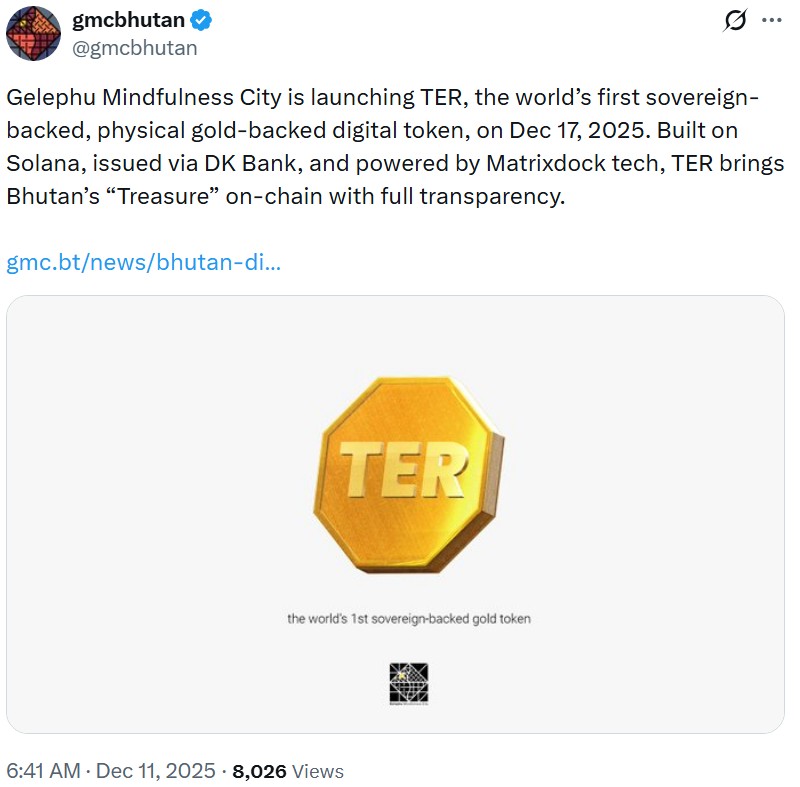
The launch adds to Bhutan’s ongoing integration of blockchain technologies.
The country has reportedly operated hydropower-driven Bitcoin mining facilities since 2019 and holds about 5,984 BTC valued at roughly $540 million, according to Arkham Intelligence, placing its holdings fifth in sovereign Bitcoin rankings tracked by the data provider.
Philippine blockchain budget bill
The Philippine Senate has approved on second reading a measure that would require all government agencies to upload budget-related documents onto a public blockchain-backed platform designed to prevent tampering.

The Citizens Access and Disclosure of Expenditures for National Accountability (CADENA) Act, also known as the “Blockchain the Budget Act,” is moving forward with executive support after being placed on the president’s priority list.
The bill was introduced by lawmaker Bam Aquino, who said the system aims to curb corruption by helping citizens track how public funds are allocated and spent.
With the bill’s approval on second reading, the Senate will next finalize and print the measure for a third-reading vote, where no further amendments are allowed, and senators cast their final votes. If passed, the proposal will be transmitted to the House of Representatives, which must approve its own version before the measure can proceed to a bicameral conference committee or be sent directly to the president for signature.
Stablecoin issuance is holding back South Korea’s crypto bill
South Korea’s crypto industry is expected to see the introduction of a national crypto bill in January, regardless of whether the government submits a proposal.
The Financial Services Commission (FSC) failed to meet its Wednesday deadline to present a draft, according to multiple local reports. On Thursday, the ruling Democratic Party’s crypto task force held a closed-door meeting with the regulator to press for submission by the end of the year.
Now, the Democratic Party’s crypto task force is preparing to advance its own version of the bill in January if the government fails to deliver its draft by the end of the year.

According to lawmakers who briefed reporters after the meeting, progress has stalled due to disagreements with the Bank of Korea, the nation’s central bank.
The FSC and the Bank of Korea are reportedly in the final stages of negotiations over unresolved issues. A central point of contention is stablecoin issuance and who will be permitted to issue them. The Bank of Korea wants to restrict issuance to consortia in which commercial banks hold at least 51% ownership. The FSC is pushing to allow non-bank participants, such as fintech and blockchain firms.
Stablecoin policy discussions have accelerated globally since the United States signed the Guiding and Establishing National Innovation for US Stablecoins (GENIUS) Act into law in July.
In Asia, Hong Kong’s Stablecoin Ordinance came into force in August, while Japan’s JPYC launched a regulated stablecoin under the country’s Payment Services Act. South Korea is one of the largest crypto markets in the world, but it has not committed to a stablecoin framework — despite it being a major campaign issue in the snap presidential election held earlier this year.
South Korea already enforces the Virtual Asset User Protection Act, which focuses on market integrity and investor protection. The forthcoming proposal is intended to address gaps left by the act, including stablecoin issuance and listing standards for digital assets.


Yohan Yun

SBF takes the stand, ‘buy Bitcoin’ searches soar and other news: Hodler’s Digest, Oct. 22-28
Sam Bankman-Fried testifies in court, searches for ‘buy Bitcoin’ surge, and Gemini sues Genesis over collateral.
Read more
They solved crypto’s janky UX problem — you just haven’t noticed yet
Crypto has finally become user-friendly thanks to intents, chain abstraction, passkeys and other new tech — and it’s already live.
Read moreBitcoin ‘bullish’ in Q1 says Willy Woo, XRP lacks CLARITY: Trade Secrets