Near.AI co-founder Illia Polosukhin loves OpenClaw, the AI agent that has gone viral for its abilities as an autonomous assistant, but thinks it’s a total security black hole.
So he’s working on recreating OpenClaw in Rust, with all the different tools sandboxed in isolated WebAssembly environments so that if one goes rogue, it doesn’t affect anything else. The system also treats prompt injections as security risks and protects against credential theft.
Polymarket traders have been experimenting with OpenClaw to find profitable bets, but a viral post this week reported that it can still reveal private keys despite explicit instructions not to.
Polosukhin says the solution with IronClaw is “to not let the LLM touch secrets at all.” Secrets are reportedly stored in an encrypted vault, with the large language model granted permission to use them only for specific sites.
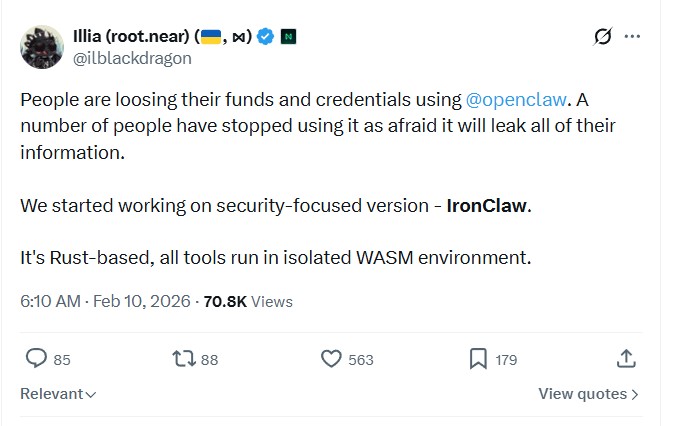
“People are losing their funds and credentials using OpenClaw,” Polosukhin explained this week. “A number of people have stopped using it as [they’re] afraid it will leak all of their information. We started working on security-focused version — IronClaw.”
George Xian Zeng, general manager of Near.AI, tells Magazine that when Polosukhin gets inspired, he works fast.
“He built the basis of it in one evening,” explains Zeng. “He was feeding his baby and building IronClaw at the same time.”
OpenClaw was originally called Clawdbot and was briefly known as Moltbot. Polosukhin has already made an enormous contribution by coming up with a way cooler name.
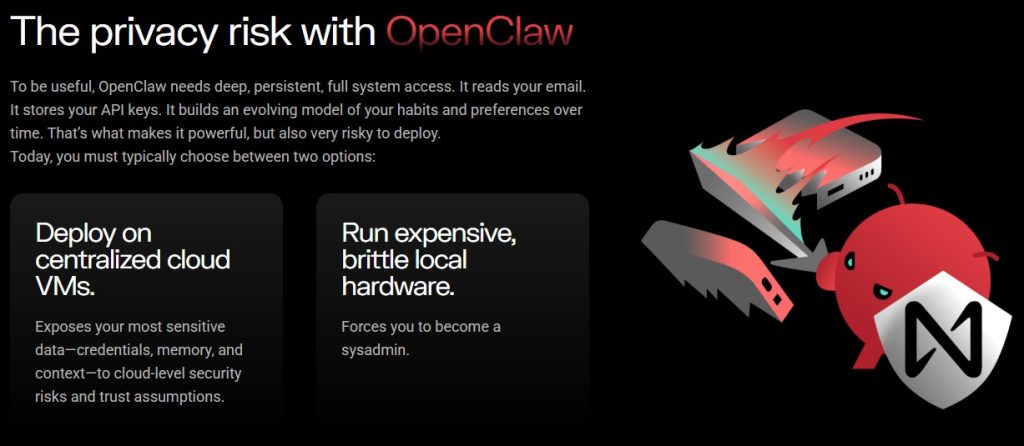
Why is OpenClaw such a security risk?
Clawdbot went viral in the first place because it’s a harness that controls a bunch of agents, tools and integrations working together to do useful stuff. The system remembers your conversation even as you switch between Telegram and Slack, and can perform actions on your computer and in your browser.
But with great power comes great security risks. Giving it terminal access, along with all your credentials and crypto wallet, is an exploit waiting to happen. It uses JavaScript, which has a large attack surface, but Rust eliminates entire classes of memory-safety bugs. Plus, it’s not very popular, so few hackers know how to use it.
Polushkin has made 74 GitHub commits in the past week, and Zeng expects IronClaw to be finished and available on Near.AI in a matter of weeks.
In the meantime, Near.AI Cloud lets anyone spin up an OpenClaw in the cloud in around half an hour (it’s in beta, so you have to apply for access right now). It runs in a Trusted Execution Environment, so everything is encrypted and nobody, including Near, can access your data.
If you want to have a private chat with DeepSeek for legal advice, you don’t have to worry about incriminating chat logs appearing in discovery. (Which is a significant risk as Magazine highlighted in January.) Near’s OpenClaw also anonymizes requests to commercial models such as Gemini and ChatGPT 5.2.
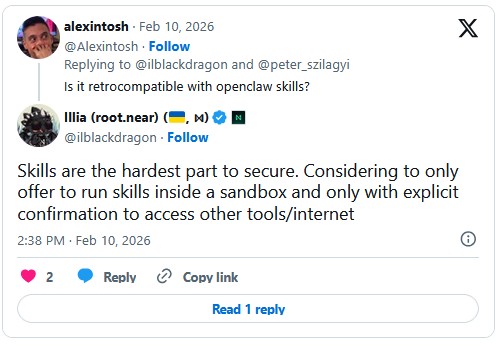
One problem yet to be solved is the amount of risk involved in downloading skills from ClawHub. Slowmist this week reported that 341 of the available skills contain malicious code to collect passwords or data.
“The cool thing … is that anyone can build a skill. But the dangerous thing about the current marketplace is that anyone can build a skill,” says Zeng.
“How do you make a marketplace that’s safe and effective, right? We’re still going through how exactly do you make that work? I think it’s reasonable to consider maybe, like, a curated marketplace.”
Near has also launched a crypto-based marketplace enabling AI agents to hire each other or for humans to hire agents. At present, many of the 1,900 available jobs involve building for Near itself, but building or buying skills might emerge as an interesting use case.
"Think of it as your guardian angel in the digital space"
Illia Polosukhin explains IronClaw's evolution, from OpenClaw in secure environments to AI you can actually trust to be on your side. pic.twitter.com/2dzuusKbwD
— The Rollup (@therollupco) February 9, 2026
Amazon’s AI surveillance state
Amazon’s Super Bowl commercial for its Ring doorbell sparked a swift privacy backlash. The ad showcased its AI-powered Search Party feature, which uses neighborhood cameras to find a cute lost dog.
But it’s pretty obvious that the feature, which is switched on by default, could turn your neighborhood into a surveillance state and track your every move. My neighborhood WhatsApp group is already full of doorbell camera footage of people stealing packages and letting down other people’s tires.
Rival doorbell camera company Wyze released this very funny take-down.
Thing of absolute beauty. Give whoever made this video a big fat raise, Wyze
pic.twitter.com/3uYktNfXsC— Enguerrand VII de Coucy (@ingelramdecoucy) February 11, 2026
Olas releases prediction market bots for Polymarket
Everyone suddenly seems to be running AI agents to try and uncover arbitrage strategies on Polymarket to exploit data update delays or market inefficiencies — such as when Yes and No are both priced at 45c, meaning if you buy both, you can theoretically make a 10c profit.
Olas has been working on the presumption that AI agents will be the main traders on prediction markets in the future and offers the Omenstrat agent on its Pearl marketplace. These agents have collectively accounted for 13 million transactions on the Omen prediction platform on Gnosis. Rechristened Polystrat, the agents are now being unleashed on Polymarket.
“This was always a somewhat niche application,” says David Minarsch, co-founder of Olas and CEO of Valory. “Users were saying, OK, well, why doesn’t this thing run on Polymarket?”
These agents don’t attempt to identify arbitrage; instead, they use a range of news sources, public data, and other tools to predict outcomes in markets that resolve in under four days. Minarsch says they “are sufficiently powerful to have above average performance over long time horizons.”
“What we see with Omestrat is that over time they have a 55% to 65% success rate depending on which models, tools they use.”
According to data shared with Magazine, the win rate is between 59.2% to 63.6% across categories like sustainability, science, business and curiosities, but falls to 37.96% to 48.57% for bets on fashion, arts, animals and social. For sports, you might as well flip a coin (51.01%).
And of course, those results are from Omen, which is a much smaller marketplace than Polymarket.
You can tailor your betting strategy by chatting with your Polystrat, and all critical wallet and bet-related functions are hardcoded to prevent the agent from going rogue with your funds.
“That’s a key architectural design decision, which really restricts the capability of the agent,” Minarsh says. “So, our fully structured agent won’t suddenly become your personal assistant. But it also means it’s safer.”
Olas takes a cut of fees paid to tools, models and other agents. You can run it locally, but using it via the Pearl store requires staking OLAS. Minarsh says funding it with $100 will enable the agent to bet autonomously on enough markets to get a sense of its strengths and weaknesses.
All Killer, No Filler AI News
— That viral story in The New York Times about a writer who churned out 200 books with AI might have just been an ad for an AI book generation course.
— Polymarket has partnered with Kaito AI to launch “attention” markets, where you can place bets on how viral something is and whether it’s being received in a positive or negative way.
— The Super Bowl was plastered with ads for AI from 16 tech companies. There’s a theory that any tech sector that dominates Super Bowl ads crashes soon after; web companies dominated in 2000, and crypto companies were everywhere in 2022.
— Everyone’s talking about how the text-to-video AI generation tool Seedance 2.0 will transform movies, but a new McKinsey report says AI tools are already transforming the production process by turning screenplays into storyboards, and generating lists of locations, props and other requirements.
This one-minute video was apparently created by Seedance with just one image and one prompt:
Seedance 2.0 kinda makes it hard for agencies and production houses to ignore AI now.pic.twitter.com/20QMJTJl00
— Dinda Prasetyo (@heydin_ai) February 11, 2026


Andrew Fenton
Real AI use cases in crypto, No. 2: AIs can run DAOs
Genuine, no bullsh*t, hype-free use cases for AI in crypto: How AIs can help run DAOs and make them genuinely autonomous.
Read more
Bitcoin’s ‘Great Accumulation,’ Binance.US resumes fiat withdrawals, and other news: Hodler’s Digest, June 18-24
Bitcoin’s “Great Accumulation” period has begun, Binance.US withdrawals resume, and the U.K. prepares for its upcoming crypto regulation.
Read moreWeb3 games shuttered, Axie Infinity founder warns more will ‘die’: Web3 Gamer