
Hong Kong stablecoin licenses coming soon
Hong Kong expects to issue its first batch of stablecoin licences in the first quarter of this year, the city’s finance chief said at the World Economic Forum in Davos.
Financial Secretary Paul Chan Mo-po said Hong Kong views digital assets as a form of financial innovation that should be embraced, but only within a framework that protects financial stability, market integrity and investors, according to closed-door remarks reported by the South China Morning Post.

Hong Kong is emerging as one of the first major international financial centers to formally regulate fiat-backed stablecoins, as global policymakers tighten oversight of digital payment tokens. In Asia, Japan has already launched a licensed stablecoin pegged to its local currency.
Hong Kong’s own stablecoin regime is widely seen as an offshore complement to China’s state-led digital yuan, offering a regulated venue for experimentation under mainland capital controls.
While China’s digital yuan remains focused on domestic payments and tightly managed cross-border pilots, a licensed stablecoin framework in Hong Kong could support international settlement, tokenised assets and institutional use cases that fall outside the mainland’s closed-loop design.
Beijing has previously used Hong Kong as an offshore venue to pilot financial infrastructure through schemes such as Stock Connect and Bond Connect, and has also participated alongside Hong Kong in initiatives such as the mBridge cross-border payments project.
Influential South Korean crypto VC to launch own blockchain for stablecoins
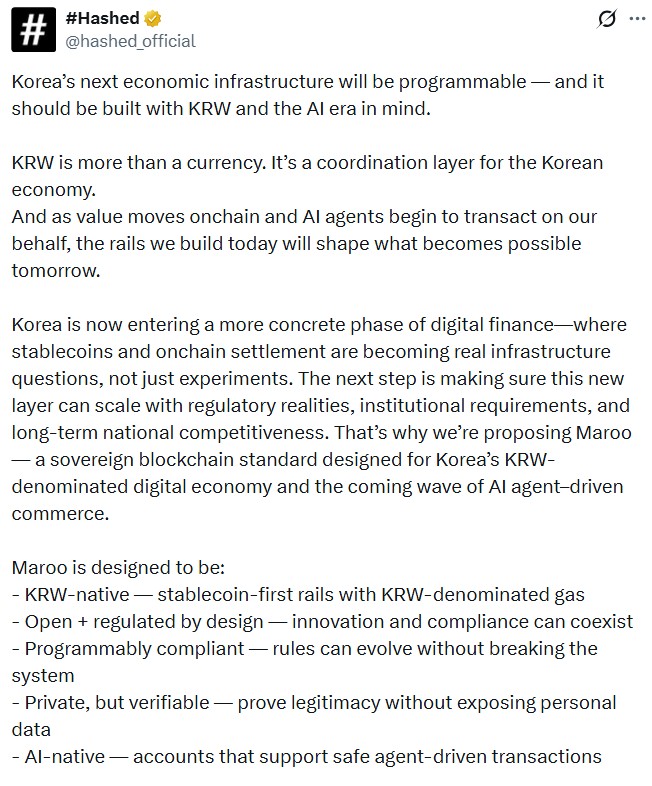
South Korean crypto investment firm Hashed has unveiled Maroo, a blockchain designed around a Korean won stablecoin.
Hashed described its new network as rails for institutional settlement and AI agent-driven payments.
One key feature is that network fees are paid in the KRW stablecoin, rather than a native cryptocurrency. Hashed said pricing gas in KRW terms makes costs easier to forecast for companies, which can budget in a familiar unit instead of absorbing token volatility.
The launch comes as South Korea moves toward the second phase of its digital asset framework, which is expected to introduce a formal regime for stablecoin issuance.
Policy debates remain unresolved, particularly over who should be allowed to issue stablecoins. The Bank of Korea has pushed for a bank-led issuance model, drawing resistance from crypto firms and some lawmakers concerned about competition and innovation.
India arrests two in post-Bitconnect kidnapping case
Indian authorities have arrested two men in connection with laundering cryptocurrency extorted in the aftermath of the BitConnect Ponzi collapse.
The Enforcement Directorate said Thursday it arrested Nikunj Bhatt and Sanjay Kotadiya. The pair allegedly helped move and conceal crypto assets that were recovered in 2018 through kidnapping and extortion linked to BitConnect.
The arrests do not involve the original BitConnect operation. Instead, they relate to events that followed the platform’s collapse, when some recovery efforts turned violent.
In 2018, businessman Shailesh Bhatt allegedly orchestrated the kidnapping of two associates of BitConnect’s founders. Authorities say the extortion yielded more than 2,200 Bitcoin, 11,000 Litecoin and 145 million rupees ($1.58 million) in cash. Investigators allege Nikunj Bhatt was involved in the kidnapping.
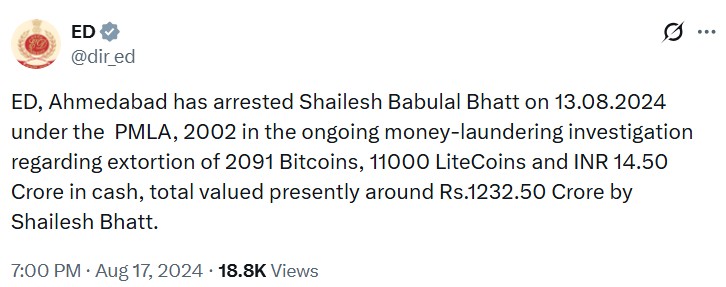
Shailesh Bhatt was also kidnapped in a separate case involving corrupt police officers and a former state lawmaker who had learned he recovered some of his lost funds. The accused were later convicted and sentenced to life imprisonment.
None of the arrested individuals is accused of running BitConnect.
BitConnect was founded by Satish Kumbhani, who promoted a so-called lending program from 2016 to 2018. In February 2022, US prosecutors indicted Kumbhani on charges including wire fraud, commodity price manipulation and international money laundering, describing BitConnect as a $2.4 billion global fraud. Kumbhani is believed to be a fugitive.
Japan plans to formalize crypto ETF push
Japan’s Financial Services Agency is reportedly planning to add cryptocurrencies to its list of assets eligible for exchange-traded funds.
According to Nikkei, Nomura Holdings and SBI Holdings are among the financial groups positioning themselves to launch Japan’s first crypto-linked ETFs as early as 2028, pending regulatory developments and approval.
Institutional interest in crypto has been growing in Japan, particularly among companies that have adopted Bitcoin or other digital assets as part of their treasury strategies. However, retail crypto participation remains relatively modest.
The FSA reported in September that Japan has around 12 million registered crypto trading accounts, equivalent to roughly 10% of the population. Despite that headline figure, more than 80% of personal accounts hold less than 100,000 yen, or about $650.
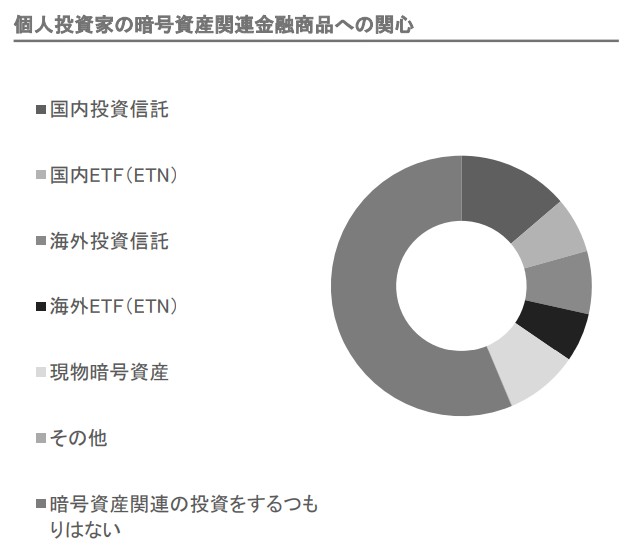
A separate Nomura study published in July 2025 found that most Japanese retail investors said they had no interest in crypto-related investment products. Among those who did express interest, the preference skewed toward regulated vehicles such as investment trusts and ETFs rather than direct ownership of digital assets.
High taxation has also slowed retail crypto demand. Gains from cryptocurrency trading are currently taxed at up to 55%, significantly higher than the rates applied to stocks and other financial products. Japan is considering lowering the tax burden to a flat 20%, which would align crypto with traditional investments.
Finance Minister Satsuki Katayama recently said in a local media interview that she expects the revised tax framework to also take effect around 2028.
Katayama also said in her New Year’s stock market opening ceremony that crypto ETFs are increasingly used as inflation hedges, and Japan should pursue similar initiatives.


Yohan Yun

Is the Metaverse really turning out like ‘Snow Crash’?
Neal Stephenson’s science fiction novel Snow Crash predicted the Metaverse in 1992. This cult book has the amusingly-named Hiro Protagonist running around in an artificial cyber world, trying to stop a virus that wipes minds, aided by his hacker friend Y.T. Reality is a place to escape from, a neoliberal future wrecked by hyperinflation and […]
Read more
You can transform the world with blockchain: Dr. Jane Thomason
“No one knew the identities of the people coming to the hospitals — all the identity documents were gone, all the bank records were gone, all the health records were gone.”
Read moreBrandt says Bitcoin yet to bottom, Polymarket sees hope: Trade Secrets