

 Written by Felix Ngstaff editorReviewed by Andrew Fentonstaff editor
6 reasons Jack Dorsey is definitely Satoshi… and 5 reasons he’s not
MagazinePublishedDec 4, 2025
A deep dive into why some believe Jack Dorsey is Bitcoin’s creator — and why others insist he’s not.

Over the years, we’ve explored some intriguing theories about who (or what) created Bitcoin, ranging from the top government spy agency in America to a time-traveling AI and even the lizard people.
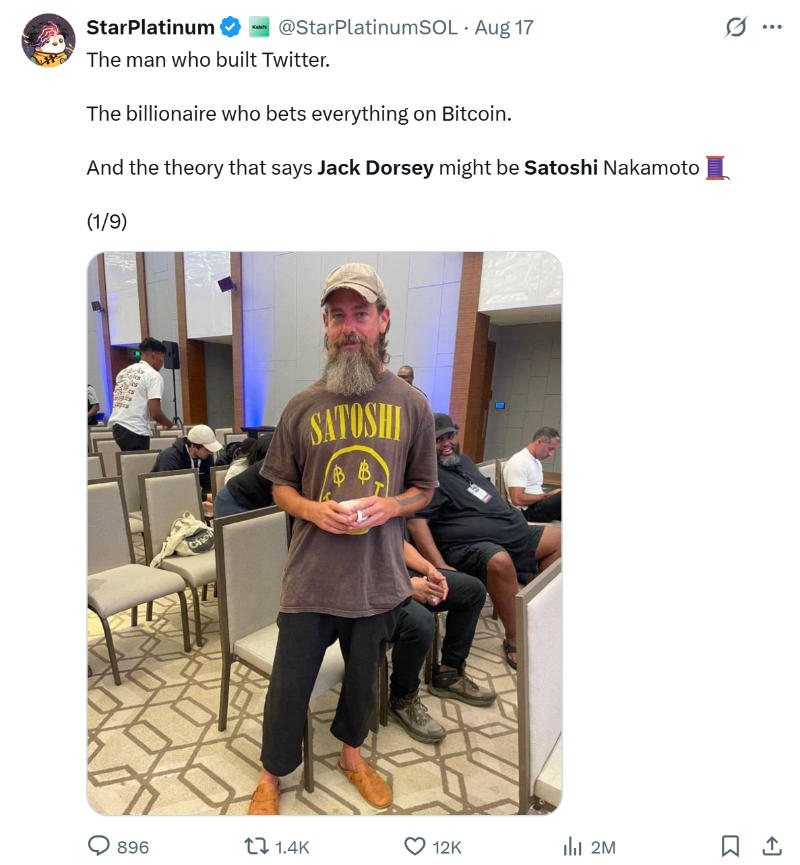
However, some are adamant that the creator of Bitcoin is much more human and has been under our noses this whole time, sporting a guru beard, sandals, and wearing a T-shirt with Satoshi written on it in large letters: the billionaire Twitter and Block founder Jack Dorsey.
“I believe that Jack has been outwardly signaling that he’s Satoshi for more than a decade,” deBanked chief editor Sean Murray tells Magazine.
“I don’t think his actions over the past decade are of someone saying ‘don’t find me’ but rather someone building on to the lore of how it’s him, why it’s him, that each blatant but indirect admission is part of the art, the brand of poetic terrorism that he subscribes to.”
So what makes some intelligent and respected people — including VanEck’s head of digital assets research Matthew Sigel — so confident that Dorsey is the creator of Bitcoin?
1. Jack Dorsey was one of the original cypherpunks in the 1990s and wanted to end dependence on the dollar
Like any good murder mystery, a killer requires a motive. Dorsey has this in spades.
Dorsey was one of the original 1,300 members of the famed Cypherpunk mailing list — a foundational online community founded in 1992 that prized privacy and digital freedom and laid the groundwork for Bitcoin as money outside the control of the state. He joined the list in 1996 while a student at the University of Missouri–Rolla at around 20 years of age.
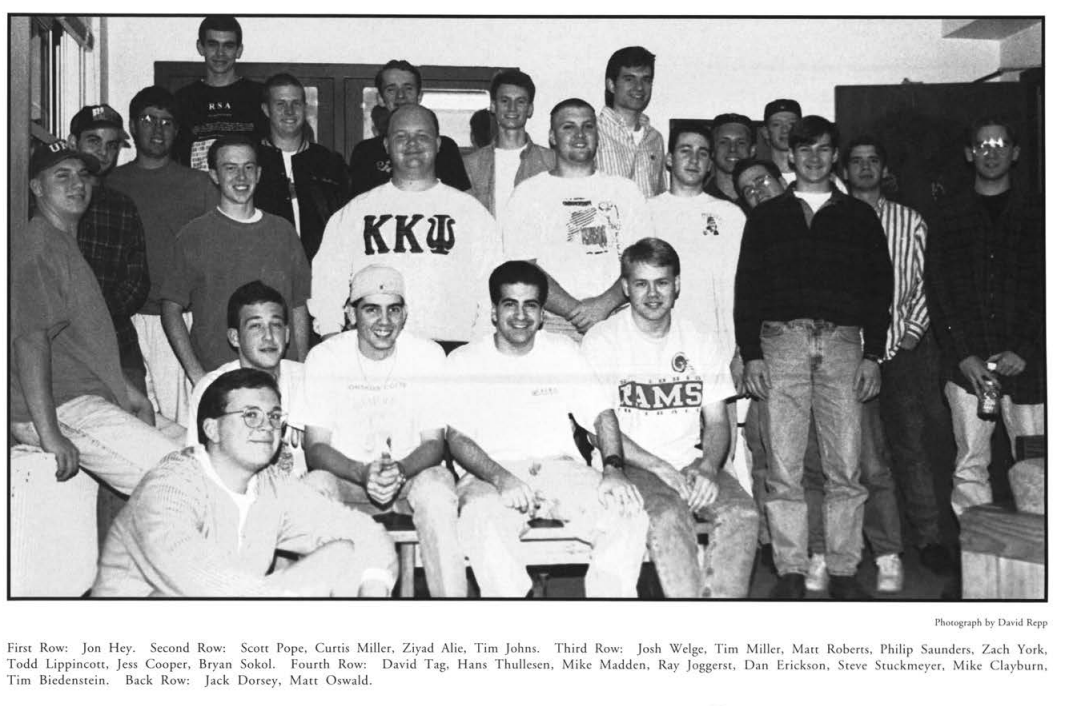
Jack Dorsey wearing an RSA shirt designed by Dr Adam Back in protest of the US government’s ban on the export of RSA encryption. (Sean Murray)
Dorsey even created a website that promoted the cyberpunks’ mission using his university domain. It’s safe to say he was a massive fan of the movement and familiar with Adam Back and Hal Finney and DigiCash long before they became well known.
Fun fact: In 2003, Dorsey reportedly blogged, “I also wish to end my dependence on the American Dollar ($) and in that vein am setting up a bartering network.”
2. Dorsey’s ventures are about Bitcoin and decentralization
Dorsey’s alignment with the cypherpunk movement persists to today. In 2009, he founded the now crypto-forward payments company, Square (now known as Block), which has just rolled out Bitcoin payments to over 4 million merchants.
In 2019, after his second return as CEO of Twitter, he created Bluesky, a decentralized Twitter alternative that embodies some of Bitcoin’s decentralized ideals. It didn’t live up to his ideals of decentralization so he focused his efforts on supporting Nostr instead.
Then, earlier this year, Dorsey launched Bitchat. This decentralized communications platform enables people to contact each other without the need for the internet, which has proven particularly valuable amid government protests and natural disasters, much like Bitcoin has in the past.

Screenshot of Jack Dorsey’s early cypherpunk website. Credit to Sean Murray
His charity, Start Small, donated a whopping $21 million to OpenSats, a nonprofit that supports the developers of Bitcoin Core and other projects related to Bitcoin.
No matter which way you slice it, Dorsey is a cypherpunk OG who has the motivation, and as we will see, the know-how to create and support the growth of Bitcoin.
3. See? Plus, plus: Jack Dorsey had the know-how to code Bitcoin
So, if Dorsey wanted to create Bitcoin, did he have the skills to code it?
The answer to this is also a resounding probably. Dorsey was obsessed with computers since his father brought home an IBM PC Junior, when he was around 8 years old. They later got a Macintosh, and by the age of 11, he had taught himself to code.
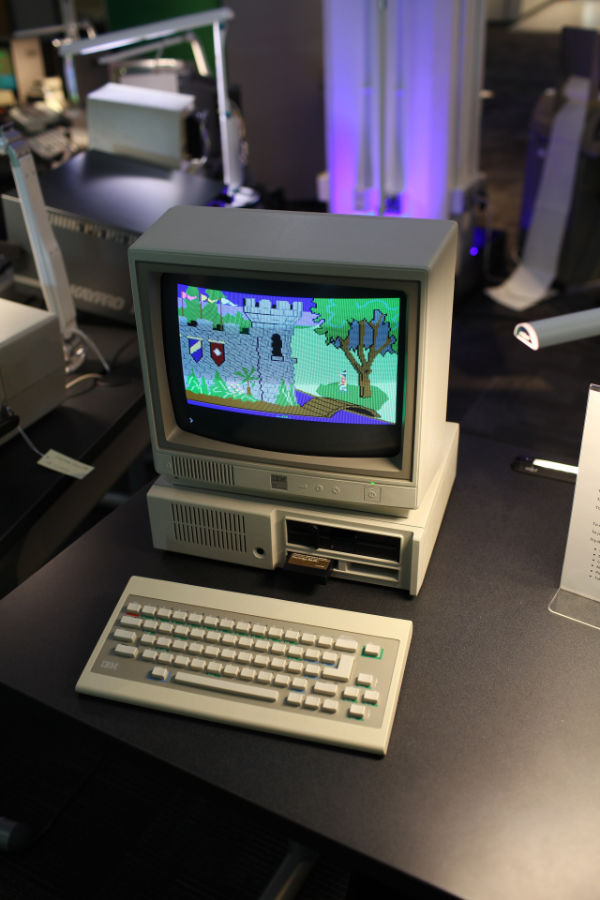
What an IBM PCjr looked like (Wikimedia Commons)
“I was enthralled by both of them, mainly the ability to just change what they do. So I learned how to program in BASIC, and I played with HyperCard, and little by little I got better and better at newer programming languages like C,” said Dorsey in a Harvard Business School podcast in 2014.
By around the age of 15, Dorsey was already writing dispatch software for taxi cabs, couriers and emergency services that would later be used for decades.
When deBanked’s Murray Dorsey uncovered Dorsey’s early cypherpunk website from the late 90s, it showed Dorsey already knew coding languages including C, Python, Java, Perl, PHP, OCaml, JoCaml, Lisp, ObjC and more. And yes, it did show he knew how to code in C++, the language the original Bitcoin client was written in.
So, it’s not a giant leap to think that Dorsey would have had an even firmer grasp of programming by the time he was 32, which was how old he was when the Bitcoin white paper was released.
4. Dorsey was focused on other things outside his day job in the lead up to the BTC white paper
The theory becomes even more intriguing once you realize that Dorsey, who founded and ran Twitter from 2006 to 2008, happened to have some downtime just weeks before the Bitcoin white paper was released — downtime potentially related to spending too much time away from his day job.
Writing Bitcoin would not have been an easy task. Nakamoto once told early Bitcoin user and developer Mike Hearn in 2010 that it took him two years of development before releasing the Bitcoin paper and code, “and I could only spend so much time on each of the many issues.”
This would have been precisely the time frame that Dorsey was working as the CEO of Twitter before he was fired in October 2008.
Why did he get fired? Many reports pin it to Dorsey’s failure to address the platform’s frequent service disruptions and perceived leadership issues.
However, some suggest that part of the reason is that he would leave the office early to “de-stress and attend night courses in fashion and drawing.”
Satoshi Nakamoto would go on to share the Bitcoin white paper for the first time on Oct. 31, 2008, with the message:
“I’ve been working on a new electronic cash system that’s fully peer-to-peer, with no trusted third party.”
Bitcoin officially launched a few months later on Jan. 3, 2009.
5. The coincidences
Then, there are the many “coincidences” aligning specific dates in Bitcoin with aspects of Dorsey’s personal life. Believers are convinced these Easter eggs were made to subtly point toward Dorsey.
Here are some key ones, with credit to Murray and Sigel; however, there are countless more that we didn’t cover, which can be found here.

Oct. 31, 2008: Bitcoin white paper comes out / Oct. 31, 2008: Neal Stephenson, author of “Snow Crash,” birthday. Dorsey is a fan of the book.
Jan. 9, 2009: Dorsey attends an award show in San Francisco / Jan. 10, 2009: Nakamoto accidentally logged into IRC from an IP address in California
Jan. 11, 2009: Nakamoto’s first recorded transaction / Jan. 11, 2009: Dorsey’s mother’s birthday
Nov. 19, 2009: Nakamoto registers for the Bitcoin forum as “satoshi” / Nov. 19, 2009: Dorsey’s birthday / Nov. 19, 2015: Square (now Block)’s IPO / Block Investors Day, Nov.19 2025.
May 3, 2010: Nakamoto’s last mined Bitcoin / May 3, 2010: Dorsey’s father’s birthday.
Then there’s the coincidence that his good friend Alyssa Milano wrote a graphic novel called Hacktivist about a billionaire character based on Dorsey who runs a social media company but is a secret hacker who develops a decentralized encrypted peer to peer network. Hmmm.
6. Jack Dorsey bankrolled the case against Faketoshi
Another circumstantial piece of evidence is what Jack Dorsey did when he saw a man parading around the world claiming to be Satoshi Nakamoto.
For years, Australian computer scientist Dr. Craig Wright claimed to be the inventor of Bitcoin. He ultimately lost the battle last year and was forced to admit he was not.
But before that, his lawyer, Anthony Grabiner, had argued that it was “striking” that no one else had publicly claimed to be the creator of Bitcoin.
“If Dr Wright were not Satoshi, the real Satoshi would have been expected to come forward to counter the claim,” said Grabiner.
Jack Dorsey answered the call.
In May 2020, 145 ancient Bitcoin addresses signed a message stating that Craig Wright was not Satoshi and a liar and a fraud. The oldest Bitcoin address that signed the message started with 1jak — Jack’s old pseudonym.
Through Block, Dorsey co-founded and bankrolled the Crypto Open Patent Alliance (COPA), which sued Wright in 2021 to legally declare he is not the creator of Bitcoin.
Dorsey began wearing the Satoshi T-shirt in February 2022, in the midst of the saga.
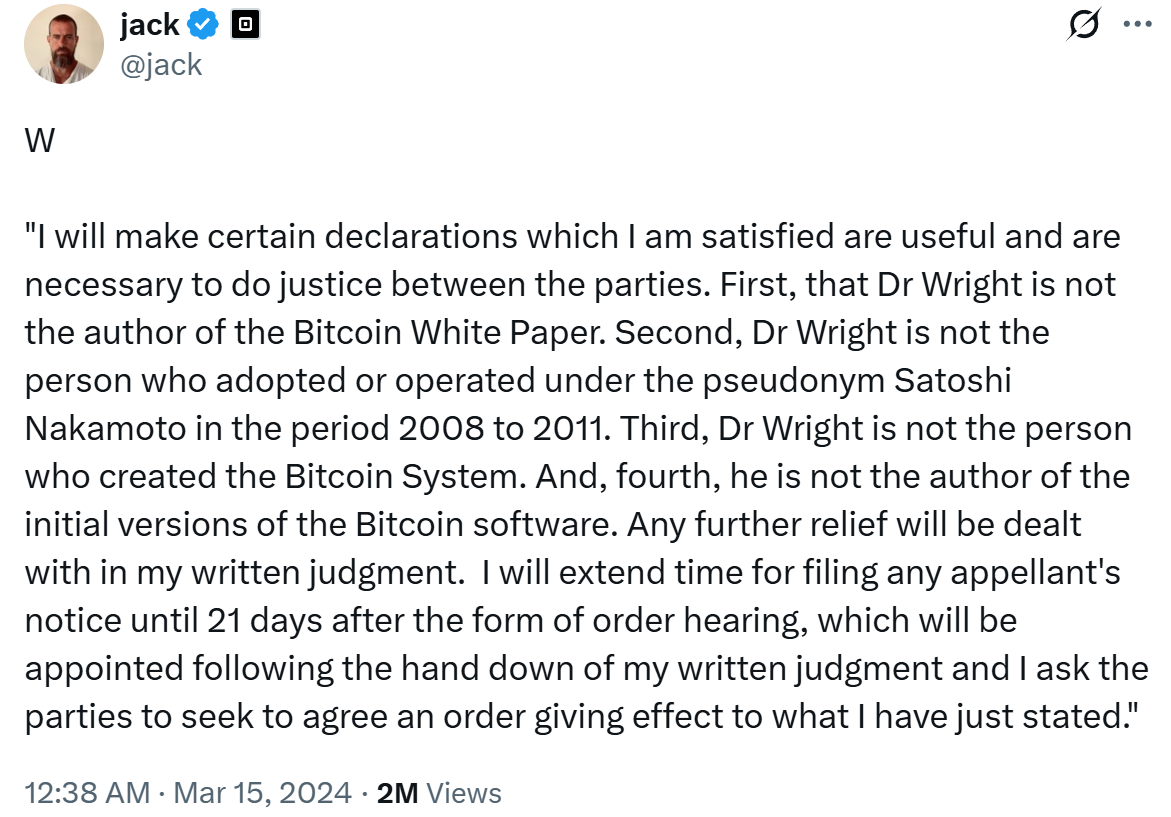
The case concluded with a High Court ruling in March 2024 in their favor. Dorsey simply and humbly labeled it a “W” after the verdict was announced.
5 good reasons why Jack Dorsey isn’t Satoshi Nakamoto
While none of the evidence above could be considered bulletproof, supporters of the theory say there’s more than enough circumstantial evidence to seriously point toward Dorsey. Not everyone agrees, though.
Knowing how to code and being a member of the Cypherpunk mailing list is probably just the bare minimum to be a Nakamoto candidate. Julian Assange was also on the list, along with Adam Back and Wei Dai, for example.
Critics of the theory argue that there’s no single piece of evidence that concretely links Dorsey to Nakamoto.
Jameson Lopp, the co-founder of crypto security company Casa, is one of these people, calling the theory a “half baked narrative.”
“It’s true that Jack was a cypherpunk and a programmer, but that’s the strongest ‘evidence’ available to support this theory. Everything else is circumstantial if not outright mental gymnastics via numerology,” says Lopp.
1. Dorsey would have had to juggle Bitcoin, Square and Twitter
“I think Jack is by far one of the least plausible theories because there’s so much evidence that he was too busy doing other things (traveling, building, and promoting Twitter) to be deep in the weeds on a project as novel as Bitcoin,” Lopp tells Magazine.
Common sense says that Dorsey wouldn’t have had the time to work to grow Bitcoin, argues Lopp. While Dorsey was indeed fired as Twitter’s CEO in 2008, just before Nakamoto released the Bitcoin white paper, Dorsey remained chairman of the board.
Then a year later, Dorsey founded Square, a company that allows anyone to accept credit card payments on a mobile device. It would be pretty challenging for Dorsey to have assembled a brand new company while steering the Bitcoin ship.
“It’s quite clear that he was an extremely busy person not only overseeing multiple companies, but traveling around the world meeting important people, doing press interviews, speaking at conferences, promoting philanthropic causes, and more,” argues Lopp.
“His activities do not fit the profile of someone who had the time and mental bandwidth to also be building a completely new financial system from scratch while maintaining perfect anonymity.”
But Murray argues that this is precisely why Nakamoto complained about being “really busy” on several occasions between 2009 and 2011, eventually leaving the Bitcoin project, posting on April 23, 2011 that “I’ve moved on to other things. It’s in good hands with Gavin and everyone.”
2. Satoshi wary of government, Dorsey worked with them
Another piece of evidence that suggests Dorsey is not Nakamoto is that the creator of Bitcoin comes across almost as a cautious recluse and wasn’t a fan of the government or government control.
Lopp argues that, in contrast, Dorsey is a highly public figure.
“The funny thing about Jack is that, unlike most cypherpunks, he was an extremely public individual who posted what he was up to on nearly an hourly basis,” he explains.
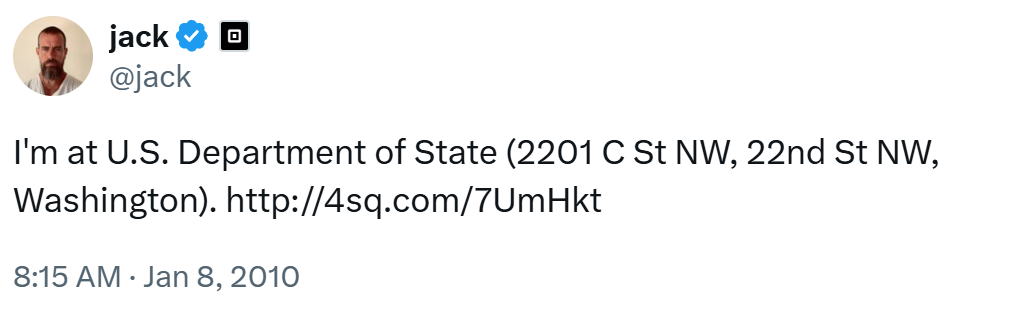
Dorsey also reportedly spent 2008 and 2015 engaged with the US State Department as part of several delegations to Iraq, Iran and Russia with other representatives from the tech sector, which would appear to be out of character for Nakamoto.
3. Satoshi Nakamoto had regular PT posting patterns
Lopp also noted that Satoshi’s online activity suggests a consistent sleeping pattern in the Pacific timezone. Cities in this timezone include Los Angeles, San Francisco, Seattle, Vancouver and Tijuana.
In contrast, Dorsey’s tweets were far more erratic — consistent with someone who is constantly travelling between different time zones. However, it is worth noting that Dorsey was based in San Francisco around the time Bitcoin was created.
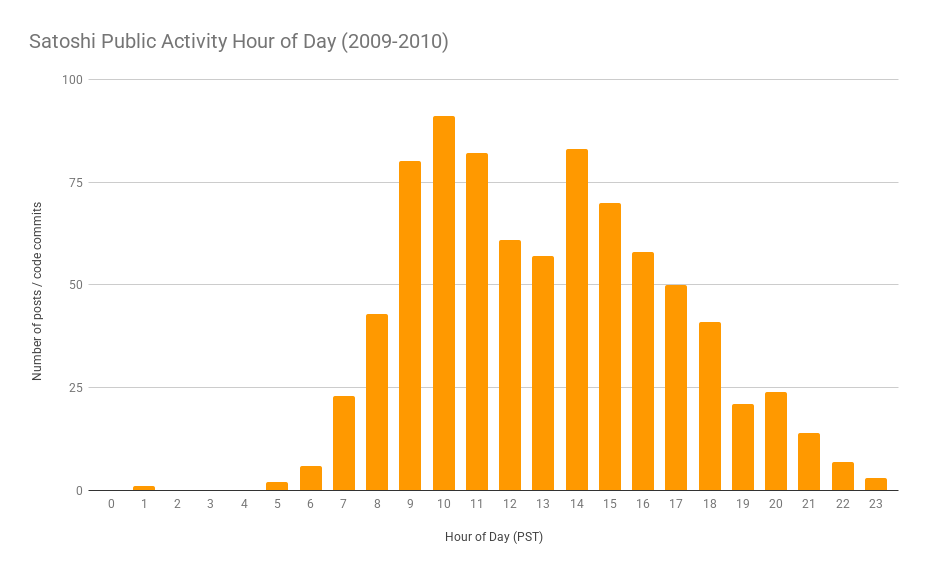
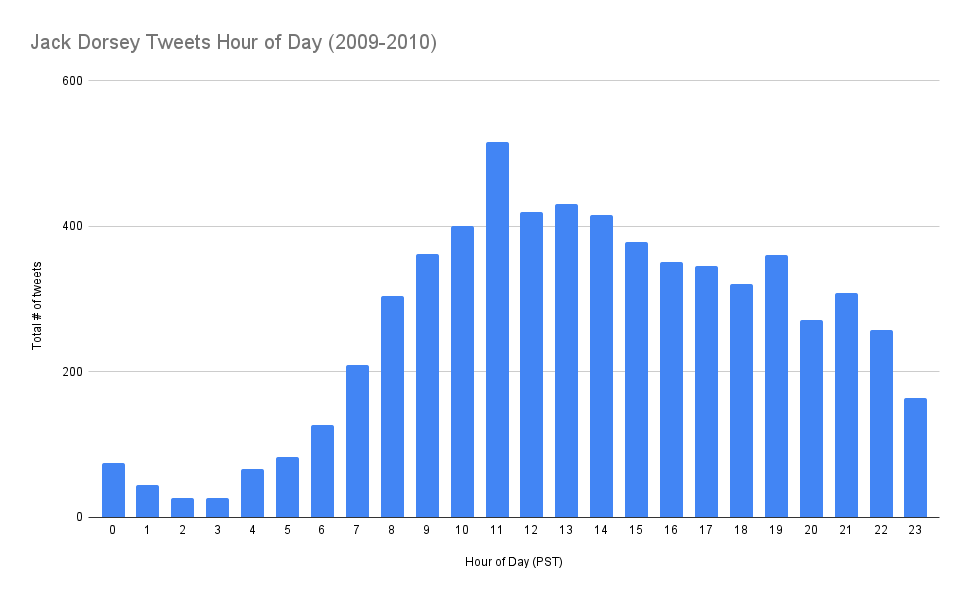
Satoshi Nakamoto and Jack Dorsey had different online activity patterns (Jameson Lopp)
4. Dorsey and Nakamoto had conflicting activities
A related point is that Lopp argues that there are specific event conflicts that make it doubtful that Dorsey and Nakamoto are the same person.
For example, in November 2009, Dorsey tweeted he was having a “late lunch” with venture capitalist Fred Wilson, but only five minutes later, Nakamoto committed code to the SourceForge repository.
In another instance, Jack said he was walking to meet the mayor of Paris at City Hall on Dec. 9, 2009, and only 18 minutes later, Satoshi posted several responses to a technical suggestion thread about Bitcoin.
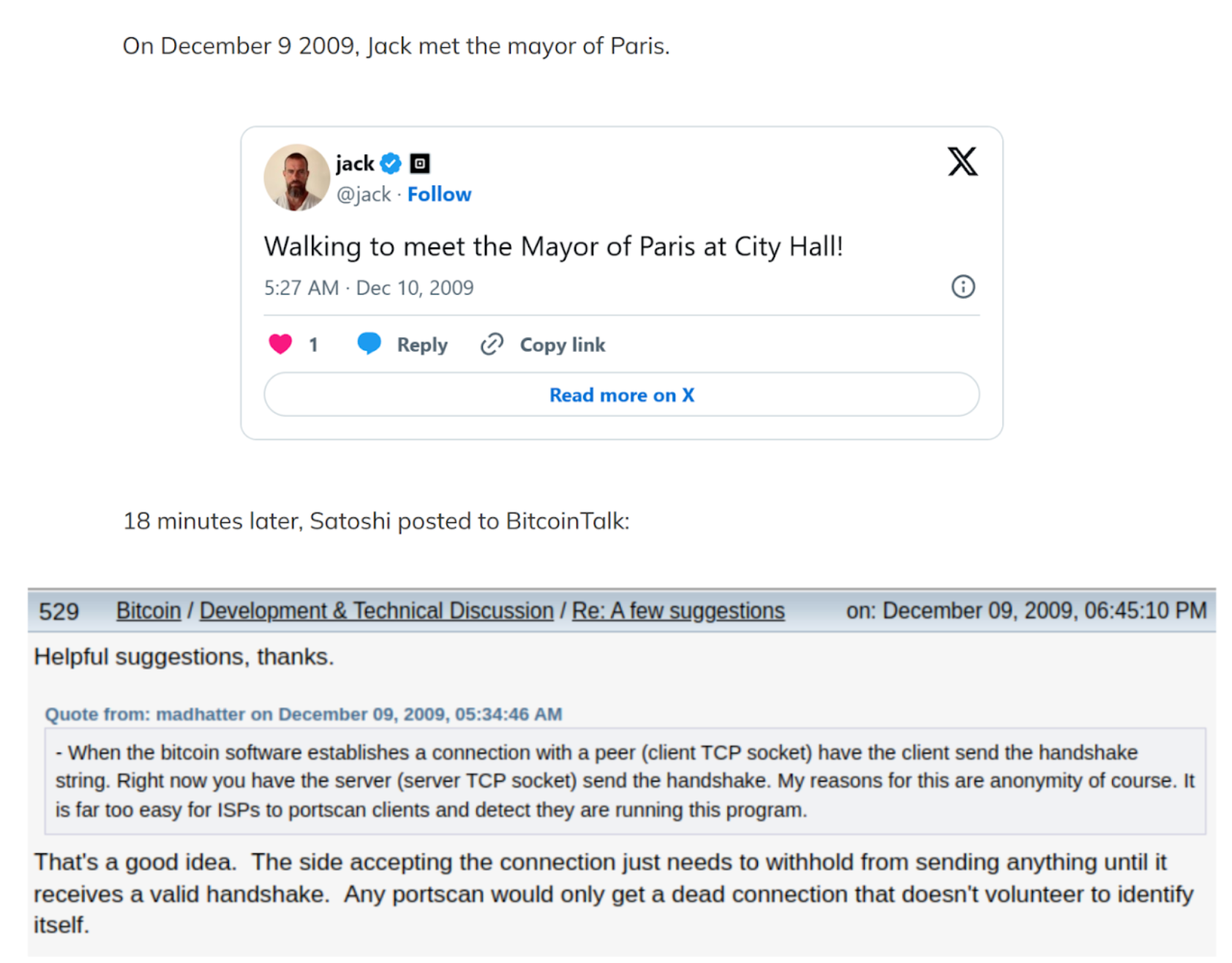
Satoshi Nakamoto’s post to BitcoinTalk, as Jack Dorsey was set to meet the mayor of Paris (Jameson Lopp)
Another potential conflict arose in July 2010, when Jack tweeted that he was getting ready to go on stage to present at the Square headquarters, and posted “Boom” around 28 minutes later, presumably when he had finished the presentation.
During this time, Satoshi posted to the Bitcoin talk forum.
Of course, if you can design an entirely new monetary system in your spare time, you can probably schedule in a few posts to throw people off the scent.
Lopp acknowledges that it’s not impossible that Dorsey pre-timed certain posts on Bitcointalk or posted with his mobile phone while on the go, but argues that if that was the case, Dorsey would have picked much more public events and settings to set his pre-timed posts as Nakamoto.
5. Coincidental dates are meaningless
Lopp also argues the so-called “numerology” — like Nakamoto signing up for BitcoinTalk on the same day as Dorsey’s birthday is “absolute junk.”
“You can find patterns in anything,” Lopp tells Magazine. “It preys upon our monkey brain’s innate desire to find patterns in random noise and try to make sense of them.”
There’s actually a scientific term for this called “Apophenia” — the psychological phenomenon of perceiving meaningful patterns or connections between unrelated or random things. It’s seen as one of the key reasons why humans can navigate the world in the way we do.
Apophenia could be why people keep accidentally finding Jesus Christ in their grilled cheese toast (YouTube)
Famed physicist Neil deGrasse Tyson once made a similar observation.
“Over centuries of evolution, humans’ pattern recognition skills determined natural selection. Hunters skilled at spotting prey and predator and telling poisonous plants from healthy ones offered them a better chance of survival than those blind to the patterns. It enabled the survivors to pass on those pattern-friendly genes to future generations.”
The debate goes on
The evidence pointing to Dorsey is certainly fascinating, but is far from irrefutable. Murray remains convinced that Dorsey is Nakamoto.
“I believe that the Satoshi character is a Jack Dorsey story, that the circumstantial evidence, skillset, timeline, background, and modus operandi are a perfect match,” he tells Magazine.
“Prior to my research, there were very few people, if any, that were even aware Jack was one of the original cypherpunks or that he was obsessed with cryptography as a youth, that he knew of Adam Back and Hal Finney and DigiCash by name.”
“The pieces were intentionally put there to be found, even if we may never be afforded the satisfaction of him directly coming out and saying it’s him.”
Lopp thinks it’s more likely to be someone other than Dorsey — but argues that for the sake of Bitcoin, we would be better off not looking.
“I find the aggregate of all the evidence to provide so much doubt that a reasonable person would conclude that it’s far more likely that Satoshi was someone else,” says Lopp in a blog post.
“Bitcoin is better off with Satoshi’s identity remaining unknown. A human can be criticized and politically attacked. A myth will withstand the test of time.


Subscribe to daily byte-sized crypto news from Cointelegraph
Cointelegraph publishes long-form journalism, analysis and narrative reporting produced by Cointelegraph’s in-house editorial team with subject-matter expertise. All articles are edited and reviewed by Cointelegraph editors in line with our editorial standards. Content published in here does not constitute financial, legal or investment advice. Readers should conduct their own research and consult qualified professionals where appropriate. Cointelegraph maintains full editorial independence.
More on the subject