


 Written by Yohan Yunstaff editorEdited by Andrew Fentonstaff editor
China to ban owning Bitcoin? Gate.io to pay $30M over liquidations: Asia Express
MagazinePublishedJun 5, 2025
Traders get wrecked by Gate.io’s LA token perpetual contract price bug, Philippines crypto influencer crackdown, and more.

Rampant China Bitcoin ban rumors
The crypto industry has never been short on rumors suggesting that China is preparing to unban Bitcoin since the nation’s 2021 crackdown on crypto trading and mining.
But this past week, the narrative flipped, with some media outlets claiming that China is now banning Bitcoin ownership outright. One of the most widely circulated stories came from India-based Financial Express, which cited a supposed “Binance” report.
Magazine found no such report authored by Binance, and the exchange did not respond to a request for comment. Magazine also found no supporting reports from Chinese state media or official government sources.
However, a May 30 post on Binance Square claims that China announced a new ban on holding crypto, including Bitcoin. Binance Square functions as a content-sharing social platform for the exchange’s community. Its terms and conditions say that Binance will not be responsible for errors in content shared by users.
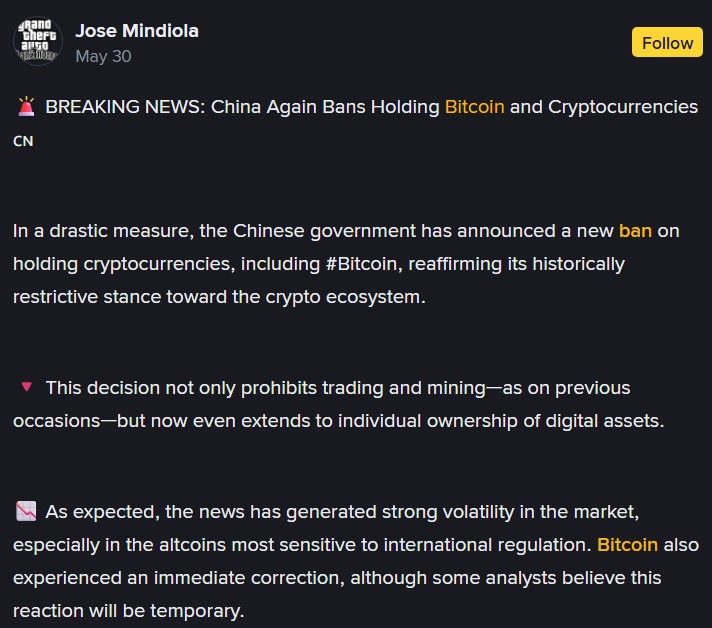
A Binance Square user-generated content claims China bans crypto ownership. (Binance Square)
A blanket ban on crypto ownership would be highly unusual, even for China. Despite restrictions on trading and mining, Chinese courts have repeatedly ruled that cryptocurrencies are legally recognized as property. In November, a Shanghai judge affirmed that crypto assets are not explicitly prohibited and described Bitcoin as a commodity.
Gate.io faces $30 million compensation bill
A sudden price spike in the Lagrange-USDT perpetual contract on Gate.io has ignited community outrage, with several traders reporting forced liquidations and even negative balances within seconds of opening short positions.
The drama began when Binance announced it would list Lagrange (LA) on its Alpha program, an early-access platform for new tokens. Traders across the crypto market saw a familiar opportunity, given that Alpha-listed tokens often drop in price soon after listing.
Many traders expected LA to follow the same pattern and rushed to short the token. Gate.io was one of the only exchanges that offered the option at the time.
But instead of a crash, LA’s price on Gate.io spiked to as high as $25 while it was trading for less than a dollar on other exchanges, triggering a cascade of liquidations.
Some users accused Gate.io of manipulating prices, trading against users, or running a coordinated liquidation scheme. Others criticized the decision to list a highly illiquid token like LA for leveraged trading in the first place. One post claimed a trader ended up over $200,000 in the red.
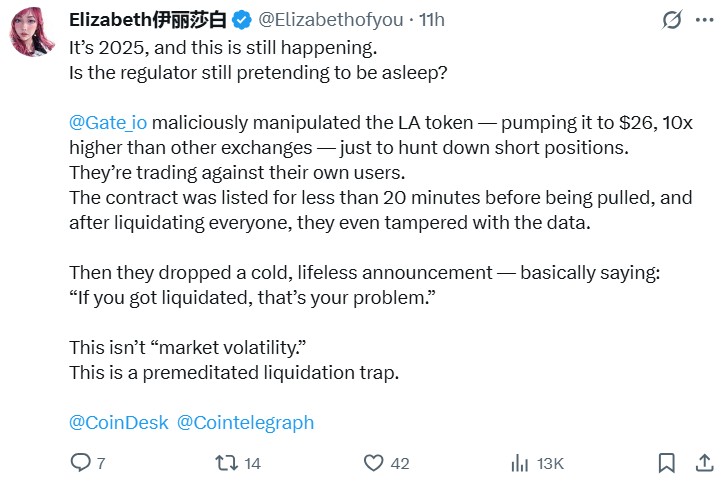
Users attempt to get media attention while alleging Gate.io manipulated the LA token contract. (Elizabethofyou)
Gate.io delisted the LA perpetual in about 15 minutes after launch, citing “abnormal price behavior.”
The exchange’s chief business officer, Kevin Lee, posted a response, denying any manipulation. According to Lee, the spike was caused by an “index price feed anomaly,” which was compounded by the exchange’s automated risk controls.
“There was no internal manipulation, no sniper liquidation, and no deliberate targeting of users,” he wrote.
Gate said it delisted the LA contract to limit further damage. It vowed to reimburse all accounts that dipped into negative balances and will allow users to keep any legitimate trading profits. The exchange’s total compensation bill is expected to exceed $30 million.

Crypto is banned in China but the nation’s financial center is putting blockchain to work. (Woong Hoe)
Shanghai adopts blockchain for documents
Shanghai’s Pudong district will formally enforce blockchain-based electronic document rules starting July 1.
Pudong authorities released a 16-article document of rules for blockchain-based e-document applications. It outlines how businesses and government bodies should deploy official documents on blockchains, such as managing, issuing and verifying.
These rules were approved internally on April 30 after Shanghai’s local congress passed the country’s first localized law specifically governing blockchain-enabled documents on Dec. 31, 2024. Pudong’s rules were released to the public on June 3.
The implementation rules specify technical and operational requirements such as document authenticity, digital identity verification, crosschain interoperability and system reliability.
They also promote cross-border data flows, integration with China’s central bank digital currency and the development of international standards that can help position Pudong as a blockchain innovation hub for digital trade.
Crypto influencers face crackdown in the Philippines
Crypto influencers in the Philippines can no longer promote digital tokens or crypto-asset services without proper authorization under sweeping new rules issued by the nation’s Securities and Exchange Commission.
The market watchdog’s latest policy directive enforces tighter restrictions on marketing and public offerings — effectively prohibiting many common practices without official permission.
The rules target not only registered crypto firms but also third-party service providers, including individuals who promote tokens online. Social media posts, YouTube videos, podcasts and even educational content could fall under the definition of “marketing” if the creator receives any form of compensation or benefit. Those found in violation could face fines, suspension or even up to five years behind bars.
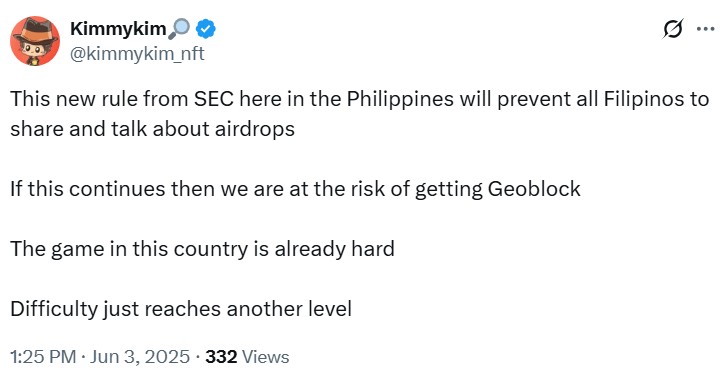
Crypto communities in the Philippines fear they will be silenced. (Kimmykim)
The SEC said that individuals publishing crypto-related educational content will be presumed to be marketing a financial product unless they can prove the content is made in good faith, strictly for educational purposes and free of any benefit. If not, they must either register as financial advisers or disclose as agents of the crypto asset service provider they were commissioned to promote.
Even airdrops are subject to scrutiny. The rules specify that an airdrop will not be considered free if the recipient gives up data, value, or non-monetary benefits in return.
Additionally, any entity offering crypto-assets to the public in the Philippines must now register as a corporation and secure authorization from the SEC or relevant regulators. This includes firms running exchanges, offering tokens through initial coin offerings, or engaging in crypto intermediation activities such as brokerage, advisory, or custodial services.


Subscribe to daily byte-sized crypto news from Cointelegraph
Cointelegraph publishes long-form journalism, analysis and narrative reporting produced by Cointelegraph’s in-house editorial team with subject-matter expertise. All articles are edited and reviewed by Cointelegraph editors in line with our editorial standards. Some articles contain affiliate links, from which Cointelegraph may earn a commission. These relationships do not influence which products we review or our editorial conclusions. Content published in here does not constitute financial, legal or investment advice. Readers should conduct their own research and consult qualified professionals where appropriate. Cointelegraph maintains full editorial independence.
More on the subject