


 Written by Jesse Coghlanstaff editorEdited by Felix Ngstaff editor
Hyperliquid, Paradigm urge revision of GENIUS money-laundering rule
Latest NewsPublishedJun 10, 2026
The Hyperliquid Policy Center and Paradigm say the Treasury’s money-laundering rules for the GENIUS Act are too onerous for stablecoin issuers.

The lobbying arm of crypto futures exchange Hyperliquid and venture capital firm Paradigm has urged the US Treasury to revise a proposed anti-money laundering and sanctions rule for stablecoin issuers.
The Hyperliquid Policy Center and Paradigm said in a letter on Tuesday that some secondary market obligations should be clarified or narrowed “to avoid unintended consequences for permissionless blockchain infrastructure and the DeFi ecosystem.”
The pair said they endorse the Financial Crimes Enforcement Network’s (FinCEN) approach of putting compliance obligations on the “primary market,” such as issuers who have customer information, and taking a “limited approach” to the secondary market, where issuers only see wallets and transactions.
“The same principle should guide the agencies’ implementation of AML and sanctions requirements for stablecoins deployed to permissionless environments,” they argued.
The letter was in response to a rule the Treasury proposed in April to implement GENIUS Act provisions relating to stablecoin issuers, requiring stablecoin issuers to have the capability to block, freeze or reject transactions that violate US law or sanctions on both the primary and secondary markets.
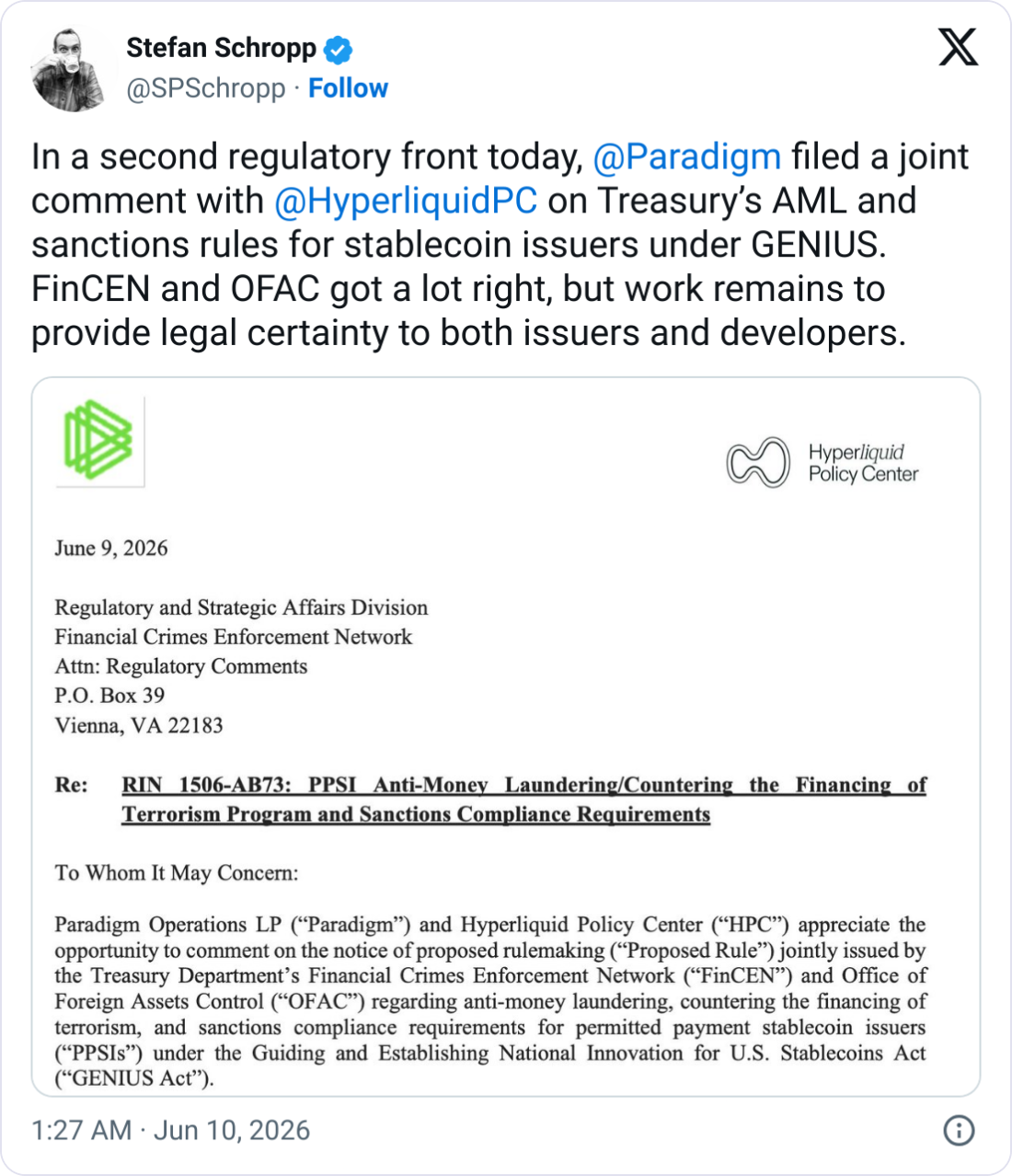
Source: Stefan Schropp
Hyperliquid and Paradigm said the proposal sweeps secondary market activity into an issuer’s compliance perimeter that they “cannot meaningfully police.”
They argued it also treats smart contract interactions as an activity that carries sanctions liability “regardless of whether the issuer has any relationship with, or visibility into, the transacting parties.”
The pair said an issuer who is facing the obligations proposed would be incentivized to only deploy into a permissioned environment, which they argued would see US-regulated stablecoins pulled out of decentralized finance to create “a void filled by unregulated, offshore, non-dollar alternatives.”
Related: Solana Institute CEO says CLARITY Act must shield open-source developers
US President Donald Trump signed the GENIUS Act into law last year, which outlined how stablecoins and their issuers are to be regulated. Federal agencies are currently looking at how to implement the law, which is set to go into effect in January 2027 at the latest.
The Senate is currently debating a crypto bill that could include further rules for stablecoin issuers and remove liability for developers of crypto platforms regarding money laundering and sanctions compliance.
Provisions for the legislation, dubbed the CLARITY Act, are still under discussion, and some lawmakers are pushing for a full Senate vote on the bill before the November elections.
Magazine: The legal battle over who can claim DeFi’s stolen millions


Subscribe to daily byte-sized crypto news from Cointelegraph
Cointelegraph is committed to independent, transparent journalism. This news article is produced in accordance with Cointelegraph’s Editorial Policy and aims to provide accurate and timely information. Readers are encouraged to verify information independently.
More on the subject