Casper activates protocol upgrade 2.1: Doubling block speed and introducing fee burning to fortify real-world assets
Press releasePublishedDec 11, 2025
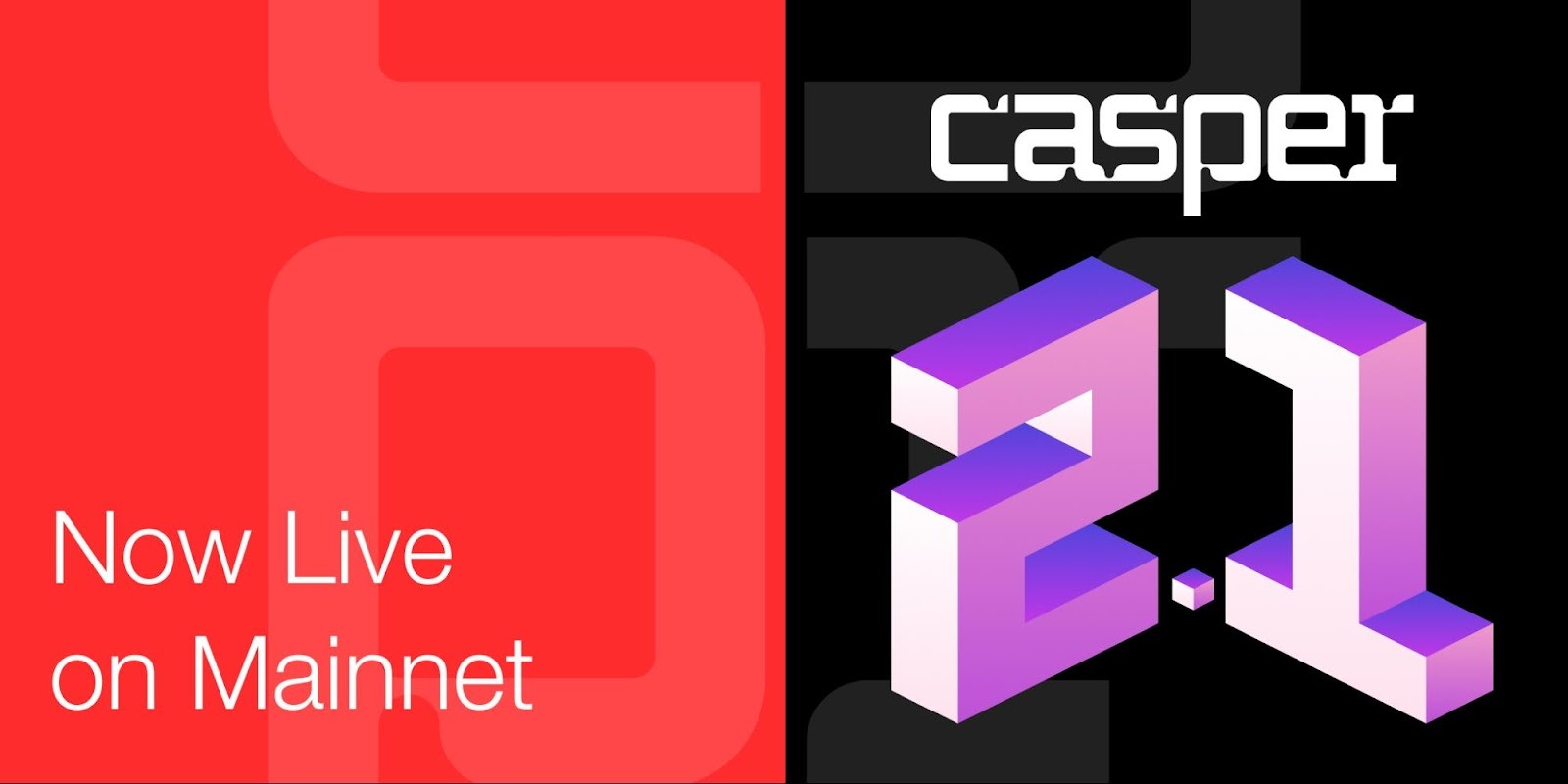
The Casper Network has successfully activated the Casper 2.1 upgrade on mainnet.
Commissioned byCasper
ZUG, Switzerland, December 11, 2025 — The Casper Network has successfully activated the Casper 2.1 upgrade on mainnet. Following the landmark release of Casper 2.0 in May 2025, with key features like instant finality and native access controls, version 2.1 further refines the network’s core to meet the demands of real-world asset tokenization.
Instant finality meets high-speed execution
Casper 2.1 reduces the maximum block time from 16 seconds to a maximum of 8 seconds, and the impact of this upgrade extends beyond raw speed.
Because Casper’s Zug Consensus provides deterministic finality, transactions are final the moment they are included in a block, meaning there are no probabilistic delays and no need to wait through extensive confirmation sequences, as is often the case with probabilistic consensus. When combined with the accelerated block time, the network achieves an average effective finalization time of approximately 4 seconds.
For industries relying on precision in how ownership is handled, such as tokenized finance and real estate, faster block finalization and instant finality combination unlocks a level of predictability and immediacy that distinguishes Casper from other networks where finality is often delayed or even reversible.
A new economic standard: 100% Fee burning
Casper 2.1 also fundamentally alters the network’s economic model through a new fee-burning mechanism, approved via on-chain governance by network validators.
Effective immediately, all transaction fees are permanently removed from circulation (burned) rather than redistributed, creating deflationary pressure that aligns network usage directly with protocol health and long-term sustainability.
While this new model simplifies the fee environment for developers and users, validator incentives remain secure, with rewards continuing to be issued through block validation.
Native Layer-1 capabilities
A critical differentiator for Casper 2.1 is the architectural decision to house these key capabilities directly on the main chain. While many blockchain ecosystems rely on complex Layer-2 scaling solutions or external add-ons to achieve speed and cost predictability, Casper provides these features natively on Layer-1.
“Predictable performance is a must-have for Casper’s enterprise partners who are working to disrupt the parking industry through on-chain transparency, settlement, and tokenization. Casper 2.1 delivers that, and more; we’re pleased to see community governance in action with the activation of deflationary economics.” — Michael Steuer, President & CTO of the Casper Association.
Improving the environment for real-world applications
The release reinforces Casper’s commitment to a blockchain architecture that respects real-world rules and accountability. This focus is driven by the conviction that real-world value cannot move on-chain unless the underlying guarantees of the real world function effectively on a distributed ledger. With faster finalization and a sharper economic design, Casper 2.1 prepares the ground for the next wave of real-world applications to build and scale.
About Casper Network & Casper Association
Casper Network (CSPR) is a decentralized, layer 1 Proof-of-Stake blockchain designed for the real-world economy. It empowers people to openly benefit from who they are, what they do, and what they own, across borders, businesses, and communities, both within and beyond Web3.
With instant finality, upgradeable smart contracts, enterprise-grade security, and flexible permissioning, Casper’s infrastructure supports the secure tokenization, management, and exchange of assets and sensitive data across both public and private environments.
The Casper Association, a non-profit organization based in Switzerland, promotes the decentralized development and adoption of the Casper protocol, network, and ecosystem.
Learn more about Casper Network at https://casper.network
Contact the Casper Association at press@casper.network


Subscribe to daily byte-sized crypto news from Cointelegraph
This publication is provided by the client. The text below is a paid press release that is not part of Cointelegraph independent editorial content. The text has undergone editorial review to ensure quality and relevance, it may not reflect the views and opinions of Cointelegraph. Readers are encouraged to conduct their own research before taking any actions related to the company. Disclosure.
More on the subject