
Written by Ayse KaramanCommissioned Content
Written by Ayse KaramanCommissioned Content
AI agents meet venue marketing: Web3 platform integrates with gateway assistant for messaging-first engagement
CommissionedPublishedMar 11, 2026
New integration allows physical venues to measure customer acquisition and configure rewards via WhatsApp and Telegram.
Commissioned byBelong
Disclaimer. This content is part of a paid partnership. The text below is a sponsored article that is not part of Cointelegraph.com editorial content. The material is written by our advertorial team and has undergone editorial review to ensure clarity and relevance, it may not reflect the views and opinions of Cointelegraph.com. Readers are encouraged to conduct their own research before taking any actions related to the company. Disclosure.

Customer acquisition, the desired outcome of all marketing efforts, has historically been troublesome to measure, especially in venue marketing.
Traditional venue marketing that involves conventional ads and influencers usually requires upfront payment, with no guarantee of actual traffic. As a traceable technology, blockchain offers a solid tool to verify retention, but it is not free from challenges either.
Feasibility crucial for both consumers and businesses
Interacting with blockchain often demands some level of technical knowledge and infrastructural gearing. The average consumer usually does not have a cryptocurrency wallet, does not understand the details like seed phrases and is intimidated by the setup process.
The same technical barriers also apply to businesses. Venues want to retain customers, but they do not want to learn about smart contracts, gas fees or token deployment.
Moreover, venues usually require attendees to download an app while the majority just prefer to communicate across widely used platforms, such as WhatsApp, Telegram and Discord. And requiring them to switch to a dedicated Web3 app breaks the natural workflow.
This fragmentation results in app fatigue for businesses as well. Venues and event organizers already juggle dozens of apps. Thus, a request to download another specialized app is often met with immediate resistance.
A blockchain-based way to track customer acquisition
Web3 platform Belong offers blockchain-verified customer acquisition to physical businesses without requiring any technical knowledge. With over 13,000 events and locations, more than 90,000 active users and over 1,000 partner communities, its flagship product, Belong CheckIn, is an onchain affiliate network for physical venues on BNB Smart Chain (BSC), with token gating supported across BSC, Sui, Starknet, Base and SKALE.
Through Belong CheckIn, organizers can create their own CheckIn campaign for a venue or event and set the rules for the reward structure. The smart contract handles the process from then, and calculates and distributes rewards automatically. Organizers only have to pay promoters for verified visits.
Meanwhile, visitors and promoters check in at participating venues using QR codes, NFC or geolocation verification — with GPS coordinates validated against the venue’s location to confirm physical presence.
Venue owners retain full control through a check-in approval system, where they can review and approve or reject pending check-ins before rewards are confirmed. Promoters also get referral bounties for every customer they bring to a venue.
Belong CheckIn lets organizers issue tickets as non-fungible tokens (NFTs). Available as both single-use and reusable, these NFTs grant access to events, physical spaces and exclusive communities.
AI simplifies interacting with blockchain
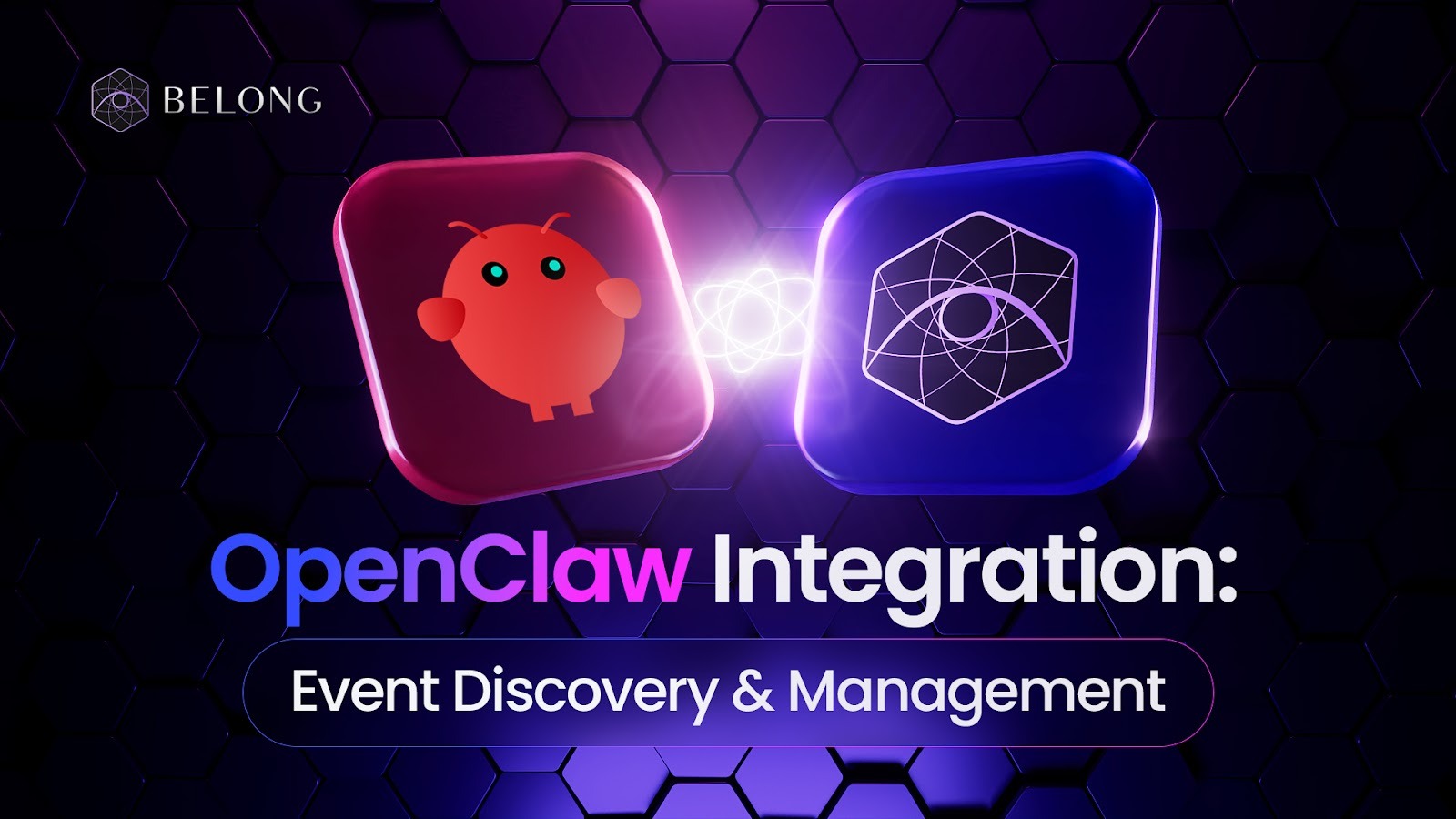
Belong has integrated OpenClaw, an open-source personal AI agent with over 211,000 GitHub stars, to tackle the aforementioned challenges and streamline venue marketing operations.
Users can run OpenClaw locally and connect to messaging platforms they use daily, including WhatsApp, Telegram, Discord, Slack, iMessage, SMS and more than 10 other platforms — over 16 channels in total. This removes the need to download a new app. Users can buy NFT tickets from WhatsApp during a group chat about the event, while a venue owner can manage check-ins from Telegram.
Source: Belong
The integration allows all processes to be carried on through natural language. Instead of navigating dashboards and filling forms, organizers can create and configure events with conversational AI by simply saying “Set up a $5 visit bounty with 10% cashback for my cafe,” or “Create a tech meetup on March 15th at 6 pm.”
Users accessing Belong through OpenClaw do not have to create and set wallets. OpenClaw automatically generates an embedded wallet in the background, and users do not even know a crypto wallet exists.
OpenClaw is open source; this means the integration benefits from a global community of developers that contribute to the protocol.
Integration responds to a market need
Belong decided to integrate OpenClaw after realizing that many venue owners in emerging markets primarily communicate through WhatsApp. The initial CheckIn dashboard, though feature-rich, was not meeting the expectations of owners.
Now with OpenClaw integrated, venue owners can:
- Check pending customer check-ins by typing “Show my pending check-ins.”
- Approve or reject check-ins with a similar, simple response.
- Configure rewards through natural language.
- Issue NFT tickets.
- View analytics.
- Withdraw earnings without having to open the web browser.
As for users, access is streamlined through an email OTP account linking flow. A user’s messaging identity is linked to their Belong account through a 6-digit code sent to their email. Combined with automatic embedded wallet creation, users can go from first message to fully authenticated participant in under 60 seconds — without encountering a seed phrase, API key or complex authentication flow.
Blockchain-based venue marketing to become a norm
The Web3 economy is usually built around the assumption that users will interact with blockchain through specialized wallet apps and decentralized application (DApp) browsers.
However, Belong believes the core friction that prevents mainstream users and physical businesses from benefiting from blockchain technology is inadequate UX, and its products are directly targeting to fill that gap.
🚀 Belong CheckIn + OpenClaw: The Future of Web3 Loyalty is Here!
We’re smashing the “crypto UX gap” with our OpenClaw integration! Say goodbye to wallet woes & app fatigue. 👋
Here’s how we’re making Web3 loyalty effortless:
1️⃣ Seamless Event Discovery: Users can now discover… pic.twitter.com/CONQZ3OqQ6— Belong (@belongnet) March 6, 2026
According to the project, the OpenClaw integration is a demonstration of how AI agents will become the primary interface for blockchain applications. Built on Anthropic’s Model Context Protocol (MCP) and exposing 17 tools across event discovery, ticketing, check-in management and venue operations, the integration exemplifies how Web3 services can meet users where they already are.
Belong envisions a future where blockchain-based marketing replaces traditional, immeasurable methods — where every venue has a tokenized loyalty program and the blockchain is invisible to the end user.


Subscribe to daily byte-sized crypto news from Cointelegraph
This content is part of a paid partnership. The text below is a commissioned article that is not part of Cointelegraph editorial content. The material is written by our advertorial team and has undergone editorial review to ensure clarity and relevance, it may not reflect the views and opinions of Cointelegraph.com. Readers are encouraged to conduct their own research before taking any actions related to the company. Disclosure.
More on the subject