


 Written by Jesse Coghlanstaff editorEdited by Felix Ngstaff editor
Crypto users wary as Anthropic releases Claude Mythos with safeguards
Latest NewsPublishedJun 10, 2026
Venture capitalist Simon Dedic said Anthropic’s latest AI models drop the cost and skill needed to find crypto exploits to “basically zero.”
AI company Anthropic on Tuesday released the first public version of its powerful Claude Mythos model, called Fable 5, with some crypto users worried it could be used for malicious purposes, despite embedded guardrails.
Anthropic said last month that its Mythos model uncovered more than 10,000 high or critical-severity vulnerabilities in “systemically important software,” leading many to question if it should be publicly released.
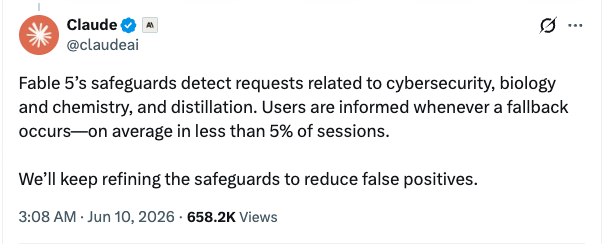
This is despite the company saying on Tuesday that Fable 5 was “made safe for general use,” and has safeguards that reroute some topics, such as cybersecurity, to a different model, Claude Opus 4.8
“Releasing a model this capable comes with risks. Without safeguards, Fable 5’s capabilities in areas like cybersecurity could be misused to cause serious damage,” it said.
Source: Claude
The guardrails have done little to reassure crypto users, with AI increasingly being used to attack crypto platforms. In April, the value of crypto stolen in hacks hit $629.7 million, the highest since February 2025, which analysts linked to the use of the technology.
Mythos release sparks warnings from crypto users
Simon Dedic, founder of the venture firm Moonrock Capital, posted to X on Tuesday that with Fable 5, the “cost and skill required to find exploitable flaws in smart contracts is about to drop to basically zero.”
“For DeFi, this should be a massive wake-up call. Unaudited protocols will become sitting ducks. Known exploits will get replayed on forks around the clock. Even small projects will get targeted simply because trying costs next to nothing now,” he added.
Related: AI agents with crypto could escape and become ‘unstoppable,’ experts warn
Dedic repeated calls online, suggesting that crypto users should protect themselves from the model, including revoking wallet approvals, removing as much value from protocols as possible and moving crypto to fresh hardware wallets.
Curve Finance co-founder Michael Egorov, however, said that the threat Claude Mythos posed to crypto was likely overblown as its success in finding bugs in other software might not translate to funding smart contract vulnerabilities in DeFi.
In May, Anthropic said Claude Mythos found thousands of critical vulnerabilities in important software through Project Glasswing. For open-source projects, which are central to how crypto protocols are managed, Mythos found around 6,200 high or critical-severity vulnerabilities in more than 1,000 projects it investigated.
Egorov argued that the software Mythos found vulnerabilities in had millions of lines of code, while smart contracts have a few thousand, “and both humans and ‘usual’ AI perfectly fit that code in context and can reason well about it.”
“I suspect we might not be having a wave of DeFi code hacks, but we may see a lot of things in OpSec [operational security] getting hacked (looking like multisig keys compromises) and supply chain attacks on frontend dependencies, and those are way less dangerous in true DeFi,” he said.
Meanwhile, Anthropic said a “small group” of cybersecurity and infrastructure providers would get access to Claude Mythos 5, the same model as Fable 5 but with safeguards lifted in some areas.
Magazine: AI-driven hacks could kill DeFi — unless projects act now


Subscribe to daily byte-sized crypto news from Cointelegraph
Cointelegraph is committed to independent, transparent journalism. This news article is produced in accordance with Cointelegraph’s Editorial Policy and aims to provide accurate and timely information. Readers are encouraged to verify information independently.
More on the subject