

Written by Nihatcan YanikCommissioned Content
Written by Nihatcan YanikCommissioned Content
Blockchain can turn idle household items into productive assets: Here’s how
CommissionedPublishedApr 21, 2026
Decentralized rental platforms can turn underutilized goods into productive assets to address inflation and waste.
Commissioned byivault

Web3’s next test is whether it can earn a durable role in everyday economic life. Households are rethinking the logic of buying goods for brief use and then leaving them idle, or discarding them altogether, because cost pressure still shapes daily spending.
OECD data shows headline inflation across member countries at 3.4% in February 2026, while the World Economic Forum has described the circular economy as a “trillion-dollar opportunity” that would move industry away from the linear “take, make and dispose” model.
Pressure on budgets converges with pressure on resources, and the result is a search for systems that can deliver immediate economic and social value. Blockchain projects that help people use, share and monetize existing assets are entering the conversation from a stronger position than they held during the speculation-heavy years.
The friction of ownership in a high-inflation era
Underused value surrounds most consumers. Power tools sit in closets for months. Cameras spend most of the year in drawers. Occasionwear often leaves the hanger once and then returns to storage. Each item represents money already spent and utility left largely untouched.
Peer-to-peer sharing promises a more efficient model, and it can extend product life cycles, ease household costs and reduce waste. The broader sharing economy has championed that idea for years, yet routine participation still feels harder than it should.
Much of the gap comes from infrastructure. Traditional Web2 marketplaces usually depend on centralized data collection, so users hand over personal information in exchange for access. Commission-heavy platforms also compress the upside for individuals who want to monetize their belongings.
Trust remains fragile when strangers need assurance about whether an item is as described, or if it will even be there when they arrive. Consumers increasingly want to own fewer items that hold physical space and share more, especially in inflationary periods, yet the supporting rails have matured slowly.
Secure, low-friction and middleman-light agreements have remained difficult to execute at scale, particularly for everyday items that sit below the value threshold of formal rental businesses.
Scaling the circular economy through tokenized rewards
Web3 rental platform ivault enters that gap as infrastructure for everyday exchange. Built for direct peer-to-peer rentals, lending, donations and lost-and-found recovery, ivault aims to reduce waste, cut out middlemen and make everyday sharing easier to trust through a mobile-first experience.
Verification anchors the model. Ivault says its patented blockchain technology confirms ownership, secures listings and reduces unnecessary data exposure, describing the architecture as one with “zero data risk.”
Privacy carries real weight in consumer marketplaces because participation usually falls when data collection becomes part of the cost of convenience. A rental platform gains credibility when trust comes from verifiable infrastructure and when users can interact without disclosing more than the transaction requires.
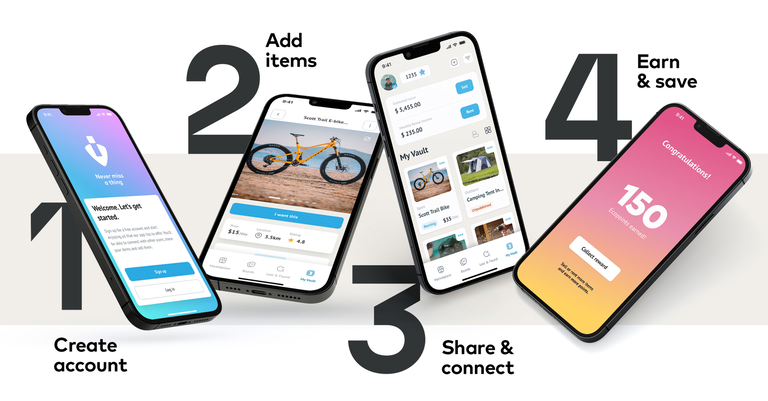
Accessibility also shapes the use case. Ivault frames the app for non-crypto natives, with onboarding designed around familiar mobile behavior rather than trading conventions or wallet-heavy workflows.
Source: ivault
Eco Points and the IVT token function mainly as an internal rewards and utility layer inside the product, which lowers the barrier for users who have no prior crypto experience. They provide the behavioral engine. Users can get Eco Points for renting, lending, donating, referring new users and helping return lost items. Conversion windows then allow those points to turn into IVT tokens, while users can also apply them to platform fees and finder’s rewards.
Sustainable behavior gains a direct economic expression inside the marketplace. In ivault’s model, that turns idle household goods into consumer-level real-world assets that can be put to use instead of sitting unused.
In early 2026, Google Cloud selected ivault for its startup program, providing the AI and blockchain infrastructure necessary to scale the marketplace from a local experiment to a global network. Scale remains essential if a circular marketplace is going to move beyond a niche audience.
Infrastructure for local growth
The integration of Vertex AI and Blockchain Node Engine is intended to strengthen the platform’s core infrastructure. Vertex AI can support smarter marketplace functions, while Blockchain Node Engine can support the blockchain layer behind verification and transaction activity as the platform expands.
Local exchange gives the model its social dimension. The app connects nearby users around borrowing, lending and lost-and-found recovery.
🚨We proudly present:
Our CEO @ASarhaddar was invited to speak at the prestigious Cointelegraph connect,event in Cannes this year!
A massive melting pot of founders,builders and investors, for us this is another milestone achieved in the legacy of this project. https://t.co/rovTCnRDH0— ivault™ (@ivaultapp) April 9, 2026
Community-level access matters in a high-cost environment. Families can avoid occasional purchases, lenders can put their dormant goods to work and neighborhoods can rely less on one-time consumption.
Ivault passed 170,000 installs in early 2026. This number points to a demand for a model that turns household items into productive assets and opens the door to users with little or no crypto background.
Access over possession
Wealth begins to look different in a system shaped by access, reuse and circulation. Ownership still matters, yet stewardship, liquidity and availability can carry equal weight when digital marketplaces make local coordination easier.
Ivault envisions an economy where households extract more value from what they already own and communities rely less on perpetual replacement.
The project’s roadmap extends the model into its next stage, with AI-driven marketplace intelligence and IoT-compatible asset tracking intended to improve verification, predictive sharing and more transparent ESG tracking over time.
Mainstream adoption in Web3 tends to favor projects that solve measurable problems in daily life. Platforms that reduce waste and widen access to economic participation stand a stronger chance of lasting relevance than projects that depend mainly on speculative momentum.


Subscribe to daily byte-sized crypto news from Cointelegraph
This content is part of a paid partnership. The text below is a commissioned article that is not part of Cointelegraph editorial content. The material is written by our advertorial team and has undergone editorial review to ensure clarity and relevance, it may not reflect the views and opinions of Cointelegraph.com. Readers are encouraged to conduct their own research before taking any actions related to the company. Disclosure.
More on the subject