

Written by Nihatcan YanikCommissioned Content
Written by Nihatcan YanikCommissioned Content
User-first CEXs widening access and lowering friction: Here’s how
CommissionedPublishedJul 1, 2026
This crypto exchange aims to eliminate cross-market fragmentation by deploying artificial intelligence utilities alongside zero-fee equity and commodity contracts.

Commissioned byMEXC
Combining traditional equities, physical commodities and digital assets into a single zero-fee trading environment, global exchange MEXC is utilizing AI-driven tools and expanded security reserves to eliminate cross-market investment friction.
Users who once split trades across brokerages, commodities venues and crypto apps are consolidating activity on exchanges. Investors with traditional finance backgrounds have started moving part or all of their crude oil, gold and U.S. stock trading onto crypto exchanges. Modern Web3 exchanges now combine functions that conventional finance platforms usually separate across accounts, interfaces and settlement rails.
Founded in 2018, global crypto exchange MEXC reflects the shift through a wider product base. For example, the exchange has recently opened a 0-fee channel to SpaceX-related valuation exposure through its pre-IPO launchpad.
Prior to SpaceX's official public listing, MEXC ran two rounds of SpaceX (PRE) Launchpad, attracting more than $173 million in subscriptions, with peak oversubscription reaching 30x.
Following the IPO, demand continued in the secondary market. SPCX futures recorded a peak single-day trading volume of over 800 million Tether (USDT) on June 16, while average daily trading volume during the first three days after listing increased nearly sevenfold compared with the pre-IPO period, demonstrating sustained user interest in high-growth technology assets.
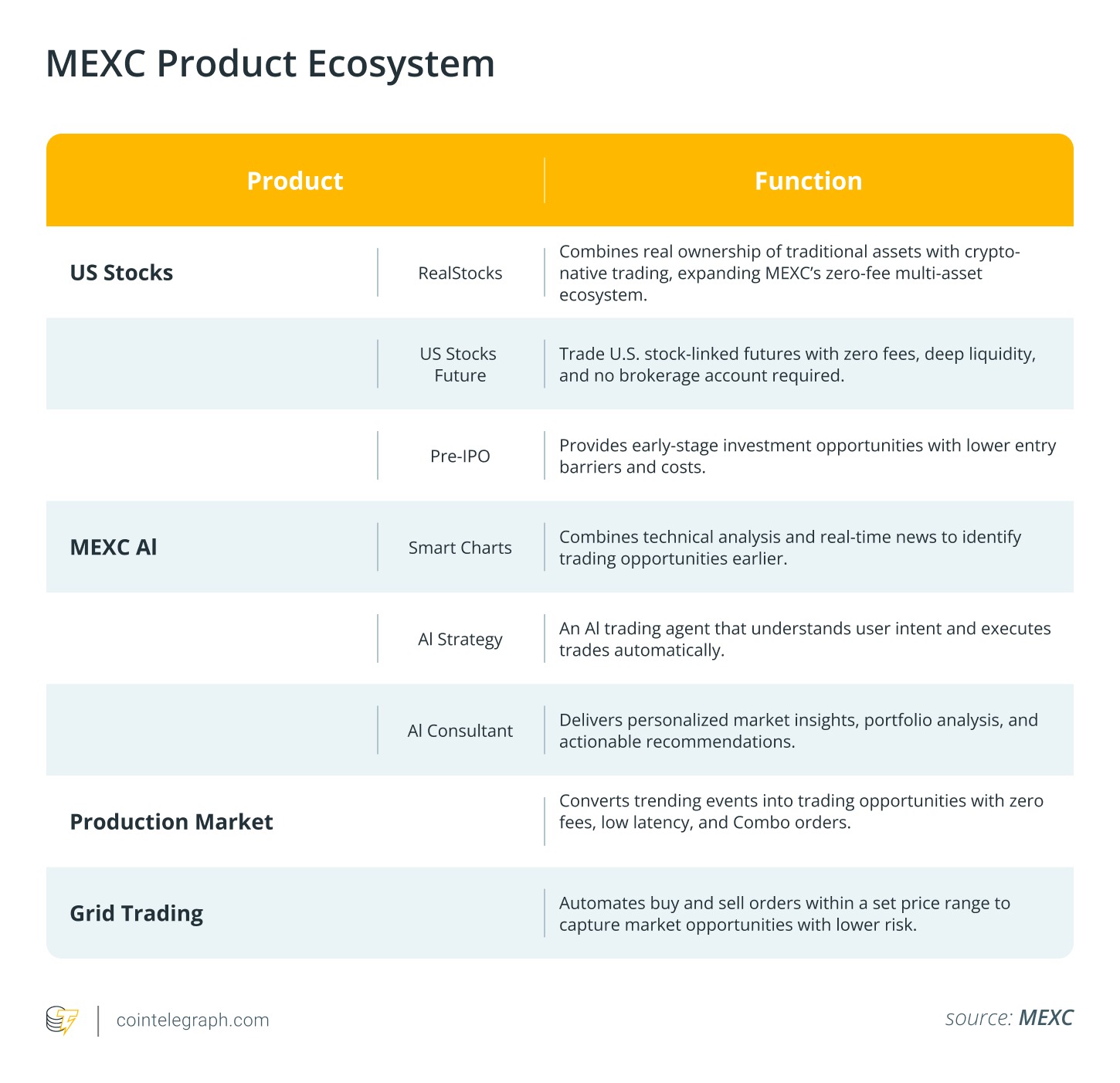
Prediction markets extend exchange access into event risk, where users can hedge outcomes inside the same account environment. MEXC has also launched RealStocks, allowing users to trade U.S. stock spot directly on the platform with 0-fees.
Stock Futures connect crypto-native traders with U.S. equity-linked contracts such as TRON, BITF, ICG and CRCL. MEXC’s gold and silver futures also bring commodities into the same trading flow.
Different markets sit behind those products, yet the user friction is similar: another account, another transfer, another workflow to learn. One-stop exchange infrastructure reduces those breaks in the process. Product depth also depends on the machinery underneath. Order books, risk controls and custody standards determine whether broader access works during active trading conditions.
Lowering costs to reduce user barriers
Wider access becomes more useful when trading costs fall. MEXC’s “0 Fees” strategy sits inside its broader “Infinite Opportunities” framework, which links market access with reduced trading friction across spot, futures and real-world asset (RWA) products.
During its 0-Fee Festival, MEXC announced that its users saved $232 million in trading fees across hundreds of spot and futures pairs. The campaign covered crypto pairs, commodities and tokenized U.S. stock exposure, with $453 billion in total volume.
Execution quality matters beyond posted fee schedules. TradFi contracts such as gold, silver and crude oil need deep books because volatility can widen spreads. Stable slippage reduces the real cost of entering and exiting positions during fast markets. CoinGecko data showed 1,281 new listings on MEXC from January 2025 to January 2026 and 8.2% global spot market share.
Empowering users through AI-driven tools
Always-on markets create a practical problem. Users cannot watch every candle, headline and community trend. AI tools compress that information flow into alerts, filters and automated execution. CEXs can connect news flow, account context, portfolio data and trading controls in one interface.
MEXC’s six-tool AI suite has reached more than 1.5 million users. AI News Radar tracks real-time market movements. AI Select List filters thousands of assets for emerging momentum. MEXC-AI (Pre AI Trending Search), tracks topics the MEXC community researches in real time.
AI Smart Charts use macro events, market news and trading data for predictive analysis. MEXC AI turns market analysis into personalized position strategies and portfolio monitoring. AI Copy Trading lets users follow performance-verified AI traders.
AI Strategy is the newest upgrade in the stack. Users can describe trading ideas in natural language, monitor social media signals, generate strategies and set 24/7 automated execution. Spot Grid Trading and Futures Grid Bot add rule-based tools for predefined ranges, risk control and trading discipline during volatile periods.
Strengthening user protection through enhanced safeguards
Security remains a core test for Web3 exchanges, especially for users who come from regulated traditional finance. MEXC has focused on capital buffers, public reserve reporting and identity-risk controls.
The platform shared that its Guardian Fund has expanded from $100 million toward a $500 million target over the next two years. MEXC also acquired 1,000 Bitcoin (BTC) for the fund, and the reserve model combines USDT liquidity with Bitcoin holdings.
Monthly Proof of Reserves reports add visibility. The latest Hacken-audited May 2026 report showed reserve ratios of 293% for BTC, 123% for ETH, 117% for USDT and 120% for USD Coin (USDC), which indicates full coverage of user assets.
MEXC’s partnership with Sumsub adds AI-powered identity verification, biometric liveness checks, address verification and risk-based workflows against deepfake impersonation and remote fraud attacks.
A user-first exchange is measured in friction
Major CEXs now compete on access, cost, practical tools and asset protection. MEXC’s expansion across RWAs, U.S. stock trading, stock futures, AI trading utilities and reserve safeguards shows how user expectations are changing.
Crypto-native users are becoming more multi-asset oriented, and increasingly want equity, commodity and digital asset exposure through crypto-native access. Exchange competition will increasingly depend on how much friction gets removed from the path between a user’s market view, trade execution and protected balance.


Subscribe to daily byte-sized crypto news from Cointelegraph
This content is part of a paid partnership. The text below is a commissioned article that is not part of Cointelegraph editorial content. The material is written by our advertorial team and has undergone editorial review to ensure clarity and relevance, it may not reflect the views and opinions of Cointelegraph.com. Readers are encouraged to conduct their own research before taking any actions related to the company. Disclosure.
More on the subject