


 Written by Yohan Yunstaff editorEdited by Andrew Fentonstaff editor
Chinese traders made millions from TRUMP, Coinbase in Philippines? Asia Express
MagazinePublishedJan 23, 2025
Top Chinese crypto traders earn millions on TRUMP, Manila turns Coinbase Armstrong’s head, the rise of Bimcoin.

Prominent Chinese traders earn millions from US president’s memecoin
Chinese-language trading accounts have raked in millions of dollars from the launch of US President Donald Trump’s memecoin.
Trump launched his token days before his Jan. 20 presidential inauguration. The memecoin’s market capitalization quickly skyrocketed, briefly placing it among the top 15 cryptocurrencies before a companion token, named after First Lady Melania Trump, made its debut.
The Mandarin-language blockchain media outlet Blockbeats analyzed trading data to report that the TRUMP token’s price spikes coincided with Asian trading hours.
Chain Insight, a Chinese-language key opinion leader wallet tracker, identified 12 Solana addresses of prominent Mandarin-speaking traders as some of the top earners from the TRUMP token’s surge. According to their rankings, 12 accounts each profited over $1 million, with a single trader, known as 0xSun, amassing $27 million. In total, these wallets earned an eye-popping $121 million, according to Chain Insight’s Jan. 22 update.
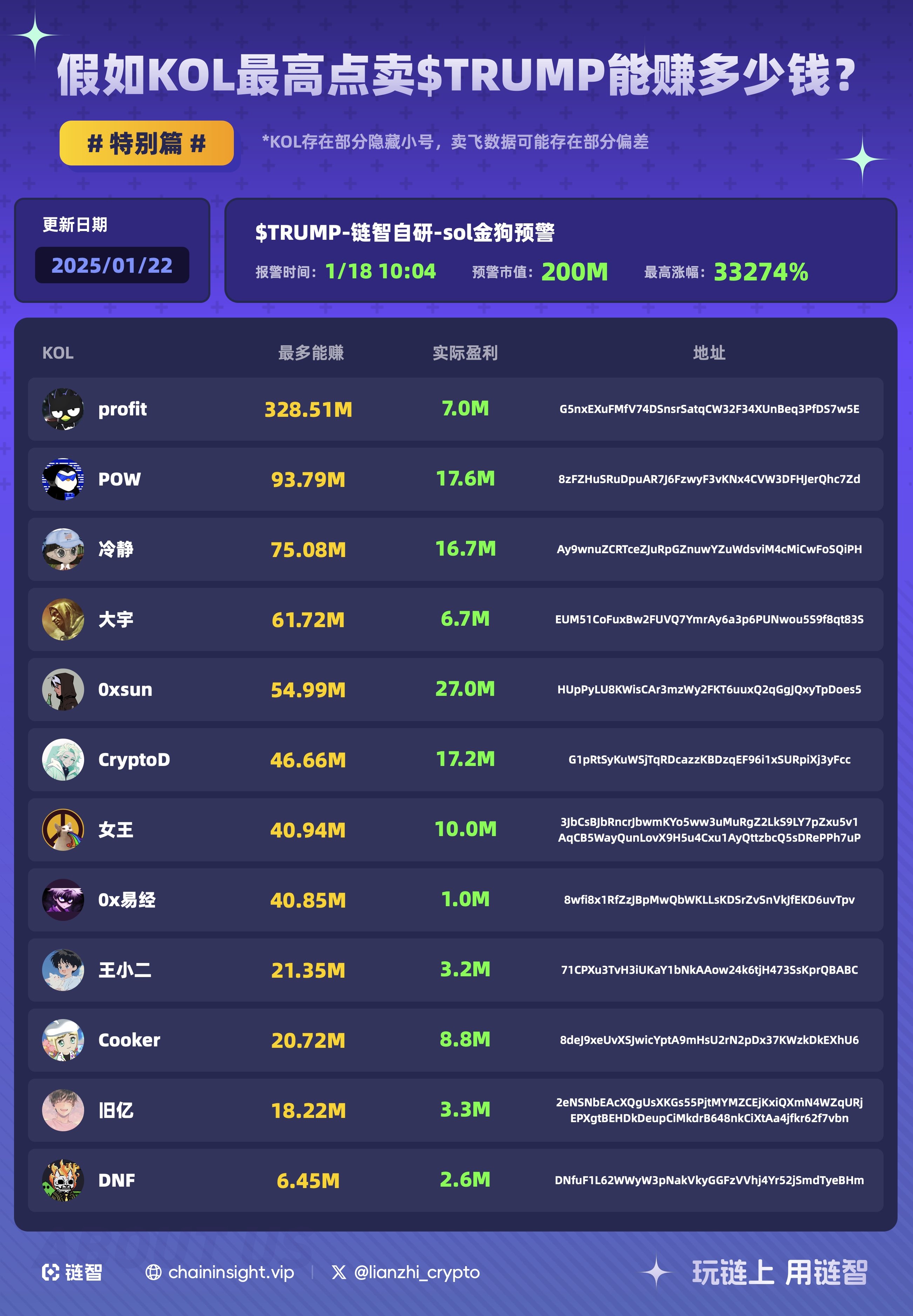
Chinese-language key opinion leaders with at least $1 million in TRUMP trading profits. (Chain Insight)
A detailed profit-and-loss analysis revealed 28 addresses in total netted profits exceeding $10 million, a threshold met by five of the Chinese-language traders featured in Chain Insight’s rankings.
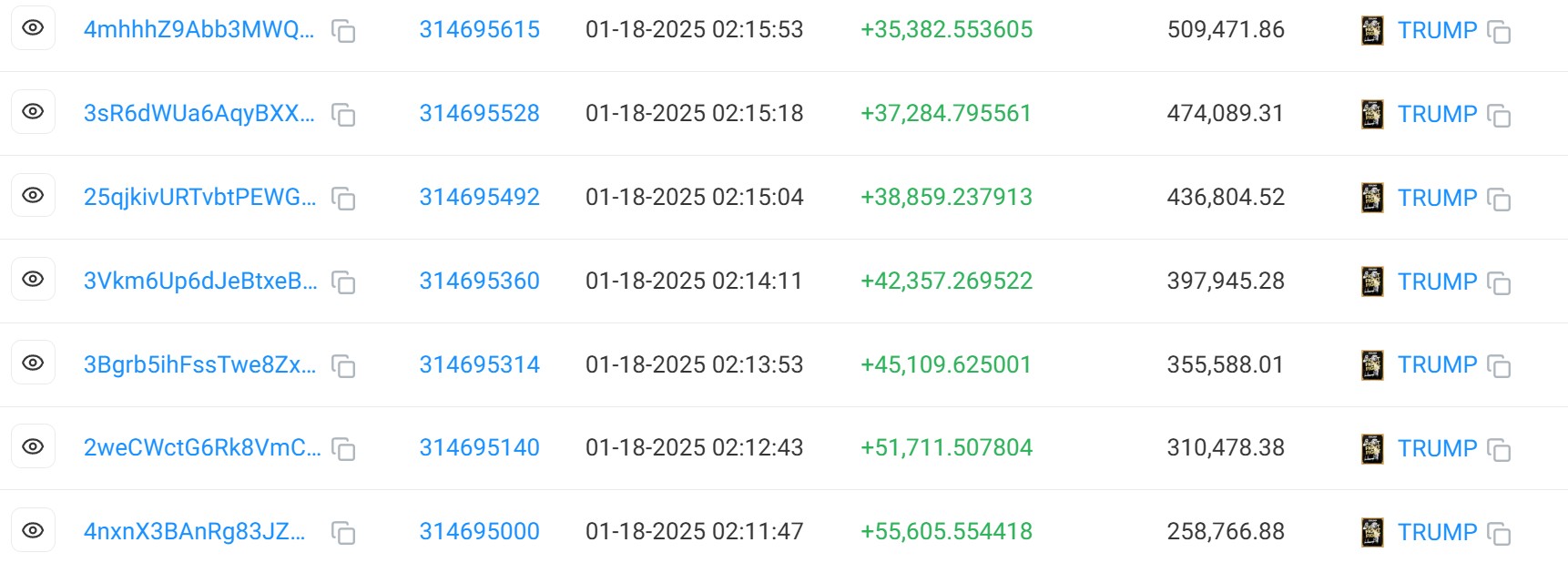
A look into 0xSun’s wallet activity shows aggressive TRUMP accumulation before official confirmation from the president’s X account. (Solscan)
The token’s explosive debut has not been without controversy. Critics from both the crypto world and political spheres have condemned it.
Congresswoman Maxine Waters accused the token of being a tool for circumventing national security and anti-corruption laws.
“Buyers could include large corporations, allied nations who are pressed to show their ‘respect’ for the President, and our adversaries, like Russia and China, which have much to gain from influencing a Trump presidency,” she said in a statement.
“Anyone globally, even individuals who have been sanctioned by the US or banned from our capital markets, can now trade and profit off of $TRUMP through various unregulated platforms.”
Ethereum co-founder Vitalik Buterin also thinks “politician coins” are “risky to democracy.”
Vitalik Buterin has concerns over politicians issuing tokens. (X)
Though the token was advertised on the president’s official X account, Trump said in a Jan. 21 press conference that he doesn’t “know much about it other than I launched it.”
Brian Armstrong goes SEA shopping
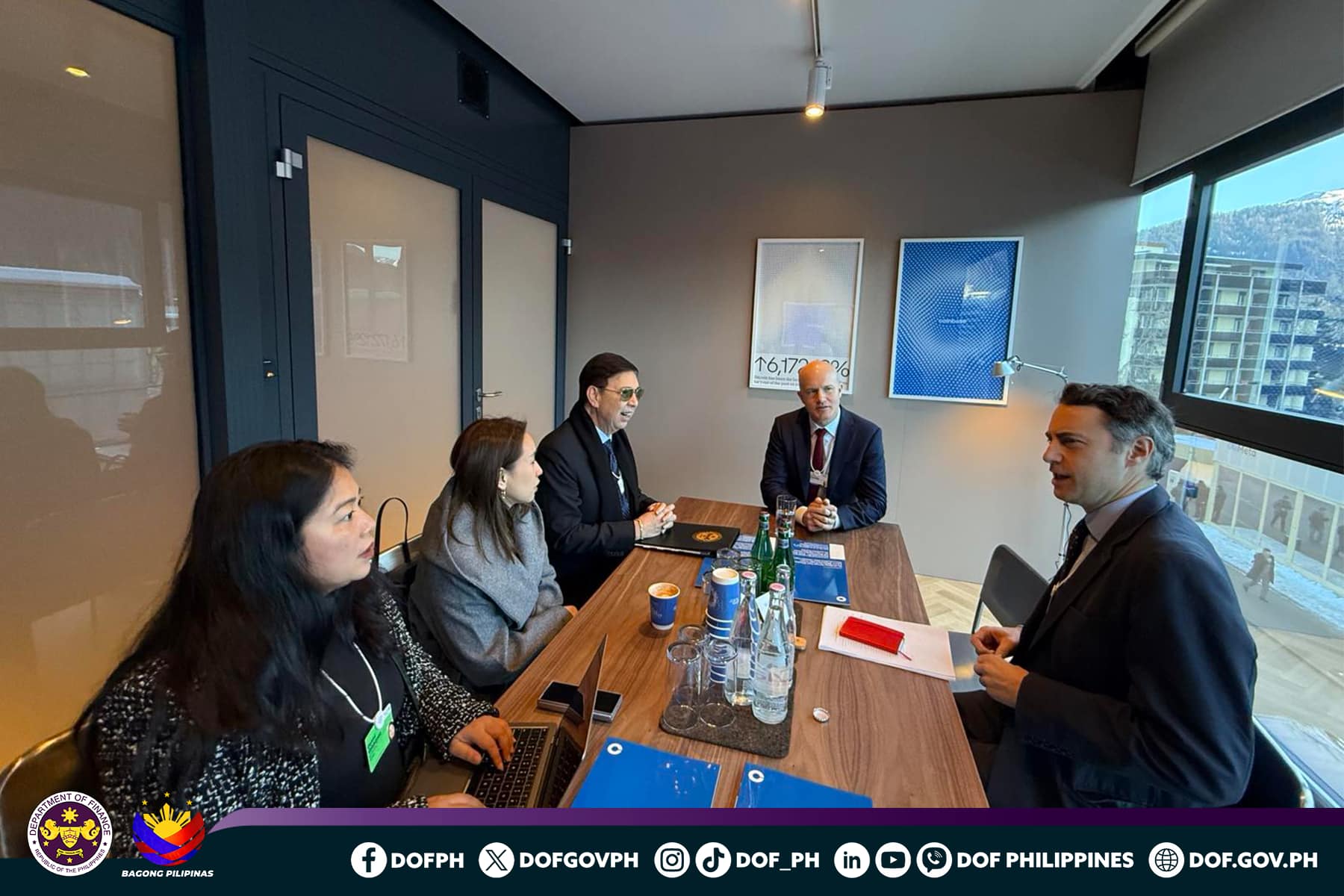
Coinbase meets Philippines finance officials at the sidelines of the World Economic Forum’s annual meeting at Davos. (Department of Finance)
Coinbase CEO Brian Armstrong appears to have his sights set on Southeast Asia as the US cryptocurrency giant considers expanding its regional footprint.
Armstrong was recently spotted in Davos, Switzerland, during the 2025 World Economic Forum, where he met with Ralph Recto, the Filipino secretary of finance.
According to the Department of Finance, Coinbase initiated the meeting to discuss a potential entry into the Philippines.
This move raises eyebrows, as it contradicts earlier indications that the exchange had little interest in a Southeast Asian expansion. However, there have been some hints.
At a crypto conference in December 2024, Coinbase revealed that its Coinbase Wallet and Base layer-2 network are actively supporting Southeast Asian developers building apps, including those tied to future stablecoins linked to Thai and Philippine currencies.
Additionally, a Q4 Coinbase-commissioned report analyzed citizens’ perceptions of their financial systems and the role crypto could play in improving them. The Philippines was one of four nations studied, alongside Argentina, Kenya and Switzerland.
Coinbase already has a foothold in Southeast Asia through its subsidiary in Singapore. The subsidiary recently obtained a license to operate its digital payment token business without transaction limits.
Line adopts Telegram’s blueprint with mini DApp portal launch
Line Next, the Web3 arm of the Japanese messaging app Line, has unveiled its DApp portal featuring “mini decentralized applications” powered by Kaia, a blockchain formed through the merger of South Korean messenger Kakao’s Klaytn and Line’s Finschia.
The DApp portal enables users to access Web3 services within the Line Messenger app. Mini DApps span categories such as games, social media, and digital content. It also comes with an integrated wallet where users can earn rewards and trade crypto assets.
Line’s move mirrors a trend popularized by Telegram, whose messaging platform claims nearly a billion active users.
Telegram’s integration of Mini Apps into its ecosystem has already proven wildly successful among crypto enthusiasts.
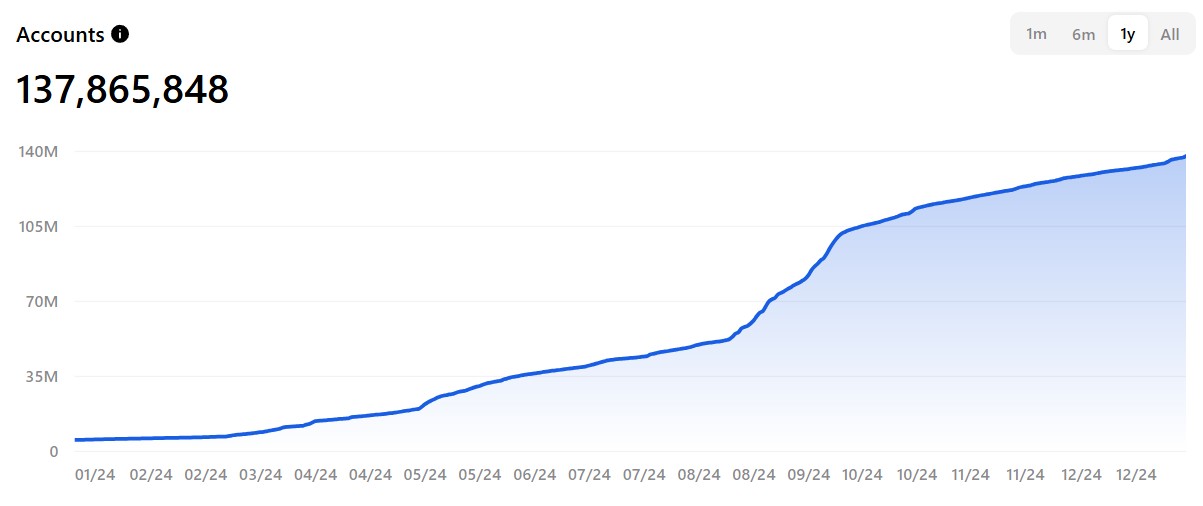
The popularity of Telegram’s Mini Apps fueled TON’s account growth in 2024. (Tonstat)
Last year, games like Notcoin and Hamster Kombat reportedly attracted millions through airdrop incentives and simple gameplay. These Mini Apps often integrated with The Open Network (TON), a blockchain conceived by Telegram, contributed to a surge in TON blockchain accounts.
At the start of 2024, TON had fewer than 4.5 million accounts, a figure that has since soared to over 137.8 million as of Jan. 23.
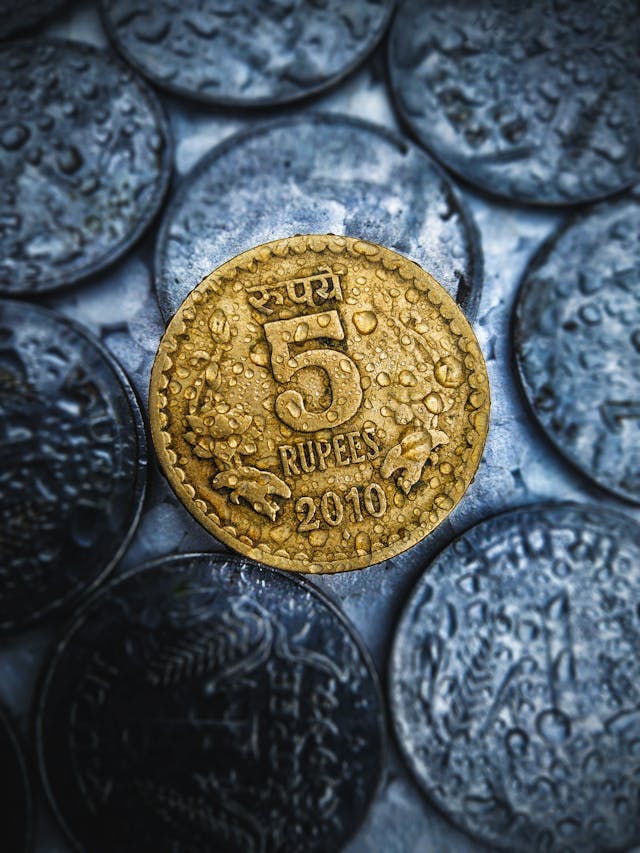
The Indian business school’s new blockchain-based digital currency is closer to a CBDC. (Mister Fotofreak)
Indian business school launches own blockchain currency
Indian business school Birla Institute of Management Technology (Bimtech) has unveiled its own blockchain-based digital currency, “Bimcoin”.
Bimtech now stands alongside IIT Madras as a pioneer in blockchain adoption among Indian educational institutions. Last year, IIT Madras deployed blockchain technology for its student elections, utilizing in-house software to enable transparent and remote voting.
The business school’s currency focuses on campus transactions among students, vendors and administrators. Its permissioned blockchain architecture draws inspiration from central bank digital currency (CBDC) models rather than cryptocurrencies based on public blockchain networks like Bitcoin.
This aligns with India’s broader regulatory stance. The Reserve Bank of India, the nation’s central bank, has long maintained a negative view of cryptocurrencies, with past attempts to impose bans. Recently, Indian regulators reportedly consulted experts advocating for a crypto ban to pave the way for the nation’s CBDC, which has been in its pilot phase since 2022.


Subscribe to daily byte-sized crypto news from Cointelegraph
Cointelegraph publishes long-form journalism, analysis and narrative reporting produced by Cointelegraph’s in-house editorial team with subject-matter expertise. All articles are edited and reviewed by Cointelegraph editors in line with our editorial standards. Some articles contain affiliate links, from which Cointelegraph may earn a commission. These relationships do not influence which products we review or our editorial conclusions. Content published in here does not constitute financial, legal or investment advice. Readers should conduct their own research and consult qualified professionals where appropriate. Cointelegraph maintains full editorial independence.
More on the subject