

Written by Erhan KahramanCommissioned Content
Written by Erhan KahramanCommissioned Content
Privacy-focused blockchain gains tools for institutional compliance
CommissionedPublishedSep 29, 2026
Sanctions screening, transaction monitoring and fund-flow tracing are adapting to an institutional blockchain built for selective disclosure.

Commissioned byIntercepta
Much of crypto’s compliance stack was built for public blockchains where accounts have addresses and transactions are openly visible. Screening engines use those records to identify counterparties and follow funds. The tools and the ledger share a vocabulary.
The Canton Network uses a different model. As regulated institutions move tokenized assets onto it, the gap between what compliance tools assume and what the ledger records creates a practical problem.
Three challenges for generic tools
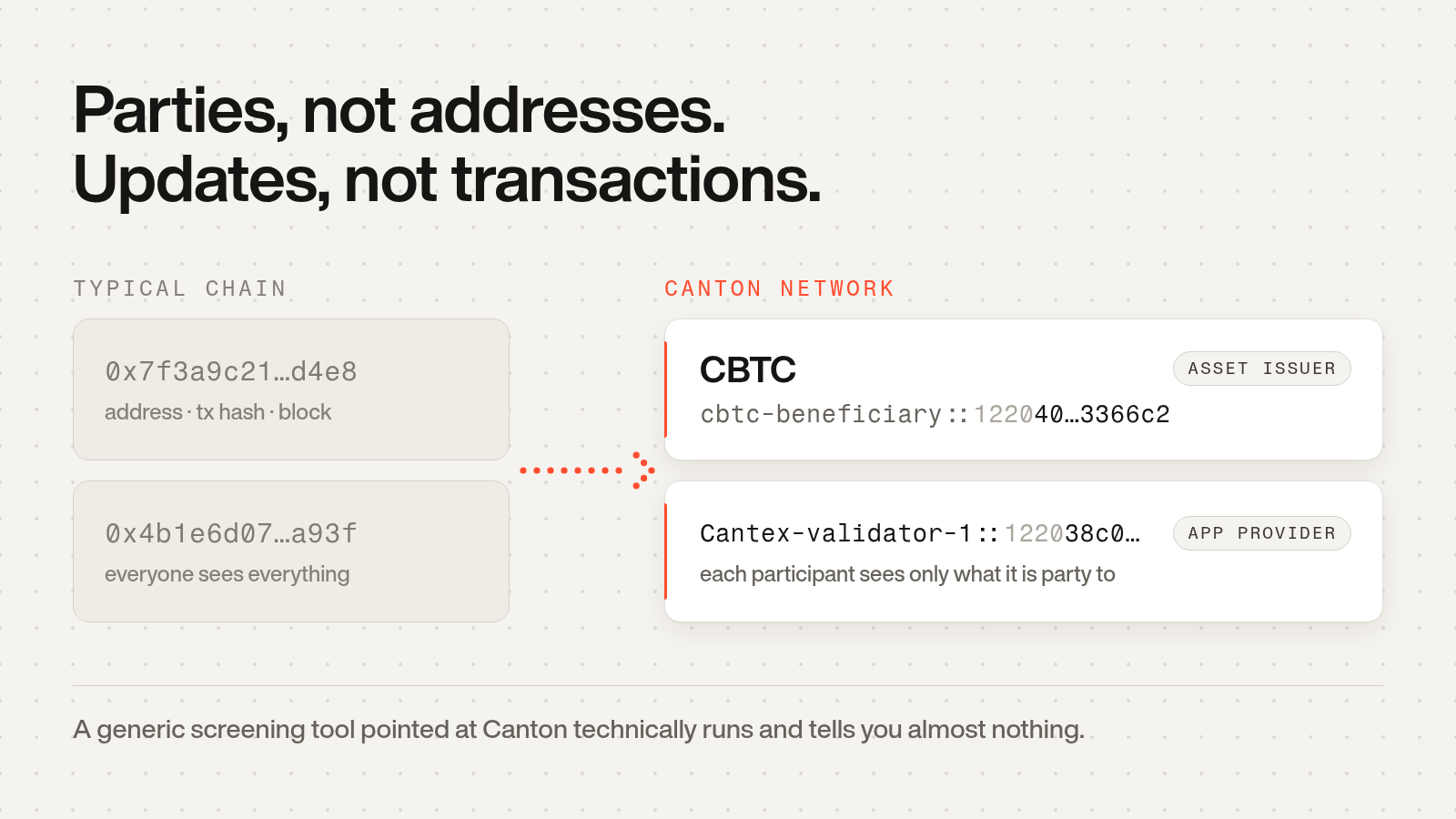
Canton identifies the user as a party, not an account. A party ID is a name joined to a key fingerprint, and the name often means nothing: many are opaque strings, and if nobody picks one, it defaults to a random UUID. So address clustering and label databases have little to grip. On Canton, the user attributes a party by who hosts it, what role it plays — issuer, app provider or validator — and how it behaves over time.
One Canton Coin (CC) payment is a tree of events: the sender’s inputs, the amount to the receiver, the change, the fees, and the rewards to the app provider and validator. A parser that expects one input and one output reads that tree wrong and puts value in the wrong place.
Visibility is also selective. Scan exposes the Super Validators’ view, including Canton Coin and network operations. Private activity may expose limited metadata while amounts remain restricted to authorized parties. A bank, regulator and application provider can therefore see different portions of the same network. Compliance tools must make those boundaries clear. The practical implications extend into individual investigations.
To address those differences, the onchain security and compliance platform Intercepta has extended its Compliance Engine and Risk Monitoring modules to Canton. Coverage became available on Sept. 15, with the tools adapted to how the network records activity.
Source: Intercepta
“A compliance answer that is correct for Ethereum and wrong for Canton is not an answer,” said Alex Dulub, founder and CEO of Intercepta. “Canton is the first network where the institutions arrived before the tooling did. We built this to read the ledger the way it is actually written.”
What the coverage includes
Intercepta screens Canton parties against sanctions lists from the US Office of Foreign Assets Control, EU, UK and UN Security Council. It applies Know Your Transaction risk scoring to Canton Coin and token-standard asset flows and attributes counterparties across exchanges, asset issuers and application providers. Where a party’s role is known, results identify the issuer or exchange deposit associated with it.
Risk Monitoring tracks party activity continuously, including treasury movements, issuance and redemptions, validator behavior and reward attribution. Alerts trigger when exposure crosses a customer-defined threshold.
Rather than requiring an analyst to expand counterparties by hand until a path appears, the system searches across several hops for routes between two parties and adds every party along the way. Each hop it returns is a real ledger update the analyst can open and verify, so the output is evidence rather than an assertion.
Cases save continuously and support simultaneous work by colleagues. Read-only links allow teams to share findings without granting editing access, while exports record the filters used to produce them.
Screening inside an institution’s perimeter
Canton’s privacy model also shapes deployment requirements. A public index reflects the activity available to the participants supplying its data. An institution’s private contracts and application flows may require access through a participant node authorized to see them.
Intercepta can be deployed inside a customer’s environment and connected to that node, producing a compliance view over the ledger the institution actually holds alongside public Canton data. In this configuration, cases, screening results and exports remain inside the customer’s infrastructure.
Authentication runs through the customer’s identity provider, with roles mapped from its directory and access recorded in an audit log. Deployment options include a dedicated virtual private cloud, an on-premises installation alongside the participant node and a managed single-tenant instance.
Following value across network bridges
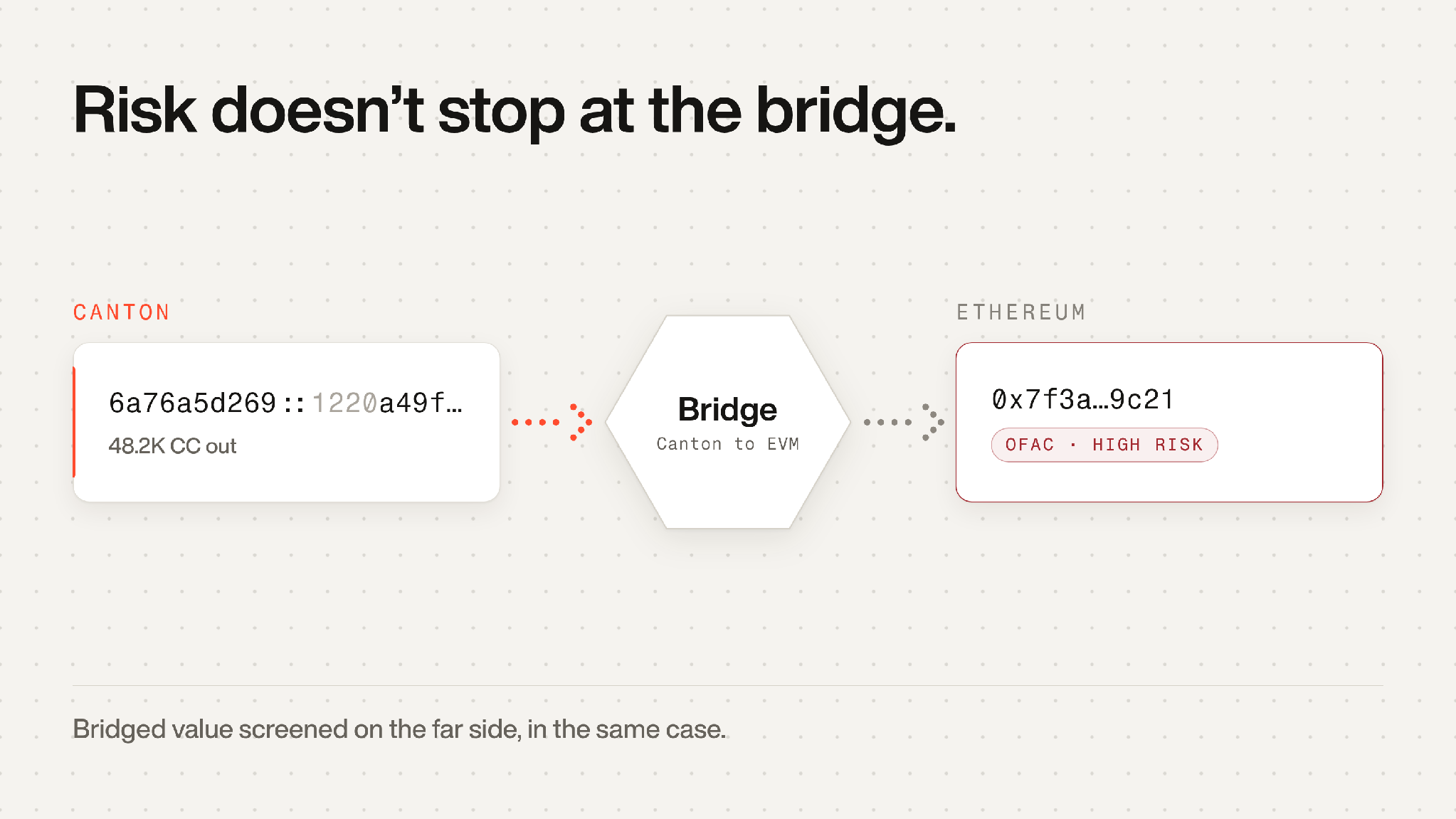
Value also moves between networks. Canton’s connections to Ethereum and other chains through bridges create another requirement for investigators: following funds beyond the originating ledger.
Source: Intercepta
Intercepta follows bridged value to the destination chain and screens counterparties there with the same engine, inside the same case. If a Canton party sends value through a supported bridge to an address on a sanctions list, the system flags the exposure in the analyst’s existing investigation, with the evidence trail included in the same export.
Extending coverage across blockchain networks
Canton joins Robinhood Chain, Arc and 15 other networks already covered by Intercepta, whose engine is used by Trust Wallet and processes threat checks in under a second. Canton coverage is available through the Compliance Engine and Risk Monitoring modules, including private deployments for institutions that require screening within their own environments.
As institutional activity grows on selectively disclosed ledgers, compliance teams will need tools that interpret network-specific records and show where their visibility ends. Tracing a path and documenting the limits of the available evidence will both matter to the resulting investigation.


Subscribe to daily byte-sized crypto news from Cointelegraph
This content is part of a paid partnership. The text below is a commissioned article that is not part of Cointelegraph editorial content. The material is written by our advertorial team and has undergone editorial review to ensure clarity and relevance, it may not reflect the views and opinions of Cointelegraph.com. Readers are encouraged to conduct their own research before taking any actions related to the company. Disclosure.
More on the subject