


 Written by Zoltan Vardaistaff writerEdited by Yohan Yunstaff editor
Hyperliquid added to Singapore’s Investor Alert List
Latest NewsPublishedJun 26, 2026
Singapore’s financial regulator added Hyperliquid to its Investor Alert List, as a reminder that the decentralized exchange was not licensed in the region.

The Monetary Authority of Singapore (MAS), the city-state’s central bank and financial regulator, has added decentralized perpetuals exchange Hyperliquid to its Investor Alert List.
The entry, added on Friday, includes the Hyper Foundation website and the Hyperliquid trading app.
The Investor Alert List is a consumer protection measure that identifies entities that may be wrongly perceived as licensed or regulated by MAS. Inclusion on the list does not constitute a ban or enforcement action.
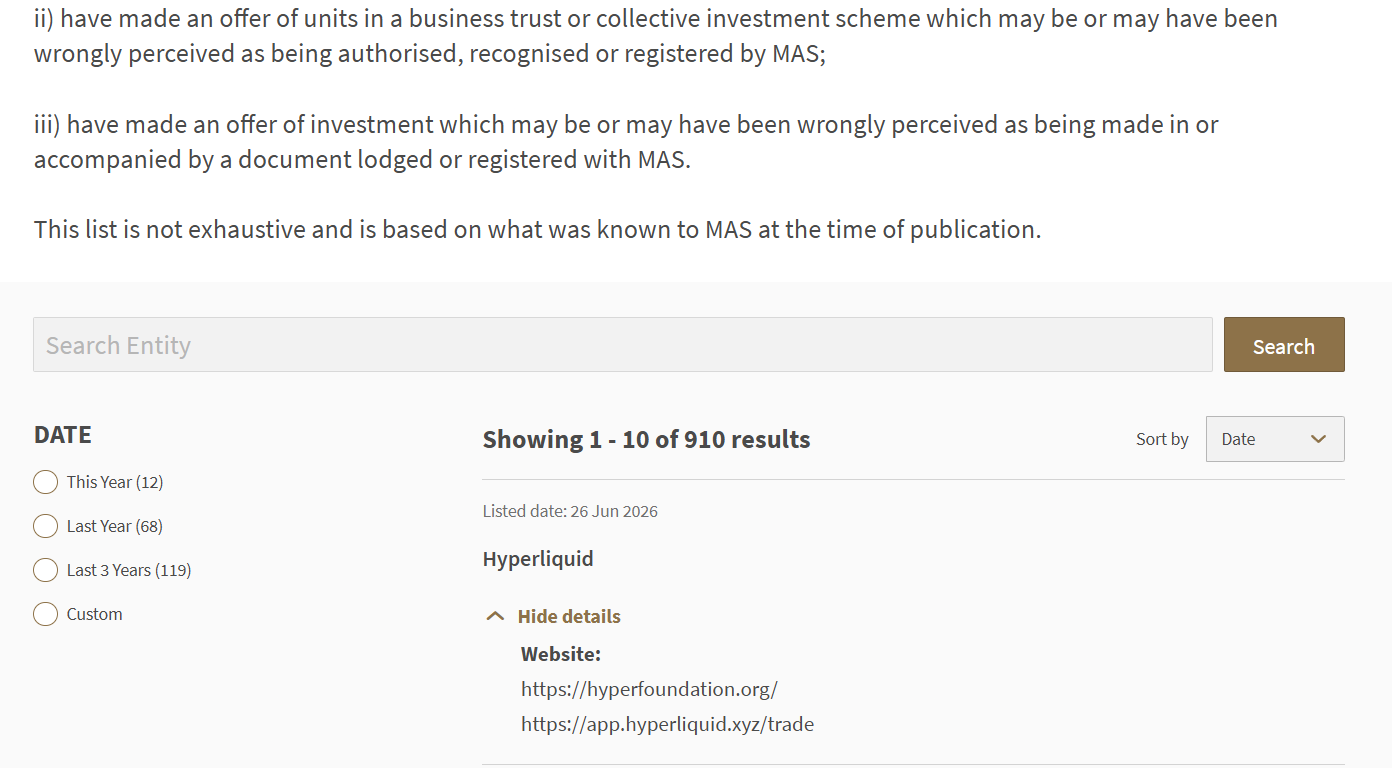
MAS Investor Alert List. Source: MAS
MAS added crypto exchange Bybit to the list on June 17. KuCoin and Bitget also appear on the list. Cointelegraph reached out to MAS for comment but did not receive a response before publication.
Hyperliquid said that it has never claimed to be licensed or authorized by MAS and that nothing about its permissionless infrastructure has changed.
Related: Ripple joins Singapore sandbox to test RLUSD in trade finance
“The Hyperliquid ecosystem remains committed to engaging collaboratively and constructively with regulators and institutions globally and to supporting clear, well-designed frameworks for onchain finance,” the platform wrote in a Friday X post.
According to CoinGecko, Hyperliquid ranks as the ninth-largest decentralized exchange by trading volume, while DefiLlama estimates it holds about $5.7 billion in total value locked.
Singapore tightens crypto oversight
Singapore has steadily tightened oversight of the cryptocurrency industry in recent years. In May 2025, MAS ordered crypto companies serving overseas customers to either obtain licenses or cease operations, saying the policy reflected a long-standing regulatory position rather than a shift in approach.
The directive closed a regulatory loophole that had allowed some crypto firms based in Singapore to avoid licensing by serving only overseas customers. MAS said it had consistently communicated its position since 2022 and was ending the transition period for firms that had continued operating without a license.
MAS said the measures were intended to strengthen consumer protection and align the Lion City’s crypto framework with international standards on Anti-Money Laundering and Countering the Financing of Terrorism.
Magazine: How crypto laws changed in 2025 — and how they’ll change in 2026


Subscribe to daily byte-sized crypto news from Cointelegraph
Cointelegraph is committed to independent, transparent journalism. This news article is produced in accordance with Cointelegraph’s Editorial Policy and aims to provide accurate and timely information. Readers are encouraged to verify information independently.
More on the subject