

 Written by Alex O’Donnellformer writerEdited by Bryan O'Sheastaff editor
Movement Labs targets 1-second L2 finality by end of 2024: Co-founder
Latest NewsPublishedSep 11, 2024
Apps will be able to settle directly on Movement’s L2 with fast finality ‘postconfirmations’ secured by stakers, the co-founder said.
Movement Labs aims to launch a new mechanism for quickly settling transactions directly on layer 2 (L2) scaling networks by the end of 2024, Rushi Manche, Movement’s co-founder, told Cointelegraph in an interview.
Fast finality ‘postconfirmations’ are an alternative to existing methods for settling Ethereum (ETH) L2 transactions — such as zero-knowledge (ZK) and fraud proofs — with the potential to cut confirmation times to less than 1 second, Movement said in a Sept. 2 blog post.
Total value locked (TVL) on L2s has more than tripled in 2024 to almost $35 billion, according to L2Beat, as Ethereum’s surging popularity strains the network’s limited bandwidth.
In the past 30-days, Ethereum’s average throughput was fewer than 13 transactions per second (TPS), compared to nearly 700 TPS for rival Solana (SOL), according to Chainspect.
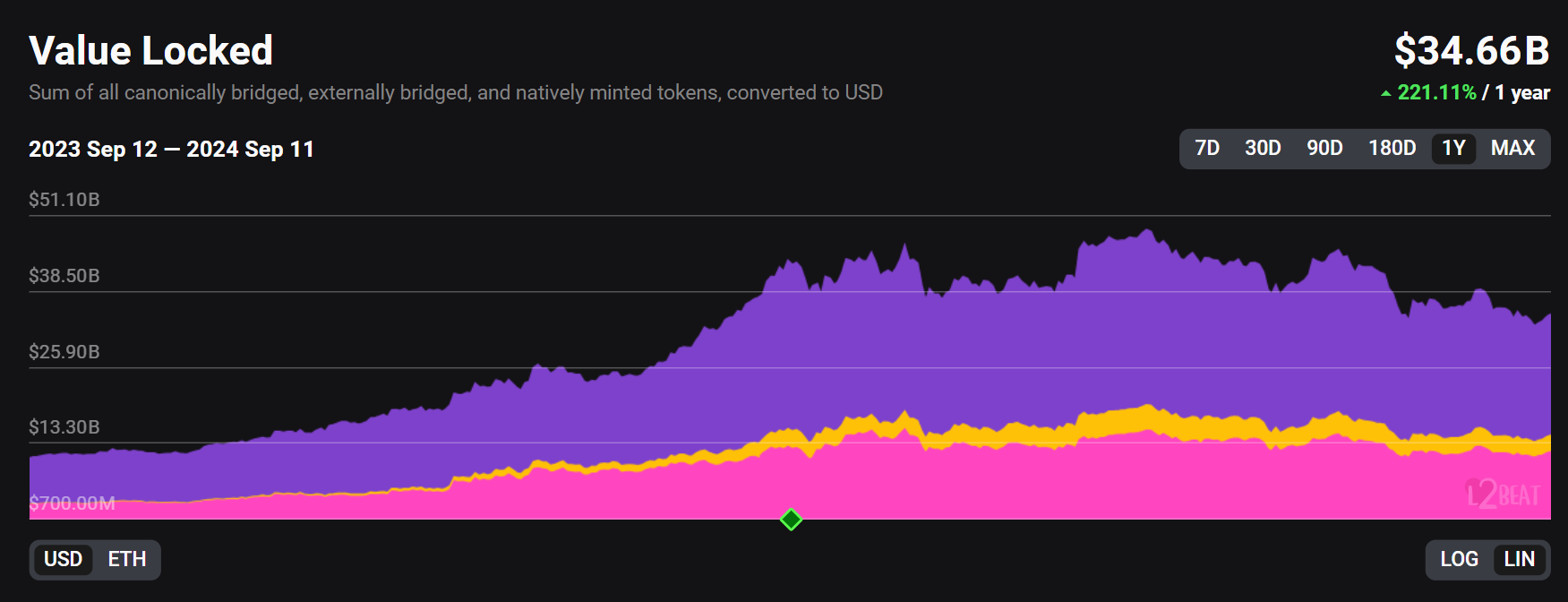
Total value locked (TVL) on Ethereum’s L2s. Source: L2Beat
Related: Celestia unveils roadmap to 1-gigabyte blocks
Existing solutions are imperfect. Fraud proofs on optimistic rollups such as Arbitrum, Optimism and Base “can take seven days for finality, and zk-rollups can be expensive,” Manche said.
With postconfirmations, applications building on M2— Movement’s upcoming L2 — can optionally route transactions to a network of validators secured by Movement’s native token, MOVE, Manche said. The token is slated to launch by the end of 2024.
“You can launch a custom rollup using a set of validators, accept L2 security, and still post call data to Ethereum. This allows you to maintain high throughput while settling on Ethereum when necessary,” Manche said.
Movement’s M2 network will also settle transactions on mainnet Ethereum similarly to other optimistic rollups. Movement is partnering with EigenDA, a data availability service built on restaking protocol EigenLayer, to handle data waiting to be settled on mainnet, Mache said.
Movement is among several Web3 developers —- including Aptos and Sui — and building blockchains on Move, a Rust-based programming language.
It has the potential to help developers build safer, higher-throughput smart contracts, Manche said. He predicts that by the second half of 2025, up to 20% of Web3 developers will work with Move, up from 7.5% today.
Magazine: Proposed change could save Ethereum from L2 ‘roadmap to hell’


Subscribe to daily byte-sized crypto news from Cointelegraph
Cointelegraph is committed to independent, transparent journalism. This news article is produced in accordance with Cointelegraph’s Editorial Policy and aims to provide accurate and timely information. Readers are encouraged to verify information independently.
More on the subject