


 Written by Martin Youngformer writerEdited by Ana Paula Pereiraformer editor
Vitalik Buterin advocates ‘copyleft’ licensing in crypto
Latest NewsPublishedJul 8, 2025
Ethereum co-founder Vitalik Buterin now backs open-source licenses, arguing they better promote open innovation as crypto becomes more “competitive and mercenary.”

Ethereum co-founder Vitalik Buterin has encouraged the crypto industry to adopt “copyleft” open-source licenses amid concerns the industry is losing touch with its collaborative roots.
In a newly released blog on Monday, Buterin said he was previously a fan of a “permissive approach” to software licensing, which enables the free sharing with everyone, but has now started to favor a “copyleft” approach.
There is a subtle difference between the two. Permissive licenses allow the public to freely modify or distribute source code files. Copyleft licenses do the same, but require the user to also open-source any derivative work using the original code.
“I generally philosophically dislike copyright and patents,” Buterin said.
Buterin shifts to copyleft open-source licenses
“I dislike the idea that two people privately sharing bits of data between each other can be perceived as committing a crime against a third party whom they are not touching or even communicating with,” he added.
Buterin said he was warming to “copyleft” because open source has become mainstream, and “nudging enterprises toward it is much more practical.”
However, he recognizes potential downsides in the “copyleft” approach in that it can be too restrictive or coercive, especially in cases where code isn’t publicly distributed but still has to be shared.
Why I used to prefer permissive licenses and now favor copylefthttps://t.co/aPGhY0Y0kX— vitalik.eth (@VitalikButerin) July 7, 2025
Copyleft in the crypto space
Buterin highlighted how the crypto space has changed, becoming more competitive and less cooperative, which weakens the old open-source ideal of people sharing code voluntarily.
“The crypto space in particular has become more competitive and mercenary, and we are less able than before to count on people open-sourcing their work purely out of niceness.”
He said voluntary sharing is no longer enough and must be accompanied by the “hard power” of giving access to some code only to those who open up theirs.
Related: Crypto should be about freeing people, not esoteric tech — Vitalik Buterin
He added that copyleft licensing in crypto forces reciprocity, ensuring that innovation benefits the whole community, not just a few closed-source actors.
He concluded that copyleft creates a “large pool of code,” or other creative products, which can only legally be used if users are willing to share the source code of anything they build on it.
“Hence, copyleft can be viewed as a very broad-based and neutral way of incentivizing more diffusion, getting the benefits of policies like the above without many of their downsides.”
Incentivizing open source is most valuable when it’s neither unrealistic nor guaranteed, Buterin said, adding that the benefits of copyleft are much greater today than they were 15 years ago.
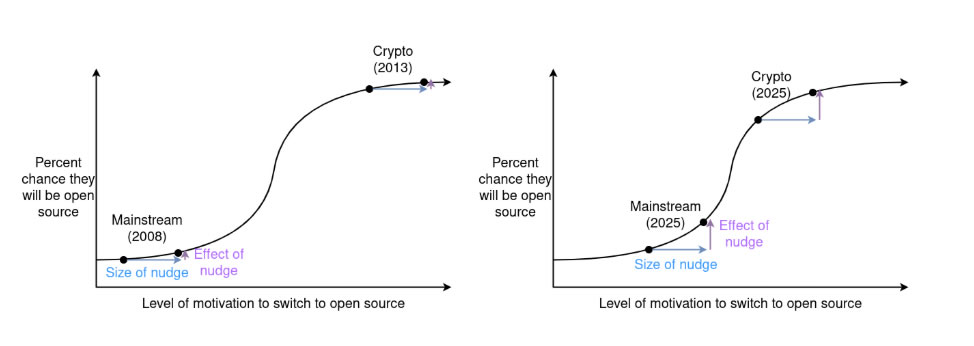
Today, both mainstream enterprise and crypto are in that situation, which makes the value of incentivizing open source via copyleft high. Source: Vitalik Buterin
Crypto venture capitalist Adam Cochran concurred, writing, “There’s some practical edge cases where copyleft is problematic, but overall agree with the philosophy.”
Related: Dogecoin set for rebound? Ripple eyes US banking license: Hodler’s Digest


Subscribe to daily byte-sized crypto news from Cointelegraph
Cointelegraph is committed to independent, transparent journalism. This news article is produced in accordance with Cointelegraph’s Editorial Policy and aims to provide accurate and timely information. Readers are encouraged to verify information independently.
More on the subject