

Written by Nihatcan YanikCommissioned Content
Written by Nihatcan YanikCommissioned Content
A single report can no longer define a DeFi audit: Here’s why
CommissionedPublishedJun 19, 2026
With DeFi losses above $1.1 billion over the past year, security teams are looking toward multi-agent AI systems

Commissioned byCecuro
Decentralized finance (DeFi) has spent years treating security as a race against attackers. That race has always been uneven: attackers only need to find one flaw, while defenders have to make sure the whole system does not give them one.
AI is now adding speed to that imbalance. DefiLlama data shows more than $1.1 billion lost to DeFi exploits between June 2025 to June 2026, intensifying the debate over how automated code review and agentic tooling will affect smart contract security.
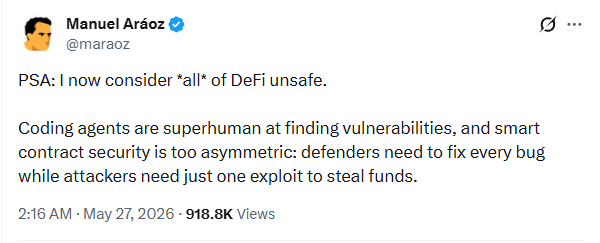
OpenZeppelin co-founder Manuel Aráoz has warned that coding agents are becoming superhuman at finding vulnerabilities. In that environment, the same tools that help developers audit contracts faster may also give attackers a faster way to scan for exploitable weaknesses.
https://x.com/maraoz/status/2059413451265441990?s=20
The recent Zcash case showed the other side of the AI security debate. A researcher used a frontier model to identify a critical four-year-old Orchard bug, which showed how AI can surface issues that remain hidden across earlier review cycles.
The trap of a clean security report
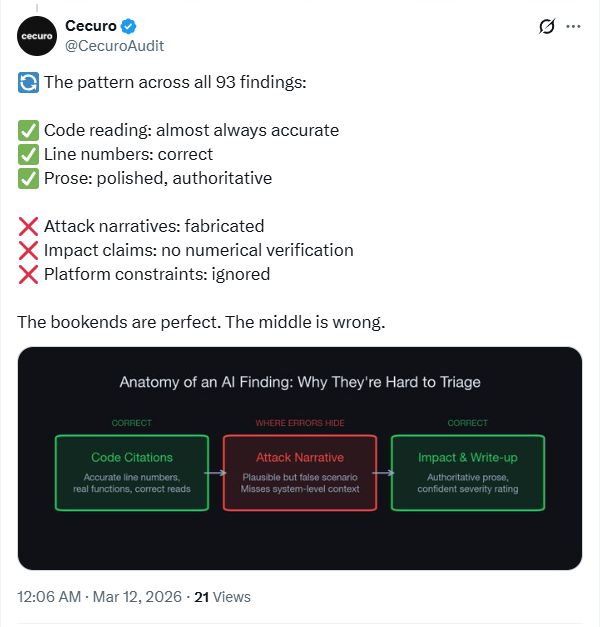
Security teams face a false-clearance problem. When a single AI audit returns no findings, the absence of alerts can be mistaken for evidence that the code has been cleared. In practice, a clean output only means the review did not surface a serious issue during that run.
On June 9, 2026, Anthropic launched Claude Fable 5 and Claude Mythos 5, and the company described Mythos 5 as having the strongest cybersecurity capabilities of any model in the world. The claim matters because Mythos is positioned for tasks that go beyond code review. It can discover and exploit software vulnerabilities.
Days after the vulnerability discovery, Zcash founder Zooko Wilcox said on June 13, 2026, that a Claude Mythos audit run at Shielded Labs’ request found no further serious bugs in the protocol.
Taken together, the two Zcash updates show how AI audits can support an iterative security process: a serious discovery can sharpen a protocol’s defenses, and a clean result can still function as one input in a wider security process.
Every review method has a defined field of view. Human auditors, frontier models and completed reports each apply a particular process to the code, which means security teams need overlapping methods to reduce the chance of blind spots surviving.
https://x.com/CecuroAudit/status/2031839294965629056?s=20
Using multi-agent AI to cross-check code
Cecuro, an agentic smart-contract auditing platform, is built around a different audit pattern. The platform is a model-agnostic proprietary agentic framework for smart contract security, with interchangeable models organized into a pipeline of specialized agents.
The system avoids reliance on a single model’s judgment. It distributes the review across agents that inspect contract behavior from different angles: economic invariants, authorization flows, state transitions and exploitability under edge-case conditions.
During a live audit of a major blockchain’s contracts, that structure produced a material result. The client had early access to Claude Mythos and ran the code through the model. Cecuro separately ran its proprietary agentic smart contract auditing engine against the same contracts.
Its system surfaced two high-severity vulnerabilities that Mythos missed. Both findings were reproduced independently, reported privately and withheld from public detail while remediation continued.
The comparison carries weight because Cecuro used an older-generation base model, which was less capable in raw terms than Mythos. Detection depth came from the method. Multiple agents checked one another, and the two findings were reproduced with executable proof-of-concept exploits before being reported to the client.
“A model or an auditor that returns nothing reads as a clean report, but it gives you no signal that a serious issue went unseen,” said Daniel Delouya, CEO at Cecuro.
“That is the trap. We treat detection as a problem of diversity. Multiple specialized agents cross-check one another, and we back our highest-severity findings with executable proof-of-concept exploits, because a finding that survives a proof-of-concept is one you can act on.”
Cecuro also pitches review economics as part of the security model. Each review is completed in hours, “at roughly 90% lower cost than traditional audits,” which makes repeated testing easier to fit into protocol development cycles.
Why detection is a problem of diversity
High-value code should face more than one detection method, regardless of which firm, model or internal team has already reviewed it. OpenZeppelin co-founder’s call for continuous AI-augmented security points in the same direction.
DeFi systems change as contracts upgrade, integrations multiply and assumptions drift. Attackers can run models again and again until one path breaks. Defenders need a security infrastructure that keeps pressure on the code from several directions at once.
Multi-agent execution frameworks give protocols a practical way to do that: model outputs compete, agents cross-check and proofs decide which findings deserve action. As AI raises the ceiling for vulnerability discovery, DeFi security will depend on audit systems that treat silence as a question, never as a verdict.


Subscribe to daily byte-sized crypto news from Cointelegraph
This content is part of a paid partnership. The text below is a commissioned article that is not part of Cointelegraph editorial content. The material is written by our advertorial team and has undergone editorial review to ensure clarity and relevance, it may not reflect the views and opinions of Cointelegraph.com. Readers are encouraged to conduct their own research before taking any actions related to the company. Disclosure.
More on the subject