
Written by Ayse KaramanCommissioned Content
Written by Ayse KaramanCommissioned Content
Bitcoin mining has an infrastructure problem — and it is not about energy
CommissionedPublishedMay 12, 2026
Bitcoin mining’s infrastructure has evolved, but its economics still depend on volatile BTC payouts. Stablecoin settlement can bring hashrate closer to commodity-style risk management.
Commissioned byNiceHash

Bitcoin mining once had a simple formula. Miners owned all the equipment, paid all the bills and invested physical capital to acquire Bitcoin. Such a formula inevitably results in the exclusion of smaller players due to the inherent mechanisms of the Bitcoin blockchain.
Bitcoin is mined by spending electricity and solving cryptographic puzzles. As the network matures and gets more crowded, the mining difficulty goes up and makes those puzzles harder to solve. This means miners have to spend more power to mine the same amount of BTC, and sends the electricity bills soaring.
Meanwhile, halving, the mechanism that keeps Bitcoin disinflationary, slashes block rewards in half every four years while the capital spent on mining stays the same at best. Post-halving environment effectively doubles the production cost of BTC and leaves the space in the hands of big, institutional players.
According to the latest data, the six largest mining pools control over 80% of Bitcoin block production. The figure points to a concentrated mining landscape, in an industry built around Bitcoin’s decentralized design.
The structural mismatch of mining economics
As margins tighten, hashrate itself has become something miners can access through software, not only through owned machines. Software solutions enable access to on-demand hashrate and allow miners to purchase computing power without having to own hardware.
The ability to mine with just a cryptocurrency wallet and an internet connection (and significantly lower capital requirements) has opened access to Bitcoin mining for individual players. The broader access can contribute to a healthier distribution of hashrate, decentralizing the space.
Yet, while the infrastructure evolves to keep up with the post-halving conditions, the economics of mining suffer from a structural mismatch that may put miners underwater.
The only revenue stream of Bitcoin miners is BTC, which is subject to constant price volatility. However, all expense items, including hardware, software and power, are denominated in fiat. This means a miner can remain profitable throughout the entire operation but still go into the red during settlement because the BTC price sank.
The problem is not unique to Bitcoin mining. But in commodity markets, like oil and copper, producers have access to well-established financial tools that allow them to manage risk more efficiently by separating operational decisions from price speculation, such as fiat settlement, structured payment terms and forward contracting. These tools are usually not available for Bitcoin miners.
The arrival of stablecoin-denominated marketplaces
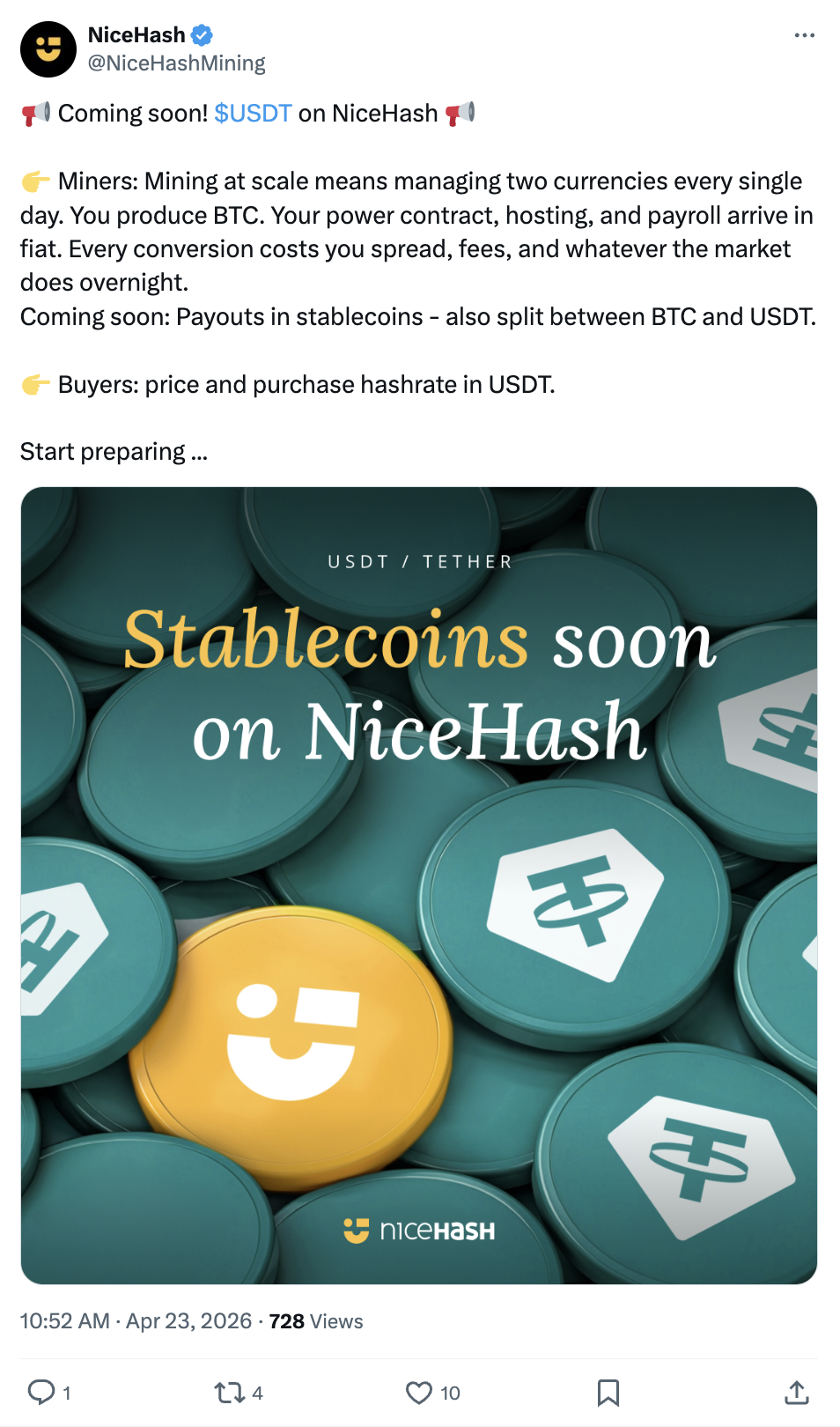
NiceHash, a hashrate marketplace, aims to iron out the mismatch by bringing stability to the space. The marketplace is introducing native USDT and USDC wallet infrastructure that will support direct exchange between these stablecoins and Bitcoin within the platform.
The wallet infrastructure will serve as a foundation for the USDT-denominated hashrate marketplace NiceHash is building separately. This marketplace will operate independently from its BTC order book and have its own dynamics and participant base.
The objective of this new initiative is to provide miners with a way to earn USDT directly, rather than converting to it as a later step. NiceHash aims to establish a market where hashrate can be priced, bought and settled in a dollar-linked asset from the start.
Source: NiceHash
Such a marketplace can help align revenue and expenses for miners by changing the settlement logic. Profitability depends on the timing of the settlement when revenue comes in BTC while bills are paid in fiat. Direct USDT settlements reduce this mismatch and give miners a steadier unit of account at the payout stage. This can make it easier to cover electricity, hosting and other recurring costs without having to convert BTC under unfavorable market conditions.
A USDT-denominated hashrate marketplace matters for buyers as well. Many institutional participants do not approach hashrate procurement as a bet on Bitcoin’s next price move. They need to allocate budgets, measure performance and report costs in USD-equivalent terms. A USDT-denominated order book gives them a cleaner environment to do that.
NiceHash’s EasyMining product is built around the same access problem. Miners can purchase hashrate on demand through this product, without buying any hardware. Around 52,500 Bitcoin blocks had been mined in 2025 in total, and 17 of them were mined through EasyMining. Solo mining remains a low-probability outcome by design, and the 17 blocks demonstrate the model's viability.

Source: NiceHash
Turning hashrate into a manageable financial asset
Bitcoin mining is no longer defined by a single model. Large-scale operations shape much of the physical infrastructure, while software-based access gives smaller participants a way to engage with mining economics without owning machines. These two sides are not necessarily in conflict. Both point to the same need: a more mature market structure around hashrate.
Stablecoin-denominated settlement is one step in that direction. Platforms like NiceHash can move hashrate closer to the way other commodities are priced and managed. Energy determines where mining happens, but market structure and financial tools determine who can actually participate in it.


Subscribe to daily byte-sized crypto news from Cointelegraph
This content is part of a paid partnership. The text below is a commissioned article that is not part of Cointelegraph editorial content. The material is written by our advertorial team and has undergone editorial review to ensure clarity and relevance, it may not reflect the views and opinions of Cointelegraph.com. Readers are encouraged to conduct their own research before taking any actions related to the company. Disclosure.
More on the subject