

 Written by Dilip Kumar Patairyastaff writerEdited by Rahul Nambiampurathstaff editor
Can AI drain DeFi? Separating Claude Mythos hype from reality
MagazinePublishedJun 29, 2026
Claude Mythos has raised concerns about AI-driven attacks on DeFi protocols. However, the same AI tools are also available to security teams, not just attackers.

Claude Mythos and DeFi: Real threat or overblown fear?
When Anthropic introduced Claude Mythos-class models as its most advanced AI system for cybersecurity, it drew the usual mix of reactions from crypto communities. The lineup included Claude Fable 5, a Mythos-class model intended for broad use, although access was later suspended after a US government directive.
The concern around decentralized finance (DeFi) was easy to understand. If AI systems can find software flaws faster and with less human input, attackers may also use them to spot weak points in protocols before security teams can fix them.
Those concerns may seem overstated, but they come from a real shift in technology. AI tools have become better at reviewing code, spotting flaws and supporting security teams. At the same time, DeFi remains a major target for attackers because its code is often public, its protocols hold large amounts of money and many systems are new or not fully battle-tested.
The key question is whether Claude Mythos and similar tools pose a serious threat to DeFi, or whether the industry is overstating what today’s AI can actually do.
The answer sits somewhere between the hype and the alarm.
What is Claude Mythos?
Claude Mythos is Anthropic’s most advanced AI system for cybersecurity. Unlike general-purpose AI assistants that can write code or explain technical concepts, Mythos is designed to handle complex security tasks.
Anthropic initially limited access to the model instead of releasing it widely. According to the company, Mythos showed clear improvements in vulnerability research, exploit analysis and layered cybersecurity reasoning compared with earlier versions.
That capability drew attention quickly because vulnerability detection is valuable in both cybersecurity and crypto.
A security expert might spend weeks reviewing code for small flaws. If AI can shorten that timeline to hours, or even less, it could change the balance in defensive security.
That possibility explains much of the unease in crypto circles.
Why Claude Mythos matters to DeFi
DeFi has lost billions of dollars to hacks, exploits and protocol failures in recent years. The concern is not new.
Flash-loan attacks, cross-chain bridge exploits, governance attacks and smart contract bugs have shown that even audited protocols can still have gaps.
Unlike traditional software systems, DeFi protocols often control large amounts of money through smart contracts. A vulnerability may not just expose information. It could allow attackers to move funds quickly and without permission.
That makes DeFi especially attractive to malicious actors.
The open-source nature of many blockchain projects adds another risk. Their code is available for security teams to review, but it is also available to attackers.
In the past, finding advanced vulnerabilities required deep technical skill. Security researchers needed strong knowledge of coding languages, blockchain architecture, cryptography and attack methods.
AI changes that.
Instead of manually reviewing large codebases, analysts can now use AI assistants to flag suspicious patterns, summarize complex systems and point out possible attack paths.
This is where concerns around Claude Mythos begin.
Did you know? In some controlled security competitions, AI systems have identified software vulnerabilities in minutes that would normally take human researchers several hours, or even days, to find.
Can AI really find vulnerabilities in DeFi protocols?
The short answer is yes. AI systems have already shown that they can find certain types of software vulnerabilities.
Studies from Anthropic and other research groups show that advanced models can review code repositories, test security assumptions and sometimes find issues that human analysts miss.
Smart contracts are well suited to this kind of analysis because they are often public and written in structured languages such as Solidity.
An AI system can quickly review thousands of contracts, spot repeated patterns and look for known types of vulnerabilities.
Areas where AI is likely to provide growing support include:
- Reviewing audit reports
- Identifying unsafe coding practices
- Comparing protocol upgrades
- Detecting permission errors
- Modeling possible exploit paths
- Analyzing interactions between smart contracts
AI is becoming a force multiplier for security researchers. A task that once required a full team of experts could increasingly be handled by a smaller group of security professionals using advanced AI tools.
That is a meaningful change, not just marketing hype.
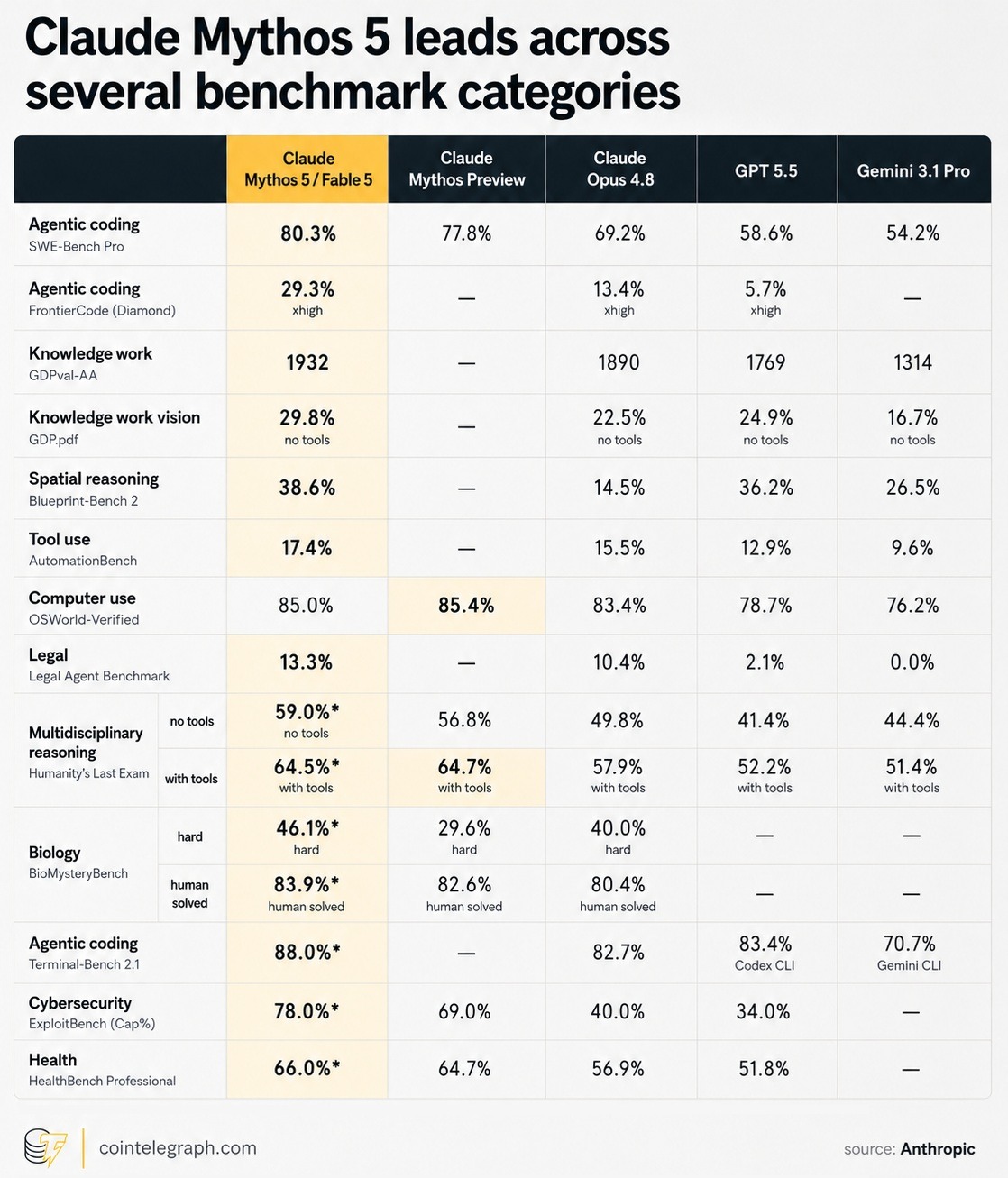
The table below shows how Claude Mythos compares with other models:
Why AI threats to DeFi may be exaggerated
Even with these advances, there is a clear difference between finding a vulnerability and stealing funds. Many crypto attacks involve much more than spotting a flaw.
Attackers often need to:
- Understand complex protocol mechanics
- Bring in significant capital
- Coordinate multiple transactions
- Exploit market conditions
- Manipulate liquidity
- Navigate governance systems
- Avoid detection
Even when a vulnerability exists, turning it into a successful attack often requires detailed planning and careful execution.
The real-world environment is far more complex than isolated coding tests.
Current AI systems also have limits. They can reach wrong conclusions, miss key details or follow weak lines of analysis. Security experts often find that AI tools produce useful insights alongside many false alarms.
An AI tool might flag 10 possible vulnerabilities, but only one may turn out to be valid. That matters because skilled human oversight is still essential.
Claude Mythos could speed up vulnerability detection, but it does not remove the need for experienced security experts.
Did you know? Many DeFi protocols publish their code online. This gives both security teams and AI tools more real-world financial software to review than in traditional banking systems.
The defensive side of AI in DeFi
A major flaw in the claim that AI will weaken DeFi is the idea that only attackers will benefit from these tools. Security teams have access to them too.
Security firms are already adding AI to their review processes. Developers are using AI-assisted code checks more often. Bug hunters can also use AI to spot issues before attackers find them.
Over time, AI may become a normal part of protocol security.
That could mean:
- Every code update goes through AI-assisted review
- AI agents continuously monitor deployed contracts
- Automated systems look for unusual on-chain activity
- Possible vulnerabilities are flagged before deployment
In that case, AI could strengthen DeFi security instead of weakening it.
The technology is neutral on its own. Its impact depends on how well attackers and defenders use it.
When AI attacks meet AI defenses
A more realistic outlook points to a future where AI systems challenge each other directly. This would make security faster on both sides.
Attackers will use more advanced models to find vulnerabilities and plan attacks. Security teams will use similar tools to monitor threats, improve code quality and respond faster.
This already happens in traditional cybersecurity, where offensive and defensive tools improve side by side.
DeFi could become the next major battleground for this contest. The likely result is not a sudden collapse of the sector. Instead, DeFi may enter a period of faster security upgrades and adaptation.
Projects that are slow to find vulnerabilities and update their code could face greater risk. Those that adopt AI-supported safeguards may become stronger than before.
Did you know? Several major crypto losses have come from compromised private keys, social engineering attacks or governance manipulation rather than flaws in smart contract code itself.
Assessing protocol vulnerabilities
Risk is not spread evenly across DeFi. Smaller projects with limited security resources often face the highest exposure.
Several categories are especially vulnerable:
- Fast deployment schedules: Projects that prioritize quick launches over careful testing may leave structural flaws in place.
- Copied codebases: Many protocols reuse or slightly modify existing code. Advanced AI tools can compare these systems quickly and expose inherited flaws.
- Weak audit coverage: Projects with little or no third-party review are less prepared for advanced attacks.
- Legacy smart contracts: Older contract designs may rely on assumptions that no longer hold up against modern exploit methods.
Automated analysis tools could sharply reduce the time needed to find these weaknesses.
What DeFi builders should do now
Claude Mythos offers an important lesson for the industry. DeFi builders should assume that attackers may already be using automated research tools. Security strategies need to improve accordingly.
Core priorities should include:
- Expanding automated security testing
- Running continuous, real-time audits
- Adding AI-assisted code analysis to development pipelines
- Increasing bug bounty rewards
- Using formal verification for critical code
- Improving threat monitoring and real-time incident response
Engineering teams must reduce the time between finding a vulnerability and deploying a fix. In an AI-accelerated environment, response time becomes just as important as prevention.
A major shift, not DeFi’s breaking point
Claude Mythos has shown that automated systems can handle complex security tasks that once required specialized experts. That marks a major shift for DeFi, where a code flaw can lead to the immediate loss of user funds.
Still, predictions of total systemic failure ignore several practical realities. Finding a vulnerability does not guarantee a successful exploit. Current AI tools still produce uneven results, human oversight remains essential and defensive teams have access to the same technology.
The more likely outcome is a change in security standards, not a collapse of DeFi. Automated tools could reduce the time and cost needed to find vulnerabilities. That will put more pressure on development teams to improve code quality, respond faster and build stronger security systems.
Ultimately, these developments are a warning, not a guaranteed outcome. The future of decentralized infrastructure will not be decided only by what AI can find. It will also depend on whether attackers or defenders use the technology more effectively.


Subscribe to daily byte-sized crypto news from Cointelegraph
Cointelegraph publishes long-form journalism, analysis and narrative reporting produced by Cointelegraph’s in-house editorial team with subject-matter expertise. All articles are edited and reviewed by Cointelegraph editors in line with our editorial standards. Some articles contain affiliate links, from which Cointelegraph may earn a commission. These relationships do not influence which products we review or our editorial conclusions. Content published in here does not constitute financial, legal or investment advice. Readers should conduct their own research and consult qualified professionals where appropriate. Cointelegraph maintains full editorial independence.
More on the subject