


 Written by Dilip Kumar Patairyastaff writerEdited by Rahul Nambiampurathstaff editor
How a fake crypto exchange reportedly attracted $150M before collapsing
MagazinePublishedMay 17, 2026
The reported DSJ Exchange collapse shows how referral networks, fake legitimacy and high-return promises allegedly helped a crypto investment scheme grow.

Why did investors keep investing despite official warnings?
The collapse of DSJ Exchange (DSJEX) has become one of the most discussed crypto fraud cases of 2026. According to investigations by regulators, law enforcement agencies and on-chain analysts, the platform allegedly drew over $150 million from participants before collapsing between late April and early May.
What makes the case especially concerning is that authorities in several countries had already issued public warnings about the operation. Despite those red flags, new investments continued to flow in.
This highlights a persistent challenge in crypto: Polished interfaces, active community support and attractive return promises can sometimes overshadow regulatory warnings and basic due diligence.
It also shows how fraud tactics have become more sophisticated. Modern schemes rarely look like clumsy phishing attempts or amateur fake websites. Instead, they often imitate real trading platforms, investment groups and professional communities, which can mislead even experienced participants.
Tracing the funds after the collapse
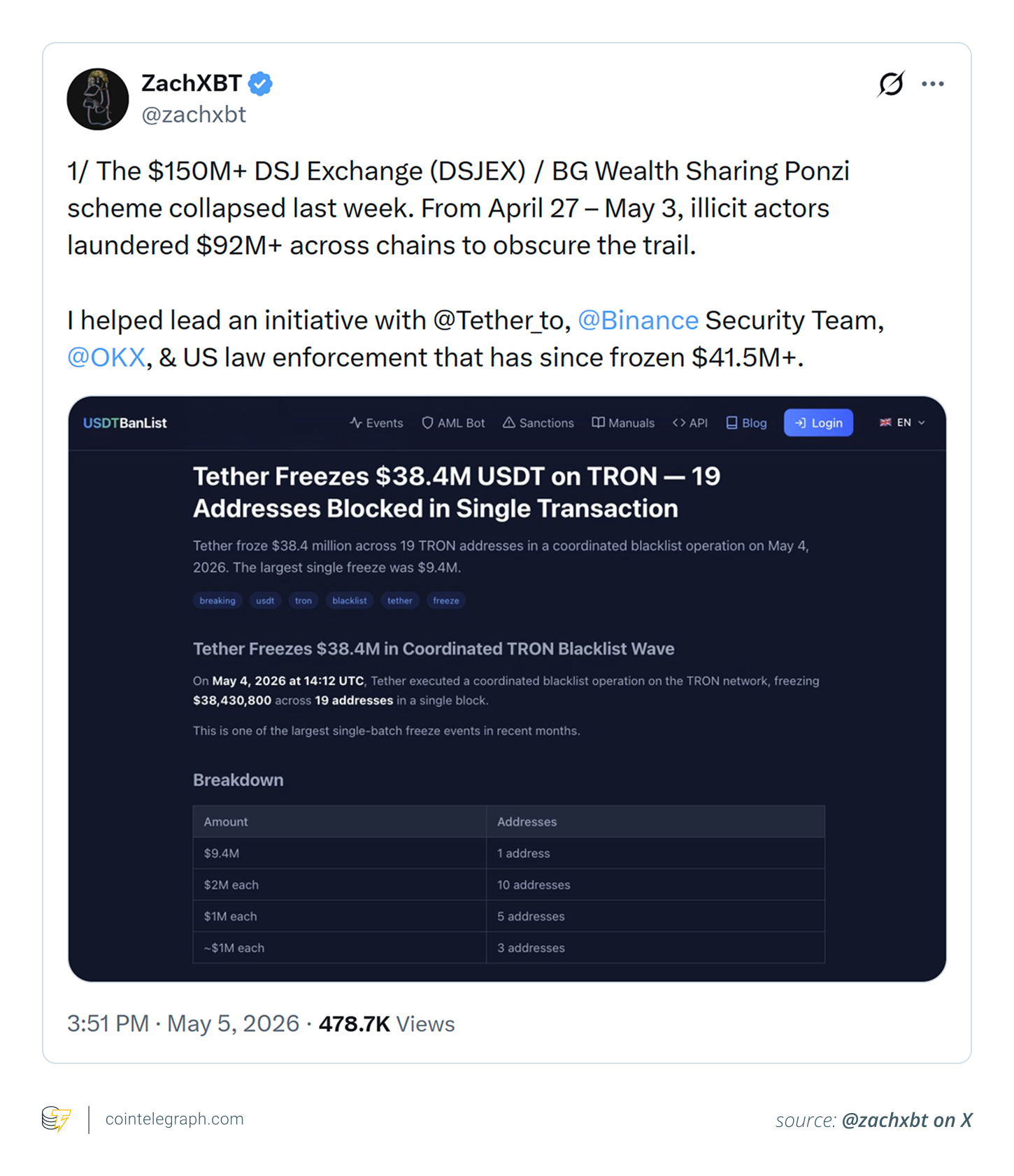
Blockchain analysts, including on-chain investigator ZachXBT, reportedly played a key role in mapping some of the alleged fund movements after the collapse.
More than $92 million was reportedly moved across different blockchains between April 27 and May 3, 2026. In some cases, exchanges, stablecoin issuers and law enforcement agencies worked together to freeze portions of the assets.
The situation shows both the advantages and limits of blockchain’s open nature. Public ledgers allow detailed transaction tracking that would be much harder in traditional finance. However, advanced mixing techniques, rapid cross-chain transfers and jurisdictional challenges can still make full recovery difficult.
It is worth noting that frozen assets do not guarantee quick returns to victims. Legal proceedings, identity checks and international cooperation often mean any restitution process can stretch over many months or even years.
Did you know? Many fake crypto exchanges intentionally allow small withdrawals at first because successful payouts can make users more confident and more likely to invite friends. This creates organic promotion without traditional advertising.
What DSJ Exchange claimed it was
DSJ Exchange presented itself as a crypto trading platform with investment-related features. It was reportedly connected to a larger entity known as BG Wealth Sharing, which marketed various investment programs centered on crypto trading within the DSJ environment.
Public warnings and investigative findings indicated that users were invited to deposit money with expectations of steady daily earnings. Regulators later suggested that the setup showed typical signs of a Ponzi arrangement, where payouts to early participants relied heavily on fresh capital from later participants rather than genuine trading profits.
On the surface, the platform appeared credible. Users reportedly accessed polished dashboards, visible account balances, interactive trading screens and performance metrics that resembled those of established exchanges. This professional presentation played a significant role in building confidence.
How high-return promises kept drawing people in
A major draw was the promise of unusually high daily returns. Users were reportedly offered returns ranging from 1.3% to 2.6% per day through supposedly automated or expert-managed trading strategies.
In conventional investing, such figures would immediately raise concerns. In crypto, where sharp price swings are common and stories of quick wealth circulate widely, these kinds of projections can appear more credible than they deserve, especially when market sentiment is positive.
Scams often package themselves with terms like “proprietary trading algorithms,” “AI-powered tools” or “expert market insights.” This technical-sounding pitch can discourage close scrutiny while seeming reasonable during periods of market hype.
Authorities also noted that early users were sometimes allowed to cash out small sums successfully. This is a classic strategy in suspected Ponzi schemes: Limited early withdrawals create visible “proof” of legitimacy, encouraging participants to invest more and recruit others through word of mouth.
These initial payouts often serve as promotional tools rather than signs of a sustainable operation.
Did you know? Public blockchain networks can help investigators trace stolen funds across wallets, but recovering assets can still be difficult because crypto can move globally within minutes across multiple chains and exchanges.
How community networks and referrals built credibility
Accounts of the DSJ situation indicate that the platform gained traction largely through chat groups, referral programs and grassroots community efforts.
This method can be highly effective because people often place more trust in suggestions from friends, family or respected local voices than in formal warnings from distant regulators.
Incentives for bringing in new users reportedly encouraged participants to actively promote the service. Over time, this turned regular investors into vocal supporters, often without them fully understanding the underlying mechanics of the operation.
The psychological impact can be significant. Seeing acquaintances or peers apparently making money can reduce doubt and create a sense of urgency to join, especially when broader crypto markets are attracting buzz and media attention.
This momentum helps explain why some operations continue to grow even after official warnings appear. Many people dismiss alerts as false information, rival sabotage or unnecessary interference with new crypto projects.
Creating an appearance of legitimacy
A striking element in the DSJ and BG Wealth Sharing case was the strategic use of official-sounding language and references to regulatory processes.
Investor notices suggest that the platform positioned itself with claims of compliance and oversight, giving users a false sense of security by implying formal approval or supervision.
This tactic highlights a common challenge in crypto fraud: Many participants struggle to distinguish between basic company registration, simple filings, licensing requirements and genuine regulatory supervision for investment services.
Scammers often capitalize on this by highlighting paperwork or vague legal references while omitting the lack of actual operating licenses. To newcomers, even basic documentation can feel reassuring and professional.
Genuine regulation, on the other hand, typically involves transparent licensing, ongoing compliance rules and records that can be easily verified on official government portals.
Did you know? Some crypto scams use real regulatory filing numbers or business registrations to appear legitimate. However, filing paperwork does not automatically mean a platform is licensed to offer investment services.
Warnings were issued, but activity continued
One of the most notable details in the DSJ case is the series of public warnings that appeared well before the eventual collapse.
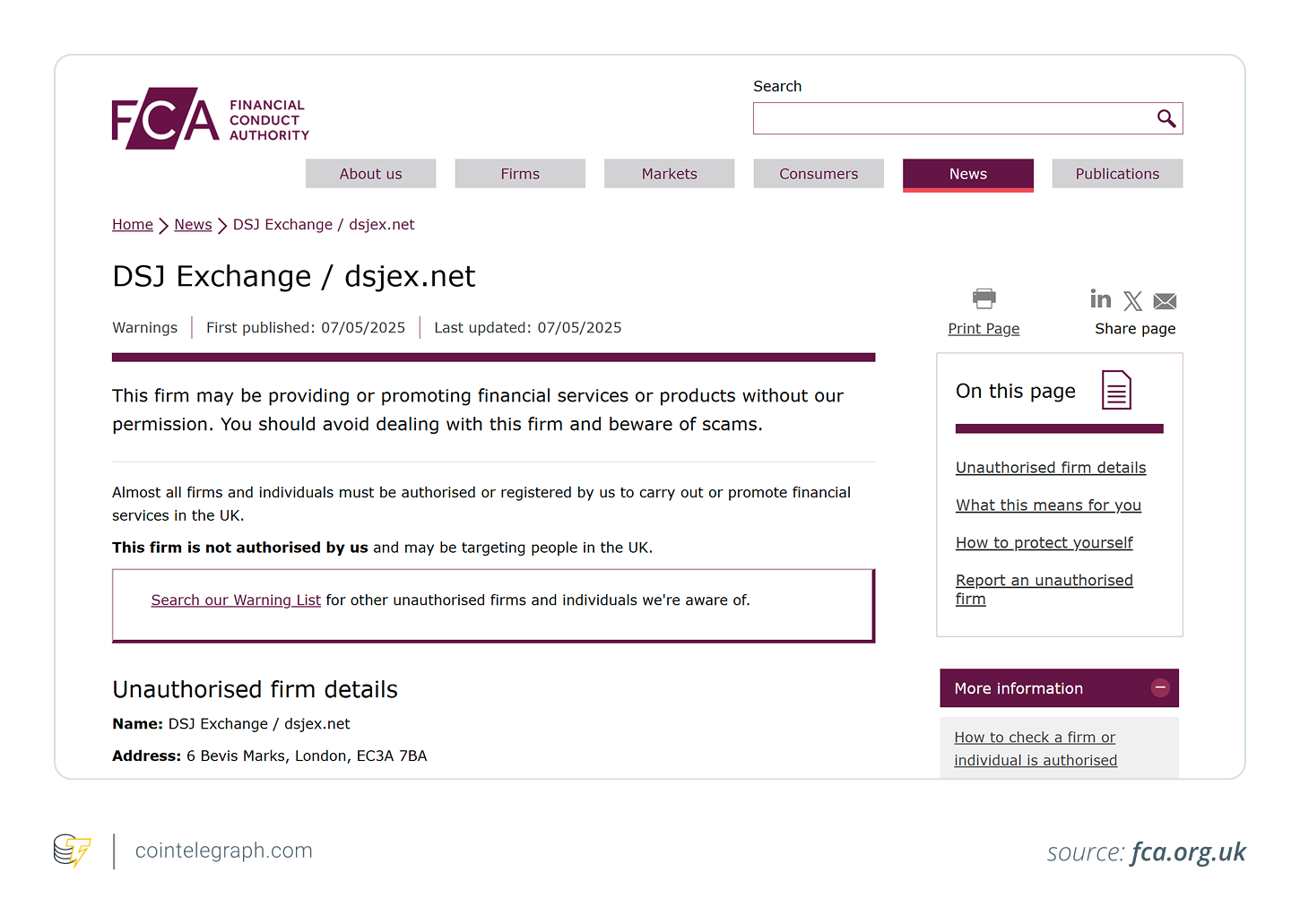
Starting in May 2025, the UK’s Financial Conduct Authority reportedly flagged the platform for potentially offering unauthorized financial services. In the months that followed, similar alerts came from authorities in Canada, the US and other regions.
By early 2026, multiple sources indicated that around 13 regulators across five continents had raised concerns about DSJ or its affiliated entities, citing issues with marketing, operations and potential risks to investors.
Despite this, the platform reportedly remained active and continued accepting deposits. This situation raises a difficult question: Why don’t regulatory warnings always stop fraudulent crypto ventures?
Part of the reason stems from the borderless nature of many crypto projects. They can operate through offshore structures, shifting domains, rotating wallet addresses and a global user base. While regulators can publish alerts, fully dismantling such operations quickly is often complex and slow.
Moreover, everyday investors often overlook official warning lists entirely. Others may underestimate their importance or fail to recognize the seriousness of the risks being highlighted.
Why regulators and enforcement action often lag behind
Crypto fraud schemes frequently outpace traditional oversight mechanisms due to their speed and adaptability.
According to investigations, those behind DSJ allegedly shifted domains, wallet addresses and communication methods as pressure mounted. This agility can make it difficult for authorities to quickly intervene, freeze assets or halt ongoing activity.
Crypto transfers differ sharply from conventional banking. They can cross borders in minutes, moving through various wallets, bridges and platforms before investigators fully map the flow.
Even after public warnings are issued, regulators may lack the immediate legal tools or cross-border coordination needed to seize control of infrastructure or lock down funds on a global scale.
The episode highlights a key limit in today’s financial oversight: Simply issuing alerts rarely stops the flow of new investments. Success depends on whether people actually notice the warnings, understand their seriousness and act on them.
Did you know? Referral systems are common in both legitimate businesses and scams. This makes them psychologically powerful because people tend to trust opportunities introduced by friends, relatives or community members.
The collapse and pressure for extra “fees”
As often happens in suspected Ponzi arrangements, problems escalated when withdrawal requests began facing delays or outright failures.
In the period before the platform went dark, some users reportedly received demands for additional “taxes” or payments, around 12% in some cases. These were framed as requirements for regulatory compliance or upcoming initial public offering (IPO) processes before funds could be released.
This tactic is a classic warning sign in fraud cases. Reputable platforms do not ask clients to send more cryptocurrency just to unlock money they have already deposited. Scammers use these advance-fee requests to extract extra funds in the final phase, while also buying time to move remaining assets or manage user panic.
For many affected individuals, the sudden inability to withdraw marks the point where trust completely disappears.


Subscribe to daily byte-sized crypto news from Cointelegraph
Cointelegraph publishes long-form journalism, analysis and narrative reporting produced by Cointelegraph’s in-house editorial team with subject-matter expertise. All articles are edited and reviewed by Cointelegraph editors in line with our editorial standards. Some articles contain affiliate links, from which Cointelegraph may earn a commission. These relationships do not influence which products we review or our editorial conclusions. Content published in here does not constitute financial, legal or investment advice. Readers should conduct their own research and consult qualified professionals where appropriate. Cointelegraph maintains full editorial independence.