


 Written by Dilip Kumar Patairyastaff writerEdited by Rahul Nambiampurathstaff editor
How Irish police accessed a ‘lost’ Bitcoin wallet holding 500 BTC
MagazinePublishedMay 14, 2026
A deep dive into how Irish authorities accessed a long-lost Bitcoin wallet and why this does not mean Bitcoin’s cryptography was broken.

The recovery of Clifton Collins’ Bitcoin wallet
For years, the Bitcoin linked to Irish drug trafficker Clifton Collins was treated as a well-known example of what happens when access to a crypto wallet is lost. The common understanding was that the funds were effectively unreachable because the private keys could not be found.
That assumption changed in March 2026. Ireland’s Criminal Assets Bureau (CAB), working with Europol’s European Cybercrime Centre, announced that it had recovered and seized a wallet containing 500 BTC connected to Collins.
The development shifts the focus of the story. Rather than suggesting that Bitcoin’s cryptography was broken, the case points to a different question: How were investigators able to regain access to assets that had long been considered lost?
The case of the “lost” Bitcoin fortune
The story began in 2017 when Collins was arrested after Irish police found cannabis in his vehicle. Investigators later established that he had used proceeds from his drug activities to buy roughly 6,000 Bitcoin between 2011 and 2012.
To reduce the risk, Collins reportedly split his holdings across 12 different wallets, with each holding about 500 BTC. According to court records and contemporary media reports, he kept the access credentials on a sheet of paper hidden inside the aluminum cap of a fishing rod case stored at a rental property.
Following his arrest and subsequent imprisonment, the property was cleared out. The paper containing the wallet access details was never found.
At the time, the conclusion seemed straightforward. Without the keys, the Bitcoin was considered lost forever.
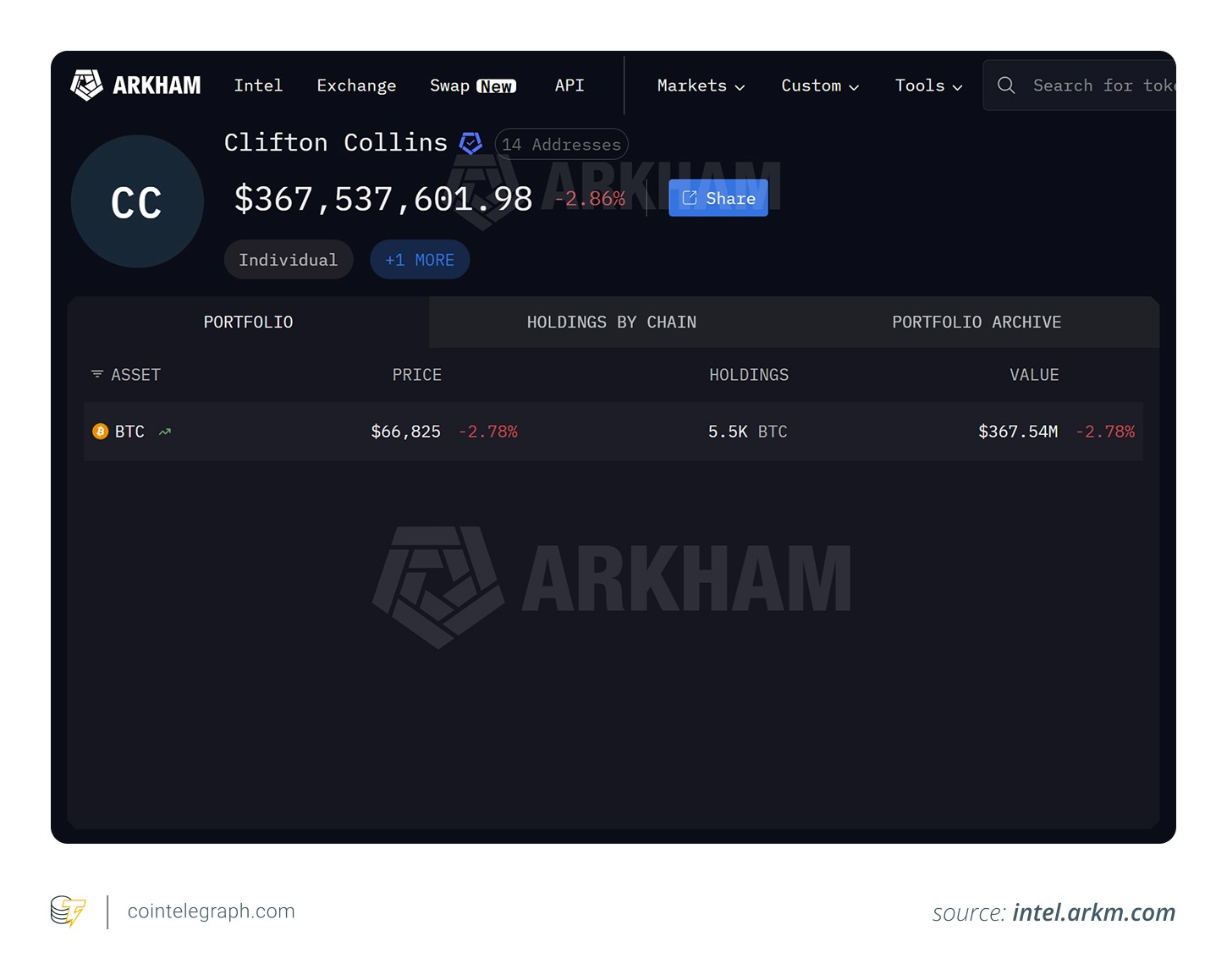
According to Arkham data, Collins controls 14 distinct addresses holding a combined 5,500 Bitcoin, with a market value of more than $377 million as of April 1, 2026.
Why “lost Bitcoin” is usually gone for good
Bitcoin’s security is based on public-key cryptography. Control over funds rests solely on possession of the matching private keys or seed phrases.
Unlike in traditional banking, there is no password recovery option, no central authority and no alternative recovery process.
If a private key is lost and no backup exists, regaining access to the funds is generally impossible.
That is why stories of lost Bitcoin wallets continue to appear throughout crypto history. Whether due to discarded hard drives or forgotten passwords, billions of dollars in Bitcoin are believed to be permanently out of reach.
In this context, the Collins case appeared to be another instance of irreversible loss.
Did you know? Early Bitcoin users often stored private keys on paper or in simple text files without encryption, as security awareness in the network’s early years was lower than it is today, when hardware wallets are more common.
What Irish authorities actually revealed
In its official statement, the CAB said it had “gained access to and seized a cryptocurrency wallet” holding 500 Bitcoin. In doing so, it seized cryptocurrency worth approximately €30 million.
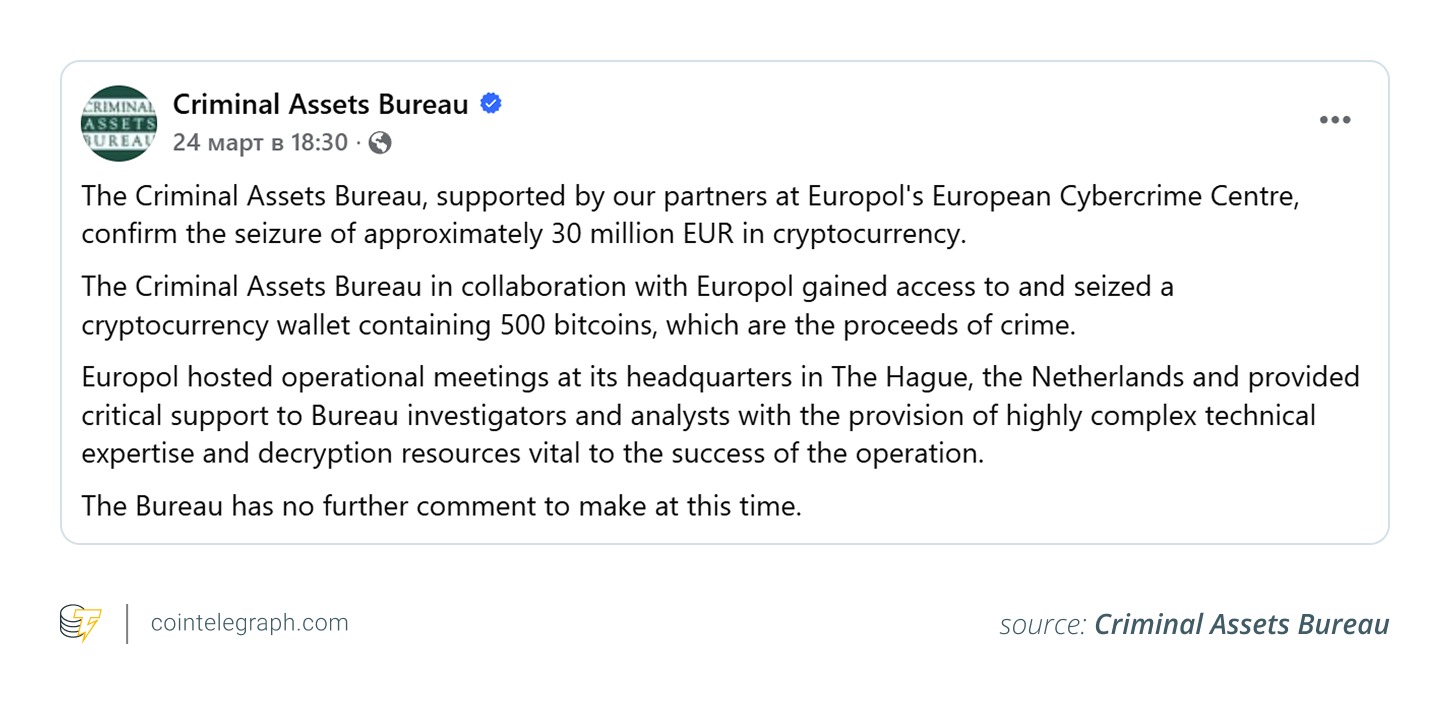
The operation was carried out with support from Europol, which contributed:
- Technical expertise
- Analytical support
- Access to advanced decryption resources
Europol also hosted operational meetings at its headquarters in The Hague.
Importantly, the statement does not explain how access was obtained. It makes no claim that Bitcoin’s cryptography was broken, nor does it mention any brute-force attack on the wallet.
That lack of detail is significant. It suggests that the word “cracked,” which appeared frequently in headlines, may oversimplify what was likely a more complex investigative effort.
The case returned to public attention when blockchain intelligence platforms detected activity from a wallet identified as “Clifton Collins: Lost Keys.”
After more than a decade of inactivity, 500 BTC was transferred to Coinbase Prime. The movement showed that someone had successfully gained access to the wallet.
The on-chain activity shifted the story from a historical case to the outcome of an active investigation. It also showed that at least one of the wallets previously believed to be lost was, in fact, recoverable.
Did you know? Blockchain analysis tools can track Bitcoin movements even after years of inactivity, allowing investigators to flag dormant wallets as soon as funds are transferred after long periods.
What likely happened behind the scenes
Although authorities have not revealed the precise method used, several credible explanations fit both the available evidence and standard investigative procedures:
- Recovery of secondary records or backups: Collins may have made additional copies of his wallet credentials besides the lost paper. Even incomplete details, when combined with forensic analysis, can sometimes be reconstructed into usable access information.
- Digital forensic reconstruction: Europol’s reference to “decryption resources” points to the possible use of advanced forensic methods. Investigators may have recovered data from older devices, storage media or encrypted files linked to the case.
- Exploiting operational weaknesses: The point of access may not have involved Bitcoin itself, but rather the way the wallet was handled. Poor storage practices, duplicate records or overlooked evidence can create paths to recovery.
- Wallet structure and metadata: If the wallets originated from a single seed or shared framework, obtaining one element may have enabled access to specific addresses.
What these possibilities have in common is that none of them requires breaking Bitcoin’s core cryptography.
Why this does not mean Bitcoin was “broken”
It is essential to distinguish between appearance and fact. There is no publicly available evidence that Irish authorities bypassed Bitcoin’s cryptography or derived private keys directly from public addresses.
Instead, the case appears to illustrate a different point. In crypto security, the most vulnerable element is often not the cryptography itself, but the way people store and manage access.
Bitcoin’s security model remains unchanged. What this case highlights is that practical wallet security depends on a combination of:
- Key management practices
- Backup strategies
- Physical and digital storage methods
If any of these elements fail, recovery, while uncommon, may still be possible in some cases.
Did you know? Some Bitcoin wallets use hierarchical deterministic (HD) structures, in which a single seed phrase can generate thousands of addresses, meaning that recovering one seed could unlock multiple wallets.
Why one wallet matters more than it seems
The recovered wallet represents only a small portion of Collins’ original holdings. Reports indicate that the total may have reached as much as 6,000 BTC, spread across several wallets.
This raises an important question: Was the recovered wallet a standalone success, or just the first step toward unlocking a much larger pool of assets?
If investigators obtained a master seed or a broader set of credentials, other wallets could potentially be accessed as well.
However, if access depended on evidence unique to that specific wallet, the recovery may remain an isolated case.
So far, authorities have confirmed the seizure of only one wallet.
What this case reveals about crypto enforcement
The Collins case illustrates a broader shift in how law enforcement approaches cryptocurrency investigations.
In the early years, crypto enforcement focused mainly on tracing transactions and identifying individuals.
Today, those capabilities have expanded to include:
- Advanced blockchain analytics
- Cross-border coordination
- Digital forensic reconstruction
- Technical decryption support
Europol’s involvement highlights how important international cooperation has become in complex crypto cases.
It also shows that even assets that have remained inactive for years can still become the subject of an investigation when recovery appears possible.


Subscribe to daily byte-sized crypto news from Cointelegraph
Cointelegraph publishes long-form journalism, analysis and narrative reporting produced by Cointelegraph’s in-house editorial team with subject-matter expertise. All articles are edited and reviewed by Cointelegraph editors in line with our editorial standards. Some articles contain affiliate links, from which Cointelegraph may earn a commission. These relationships do not influence which products we review or our editorial conclusions. Content published in here does not constitute financial, legal or investment advice. Readers should conduct their own research and consult qualified professionals where appropriate. Cointelegraph maintains full editorial independence.
More on the subject