


 Written by Ciaran Lyonsstaff writerEdited by Andrew Fentonstaff editor
A quantum roadmap would push Bitcoin much higher: Charles Edwards
MagazinePublishedJul 24, 2026
A Bitcoin development roadmap that addresses quantum computing risks could see the price surge by “double digits” very quickly, according to Charles Edwards.

Bitcoin developers need to swallow their pride and outline a clear plan to harden the blockchain against quantum computing attacks, according to Capriole Investments founder Charles Edwards. He says the day they finally bite the bullet, the price will respond very quickly.
“If the Bitcoin core team says in two or three months: ‘this is our roadmap, we’re gonna solve it in the next two years, these are the rough steps we’ll take,’ that would be amazing news,” Edwards tells Cointelegraph on Trade Secrets.
“I think that would discount a lot of the risk pretty much overnight,” Edwards says.
The question of whether Bitcoin developers should modify the network to make its cryptography quantum-resistant has sparked heated debate within the Bitcoin community, with some arguing that major changes could conflict with Bitcoin’s core ethos. Others claim quantum computers are many years away, and a rushed cure could be worse than the disease.
Charles Edwards says a clear roadmap could push price up “very quickly”
Edwards often highlights the risk of quantum computing to Bitcoin to his 132,800 X followers. The fear is that, one day, powerful enough quantum computers could break the cryptography that protects the Bitcoin network and potentially compromise Bitcoin wallets.
The uncertainty has impacted investor sentiment, and some analysts say it has contributed to the downfall in Bitcoin’s price. The world’s largest asset manager, BlackRock recently pointed to quantum computing as a potential long-term risk in materials for spot Bitcoin ETF investors.
However, Edwards says if Bitcoin developers outline a clear roadmap to address the quantum threat, as some other chains have already done, it could send Bitcoin’s price higher “very quickly.”
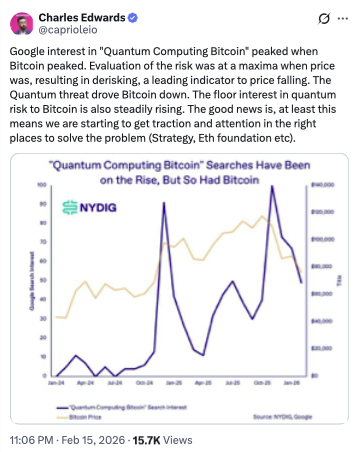
Source: Charles Edwards
“Double digits probably,” Edwards predicts. He adds the quantum issue is “somewhat counterintuitively an upside catalyst potential,” because it is currently on the back burner and the Bitcoin Improvement Proposals (BIPs) to date are “not really” a genuine solution.
Edwards is no stranger to making high-conviction calls on Bitcoin. Based in Melbourne, Australia, he founded Capriole Investments in 2019, a hedge fund focused on Bitcoin and digital assets. The firm uses a combination of quantitative models, AI, and macroeconomic analysis to guide its investment strategy across crypto markets.
Related: StarkWare CEO suggests 4% annual Bitcoin inflation to replace 21M cap
Charles Edwards says Bitcoin is 40% below its fair value
A growing number of observers worry the risk could become more serious if Bitcoin developers fail to make the necessary changes to the network before 2030. Ethereum is due to complete it’s post quantum overhaul by 2029, which will shine a spotlight on Bitcoin’s own preparations.
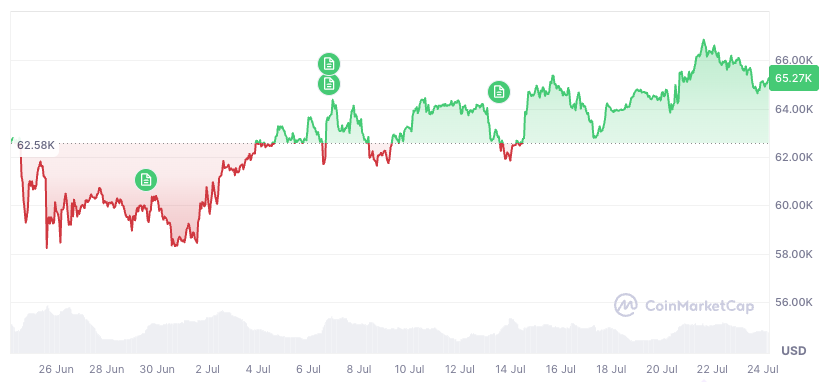
Bitcoin is trading at $65,270 at the time of publication. Source: CoinMarketCap
Edwards estimates that Bitcoin is currently around 40% below what he considers its fair value based on energy value, while arguing that quantum risk accounts for roughly a 30% discount. “That means it’s more than priced in,” Edwards said. Bitcoin is trading at $65,270 at the time of publication, roughly 49% below its October all-time highs of $126,100.
Edwards clarifies that Bitcoin’s current price reflects the quantum risk based on the information available today, rather than any unknown future developments that could accelerate the threat and tank the price further.
His estimate is based on the timelines outlined by leading quantum computing companies and researchers for when “Q Day” could arrive, the point at which quantum computers become powerful enough to reverse engineer private keys from public keys.
“That sits in that four to five year range, give or take, a few years,” Edwards says.
Edwards says he also factors in the time Bitcoin would need to develop and implement a solution, which BIP-360 author Ethan Heilman estimates could take years.
“If we’re gonna get into maths, it’s pretty simple; it is just an aggregation of those expert opinions. So it’s based on that, and based on the fact that there’s currently no solution for Bitcoin.”
“That risk again falls significantly if there’s a solution or if there’s a roadmap to a solution. But it also could grow if tomorrow we find out that Google is, you know, twice as far ahead on their roadmap to Q Day or some other major company,” he said.
“It’s priced in today, but it’s not to say that it can’t get worse or better. It’s just I think it’s skewed more probabilistically to the upside from here,” Edwards says.
Magazine: Bitcoin’s quantum dilemma: Bigger blocks or STARK proofs?


Subscribe to daily byte-sized crypto news from Cointelegraph
Cointelegraph publishes long-form journalism, analysis and narrative reporting produced by Cointelegraph’s in-house editorial team with subject-matter expertise. All articles are edited and reviewed by Cointelegraph editors in line with our editorial standards. Some articles contain affiliate links, from which Cointelegraph may earn a commission. These relationships do not influence which products we review or our editorial conclusions. Content published in here does not constitute financial, legal or investment advice. Readers should conduct their own research and consult qualified professionals where appropriate. Cointelegraph maintains full editorial independence.
More on the subject