


 Written by Nate Kostarstaff writerReviewed by Robert Lakinstaff editor
BIS warns stablecoins could weaken capital controls in emerging markets
Latest NewsPublishedJul 21, 2026
Researchers found dollar-backed stablecoins are less affected by capital controls than traditional bank deposits, raising new questions about monetary sovereignty in emerging markets.

Researchers at the Bank for International Settlements (BIS) found that dollar-backed stablecoins are creating a new form of “digital dollarization” that appears largely unaffected by capital controls, particularly in emerging markets.
The new study suggests governments may have less ability to curb stablecoin adoption than traditional foreign-currency bank deposits.
BIS researchers analyzed foreign-currency deposits and dollar-pegged stablecoin inflows across more than 130 economies, finding that both tend to increase during periods of macroeconomic stress. Unlike traditional bank deposits, however, stablecoin flows showed little response to capital controls or other FX restrictions. The authors said this likely occurs because “stablecoins are partly circulating outside the regulatory perimeter.”
Stablecoins could still undermine monetary sovereignty by allowing households and businesses to shift into dollars outside the banking system, particularly in emerging markets with weak currencies or limited access to reliable financial services, the study said.
Despite those risks, the researchers found little evidence that deposit dollarization weakens the transmission of monetary policy, though countries with higher foreign-currency deposits faced a somewhat greater risk of elevated inflation.
BIS said the findings suggest policymakers may need new tools to manage financial stability as stablecoins become more widely used, arguing that regulations designed for traditional banking and foreign-currency deposits may be less effective in a tokenized financial system.
Related: Japanese logistics company eyes JPYC stablecoin to pay drivers
Dollar-backed stablecoins expand in emerging economies
The findings come as use of stablecoins as a payment tool is growing in several emerging markets.
In its recent analysis of Nigeria, the International Monetary Fund (IMF) found households and small businesses are using US dollar-pegged stablecoins for cross-border payments, remittances and access to dollar-denominated assets as inflation, currency depreciation and limited access to foreign exchange drive demand.
The IMF said stablecoins have reduced the cost and time required to move money across borders while expanding access to financial services for users outside the traditional banking system. At the same time, it warned that widespread adoption of dollar-backed tokens could weaken monetary sovereignty by reducing demand for local currencies and shifting more financial activity outside conventional banking channels.
Stablecoin adoption has accelerated across Latin America as well. Bitso Business, the enterprise payments arm of crypto exchange Bitso, reported an 81% year-on-year increase in stablecoin payment volume during the first half of 2026. The company also said that Circle’s USDC (USDC) and Tether’s USDt (USDT) accounted for 40% of all crypto purchases in the region in 2025, surpassing Bitcoin for the first time.
Stablecoin market capitalization has increased to about $309.7 billion, up from roughly $260 billion a year ago.
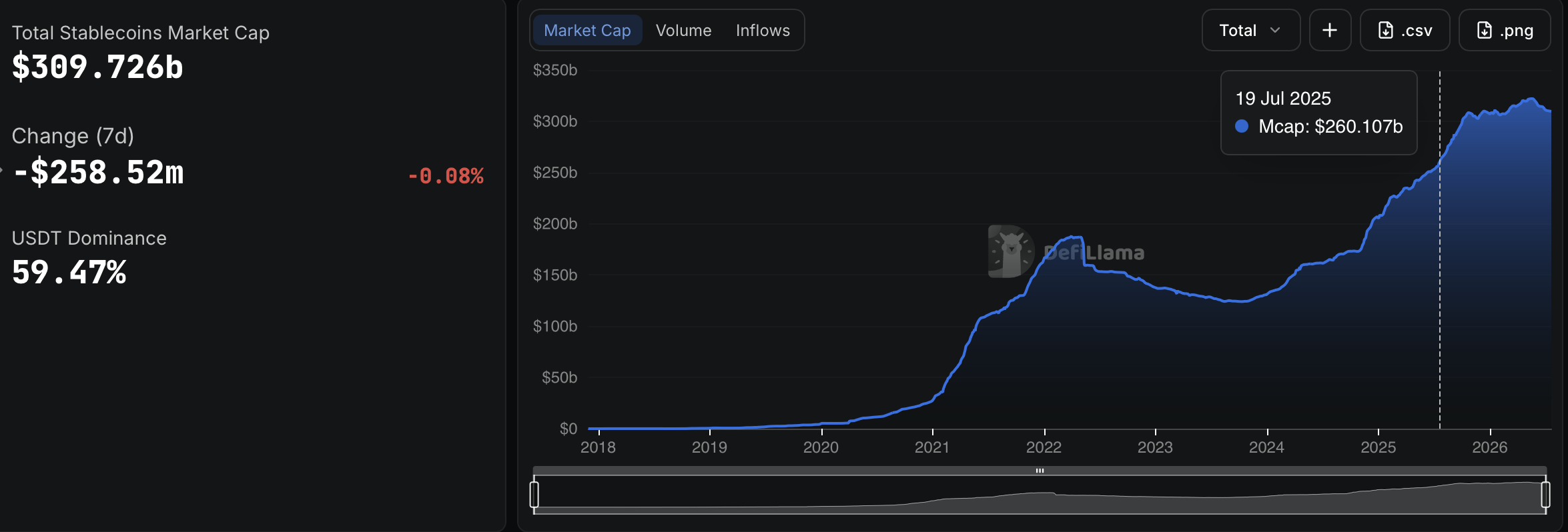
Stablecoin market cap. Source: DefiLlama
Magazine: Binance & OKX users face $1,900 fines in Vietnam, Coinbase in China? Asia Express


Subscribe to daily byte-sized crypto news from Cointelegraph
Cointelegraph is committed to independent, transparent journalism. This news article is produced in accordance with Cointelegraph’s Editorial Policy and aims to provide accurate and timely information. Readers are encouraged to verify information independently.
More on the subject