

Written by Ayse KaramanCommissioned Content
Written by Ayse KaramanCommissioned Content
How fake MEV bots turn crypto traders into their own victims
CommissionedPublishedDec 2, 2025
Social media “guides” promise to build a profit-generating MEV bot with a few lines of code, only to leave an unsuspecting user with a drained wallet.

Commissioned byWeb3 Antivirus

Web3 faces a new wave of scams that target ambition. Aspiring traders search for MEV or arbitrage strategies. MEV, or maximal extractable value, is the additional profit a trader can take from a block by controlling how transactions are ordered onchain. They encounter tutorials that promise automated profits, sometimes with code written by ChatGPT.
The reality hits them hard with malicious, self-executing smart contracts that steal money from their accounts and transfer it to hackers. Recent reports indicate that scammers managed to “earn” more than $900,000 in stolen crypto this way.
This scam belongs to a new class of educational fraud that presents a lesson in building a scalper bot while the real product is a trap. Victims deploy a contract that looks like a trading tool, fund it with ETH and then trigger the function that drains their account. The attacker never touches the wallet directly because the victim performs every technical step.
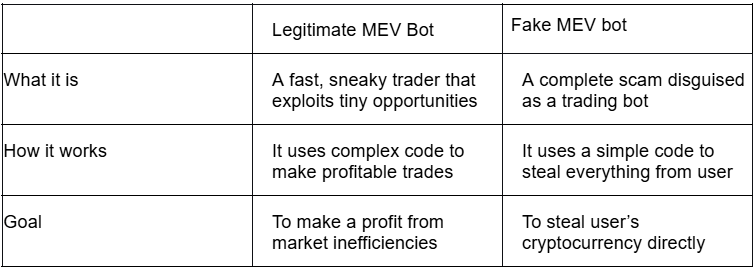
A brief comparison of legitimate and fake MEV bots. Source: Web3 Antivirus
The rise of tutorial-driven Web3 scams
Fake MEV tutorials spread across major social platforms where users already search for Web3 education. The production quality often matches legitimate trading or development content. Presenters talk on camera, switch to screenshare and walk through deployment in a familiar interface.

Social proof reinforces the illusion of authenticity. Comment sections fill with praise and accounts display avatars that resemble real bloggers plus follower counts that look established.
The hidden trap in MEV bot contracts
The real danger hides inside the smart contract template linked under the video. Each tutorial offers a slightly different file. Non-technical users see a complex but plausible Solidity contract published as open-source code and infer that the creator has already done the hard work. The code often appears in snippets shared through Pastebin or Google Docs, then moves into familiar tools such as Remix IDE and Etherscan for compilation, deployment and verification.
Buried in this code is a “garbage” string that encodes the attacker’s wallet and does not resemble a standard hexadecimal address. For example, a line like QG384C1A318cE21D85F34A8D2748311EA2F91c84f0 does not look like a normal hex address but still encodes one
Auxiliary functions reshape it into a 40-character sequence that represents a 20-byte Ethereum address. Functions with names such as “executeTrades” or “_stringReplace” copy the string, substitute characters and assemble that destination.
We’ve detected a new fake MEV bot scam.
Scammers post @YouTube guides telling users to deploy a ‘profitable bot’ and deposit $ETH. In this particular case, the victim first sent 1 $ETH, then saw fake profit activity staged by attackers (small $ETH inflows to the contract).… https://t.co/37khSJPH6J pic.twitter.com/Gobj240EyK— Web3 Antivirus (@web3_antivirus) October 3, 2025
The core purpose of the contract is not trading. Its logic reconstructs the hidden address and redirects any deposited ETH to that wallet, while obfuscation keeps this behavior away from casual inspection, and the visible parts of the code continue to mimic a legitimate MEV strategy.
How fake profit demonstrations seal the deal
After this initial hook — a professionally recorded video — the hacker explains what to do and guides the victim through every step. They walk through the process in real time and show how the balance on the contract appears to grow before a withdrawal.
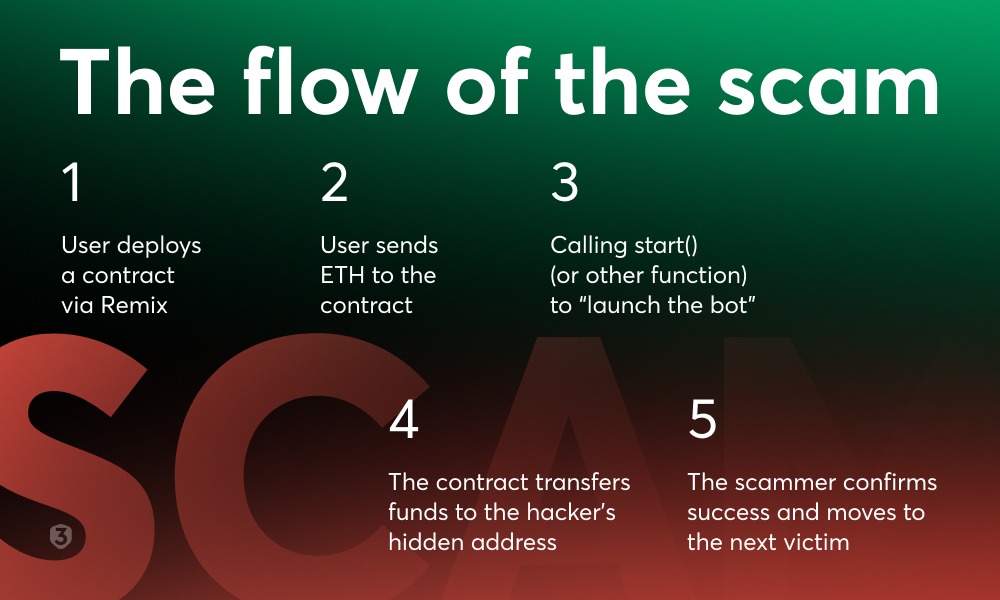
The demonstration scheme usually follows four steps:
- The victim deploys the malicious contract and funds it with ETH (for example, 1 ETH). They believe it is a profitable trading bot.
- The scammer sends a small amount of ETH (for example, 0.1 ETH) from a separate wallet to the contract address, creating a false sense of profit.
- The victim checks the contract balance and sees it grow from 1 ETH to 1.1 ETH. This apparent gain convinces them that the bot works and encourages a larger deposit.
- When the victim withdraws funds or calls a predefined function, the contract triggers a drain function that transfers the entire balance (the victim’s 1 ETH plus the 0.1 ETH bait) to the scammer’s wallet.
The trap closes when the victim interacts with contract functions. Labels such as Start, Stop and Withdraw resemble bot controls, but each version of the scam routes the drain through a different path. Some contracts move funds as soon as Start is called, while others trigger the drain only when Stop or Withdraw is used after a period of apparent profit. Attackers also monitor deployed contracts and call a separate function if funds sit idle on a contract that never reaches the final step.
Why traditional security tools miss it
Traditional security tooling struggles with fake MEV bots because the surface signals look benign. Victims deploy the contract code themselves, so transaction histories do not show malicious airdrops or classic phishing flows. The contract verifies correctly on Etherscan, Remix and MetaMask handle deployment and interaction as they would with any other decentralized application (DApp), so the entire flow looks like a standard open-source deployment.
Classic anti-phishing filters and transaction scanners focus on suspicious URLs or token approvals, while fake MEV bots shift the risk into internal contract logic. Only runtime detection and address intelligence may identify the hidden patterns inside such contracts before execution.
How Web3 Antivirus can help
Web3 Antivirus relies on behavioral analysis combined with code and address intelligence. Its detection process follows several stages:
- Monitoring: Web3 Antivirus tracks new contracts that appear on the network.
- Detecting suspicious contracts: It monitors the lifecycle of each contract and its creator. A key red flag appears when the creator funds a contract and then calls a function that drains the entire balance to a third-party address. When this pattern emerges, the system marks the contract and associated addresses as a potential scam and records the contract bytecode.
- Scam confirmation: If more than two similar drain events involve the same contract bytecode, Web3 Antivirus classifies the contract as a confirmed scam. The system tags the contract, its bytecode, affected victims and the address that received the funds.
- Updating the database: The platform adds confirmed scam bytecode to its database and checks every new contract creation against this library. When any contract drains funds, the system compares the destination address with known scam clusters. This process applies accumulated data to new transactions, contracts and addresses.
A browser extension delivers this intelligence at the point of use. The extension intercepts transactions, analyzes the target contract and checks its bytecode against the known patterns. It runs quietly in the background and raises warnings before high-risk interactions proceed, so most participants gain protection without requiring deep security expertise.
A user lost nearly 3 $ETH ($10,393) after following a fake MEV bot tutorial on YouTube.
The victim deployed a malicious contract:https://t.co/Fm7icQntrT
Then, the victim funded the contract and triggered the ‘start’ function, thinking it would generate profits. pic.twitter.com/GQfVX7apom— Web3 Antivirus (@web3_antivirus) July 24, 2025
The detection logic remains effective even when attackers modify surface details in the code because the system focuses on behavioral signatures and repeated drain flows. The database continues to expand as new scams emerge, and this continuous learning helps ordinary users avoid fresh variants that share a common structure with earlier attacks.
Toward predictive protection in Web3
Fake MEV bots clearly show the rapid adaptation of adversaries to new opportunities in Web3. Educational content has become one of the most potent attack vectors. The contract appears user-built, the tools look standard, and the visible actions involve ordinary deployment steps.
Reactive security falls short in this environment. Protection must anticipate what a contract is designed to do before large amounts of value move through it. Web3 Antivirus aims to close this gap through continuous monitoring, bytecode intelligence and real-time transaction analysis. As fake MEV bot schemes evolve, behavior-driven tools of this kind provide a critical layer of defense for everyday participants in crypto markets.


Subscribe to daily byte-sized crypto news from Cointelegraph
This content is part of a paid partnership. The text below is a commissioned article that is not part of Cointelegraph editorial content. The material is written by our advertorial team and has undergone editorial review to ensure clarity and relevance, it may not reflect the views and opinions of Cointelegraph.com. Readers are encouraged to conduct their own research before taking any actions related to the company. Disclosure.
More on the subject