
Written by Ayse KaramanCommissioned Content
Written by Ayse KaramanCommissioned Content
Licensing-to-earn protocol turns intellectual property rights into RWAs
CommissionedPublishedDec 5, 2025
A Web3 project enabling the tokenization of intellectual property rights took the first steps toward launch, with the first framework recently hitting the market.
Commissioned byBeatSwap
Disclaimer. This content is part of a paid partnership. The text below is a sponsored article that is not part of Cointelegraph.com editorial content. The material is written by our advertorial team and has undergone editorial review to ensure clarity and relevance, it may not reflect the views and opinions of Cointelegraph.com. Readers are encouraged to conduct their own research before taking any actions related to the company. Disclosure.

BeatSwap, a full-stack infrastructure that brings IP rights onchain, recently launched its first platform.
Royalties are how artists and creators live off their work. But what should flow like a steady stream often turns into a trickle by the time it reaches them.
Intellectual property (IP) makes its way to the audience through intermediaries in traditional markets. At each step, a cut is taken under long contracts with dense legal language that are difficult for creators to track or compare. By the time payments make their rounds, much of the value their work generated has already slipped elsewhere, buried in splits and figures the creator never sees in full.
Such a system has its downsides for consumers as well. Traditional royalty designs are a one-way street for fans; their support stops at the checkout, with no clear view of where their money flows or any share in the possible appreciation of the work they support.
Web3 platform BeatSwap presents a blockchain-based solution that removes the middleman from the process and puts both creators and the audience in the driver’s seat of the creator economy.
IP rights guarded onchain
BeatSwap is a full-stack Web3 infrastructure that allows creators to register and tokenize IP rights through its RWA-Launcher architecture. These real-world assets (RWA) enable owners to receive royalties from the tokenized work without any intermediary involved.
Unlike non-fungible tokens (NFTs), a widespread method for tokenizing IP, RWAs can be fractionalized. This means both the creator and the fans can have a stake in the IP and gain a right to its appreciation and revenue stream.
BeatSwap utilizes decentralized physical network (DePIN) infrastructures to track usage data and takes monthly snapshots to determine distributions. Constant onchain records allow all parties to gain a transparent view of how each work is used, how much revenue it generates and how royalty payments are shared.
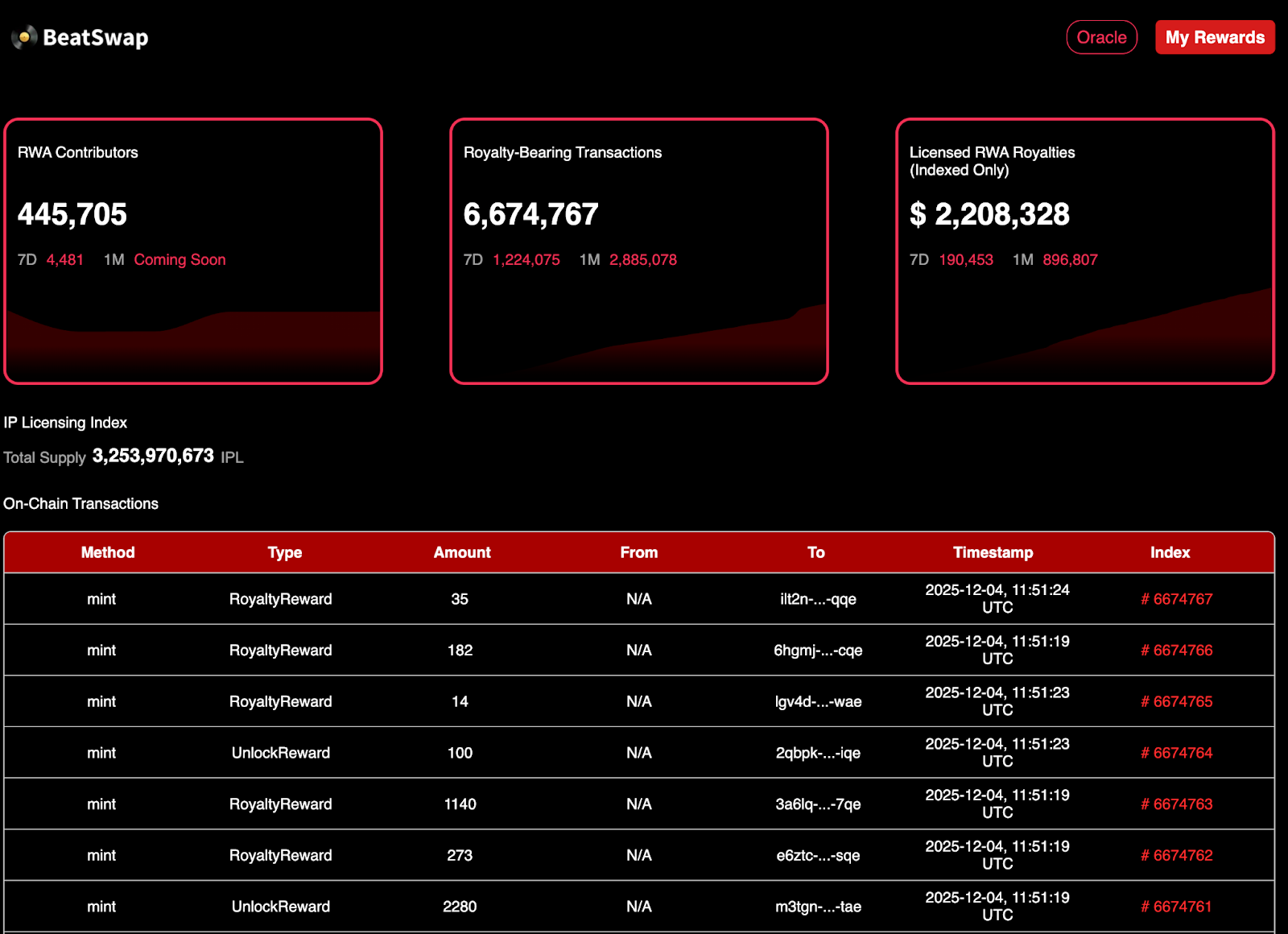
BeatSwap dashboard
Toward a decentralized creator economy
The architecture that integrates the ecosystem’s licensing system with the snapshot mechanism recently went live on opBNB, a layer-2 solution built on BNB Chain.
A notable development in the tokenized IP-Rights RWA ecosystem.
BeatSwap’s Licensing-to-Earn (L2E) architecture integrates onchain licensing verification with IPL (IP Licensing Index) minting, which is triggered when users engage with licensed tracks.
This framework connects… pic.twitter.com/potwELuy6Z— Cointelegraph (@Cointelegraph) November 26, 2025
This marks the first step toward BeatSwap becoming a fully decentralized marketplace for the creator economy. As Veni Cho, the founder of the project, puts it, “BeatSwap’s vision is to turn all IP rights, including music, into Web3-based real-world assets, creating a decentralized IP economy led by creators and fans.”
Upgrades expected in the coming months
Visibility is a major concern that pushes creators to work with intermediaries. BeatSwap develops a Web3-native solution to provide creators and artists with a place to showcase their work.
The upcoming solution, Space, is a social media platform where creators can launch personalized Spaces and display their licensed IPs. Users gain a place to market their work while also building their community. Space is set to launch in March 2026.
The final components of the ecosystem, the RWA Launcher and the BeatSwap DEX, will go live in June 2026. After this date, assets tokenized through the Launcher will be tradable on the decentralized exchange (DEX).
BeatSwap’s path centers on a practical shift: giving creators a clear view of how their work is used and what it earns, while giving fans a defined share of that value. With royalties recorded onchain instead of buried in opaque contracts, both sides can rely on the same set of numbers.
Over time, this clarity can shape how creators plan releases and choose partners, while making expectations around the timing and size of payouts more predictable for both sides.


Subscribe to daily byte-sized crypto news from Cointelegraph
This content is part of a paid partnership. The text below is a commissioned article that is not part of Cointelegraph editorial content. The material is written by our advertorial team and has undergone editorial review to ensure clarity and relevance, it may not reflect the views and opinions of Cointelegraph.com. Readers are encouraged to conduct their own research before taking any actions related to the company. Disclosure.
More on the subject