

Written by Kyrian AlexCommissioned Content
Written by Kyrian AlexCommissioned Content
Not Your Keys, Not Your Coins: What True Self-Custody Actually Requires
Commissioned researchPublishedMar 12, 2026
New research examines how investor behavior, wallet architectures, and operational security practices determine what genuine self-custody requires in 2026.

Commissioned byTrezor
The foundational promise of cryptocurrency is decentralized, sovereign ownership. But this promise has run into a far more sobering reality, as a lot of funds held on centralized exchanges have been lost over the years. Users have learned the same lesson in different forms: Not your keys, not your coins.
Cointelegraph Research’s latest report, produced in collaboration with Trezor, the original hardware wallet, and titled “The Future of Self-Custody: Turning Ownership Into Security,” examines how this realization has reshaped investor behavior. Drawing on survey responses, post-mortem analyses of exchange failures, and a breakdown of modern wallet architectures, the report explains why self-custody should be a defining topic for crypto security in 2026.
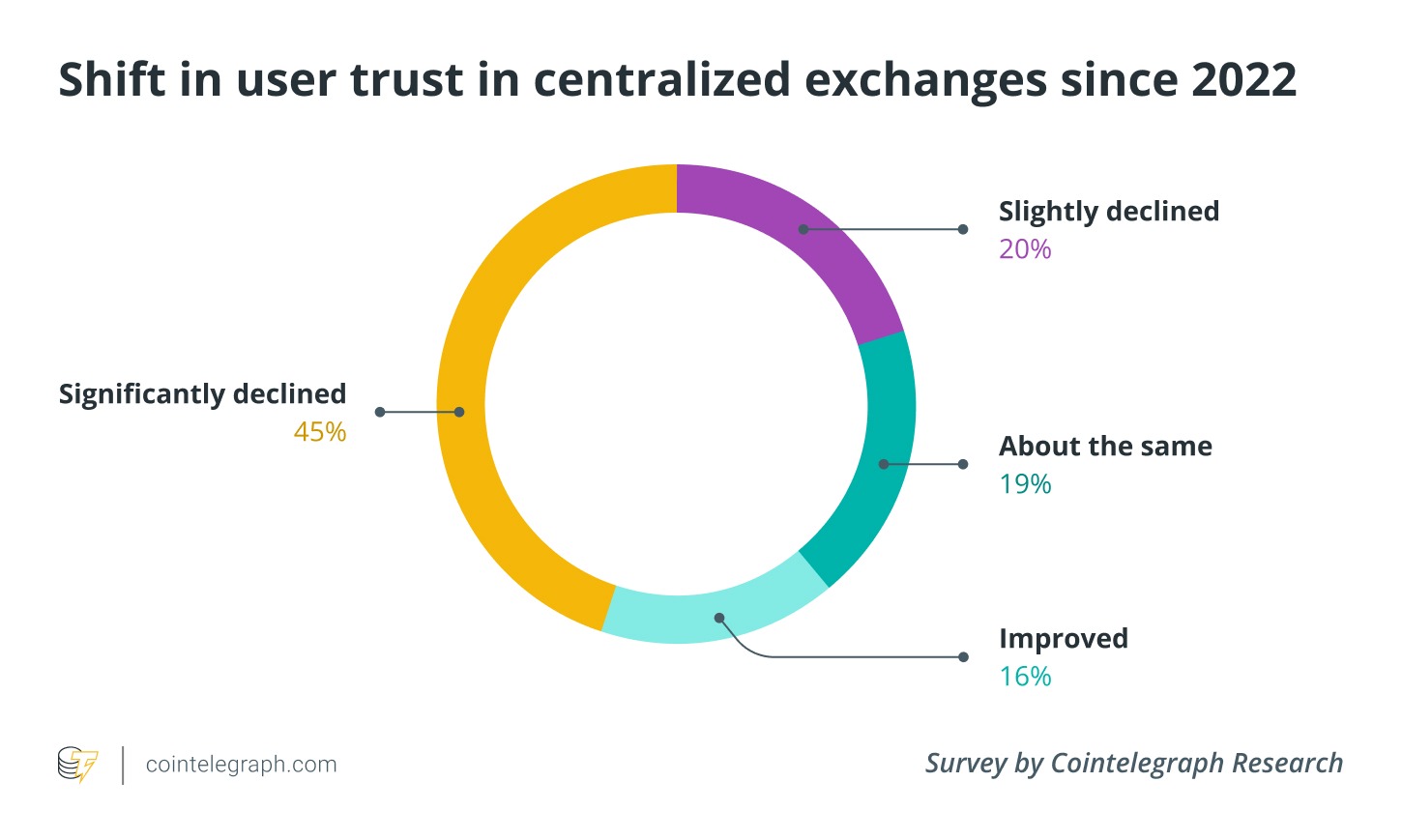
Survey data shows a decisive erosion of trust in centralized exchanges. A majority of respondents now trust exchanges less than they did a year earlier, with the memory of the FTX collapse remaining a key psychological driver. Even regulatory frameworks such as MiCA, which improve custodial oversight, do not alter the underlying dynamic. Users increasingly recognize that custodial access can be restricted or withdrawn by decisions outside of their control. Migration into self-custody has therefore become a form of risk management.
Once assets move into self-custody, security no longer depends on institutional controls but on the user’s operational discipline. The survey shows that most users converge on a simple architecture, yet many still misunderstand that while hardware wallets meaningfully reduce the risk of remote compromise, they do not eliminate losses caused by the user.

As a result, the report shifts the focus from device choice to behavior: how transactions are verified, how recovery material is stored, and how users model real-world threats.

The central conclusion is that turning ownership into security is not achieved through regulation, branding, or devices alone. It is a behavioral practice that depends on disciplined use of devices and an accurate understanding of what custody does and does not protect against.
Read the full report to understand why self-custody is important


Subscribe to daily byte-sized crypto news from Cointelegraph
This content is part of a paid partnership. The text below is a commissioned article that is not part of Cointelegraph editorial content. The material is written by our advertorial team and has undergone editorial review to ensure clarity and relevance, it may not reflect the views and opinions of Cointelegraph. Readers are encouraged to conduct their own research before taking any actions related to the company. Disclosure.
More on the subject