


 Written by Zoltan Vardaistaff writerEdited by Bryan O'Sheastaff editor
US sanctions Sinaloa cartel-linked Ethereum addresses
Latest NewsPublishedMay 21, 2026
OFAC sanctioned six Ethereum addresses linked to a Sinaloa Cartel money laundering network allegedly converting drug proceeds into crypto.

The US Department of the Treasury’s Office of Foreign Assets Control (OFAC) sanctioned six Ethereum addresses tied to a Sinaloa Cartel-linked money laundering network that allegedly converted drug proceeds into cryptocurrency.
OFAC added the addresses to its Specially Designated Nationals list (a US sanctions list of people, entities and assets subject to blocking restrictions) on Wednesday as part of sanctions against 11 individuals and two entities connected to two Sinaloa Cartel financial networks.
Treasury said one network, led by Armando de Jesus Ojeda Aviles, collected bulk cash in the US from fentanyl and other drug sales before allegedly converting the money into cryptocurrency for transfer to the cartel in Mexico.
The action highlights how cartel-linked money laundering networks are using digital assets alongside cash couriers and front businesses, raising sanctions compliance risks for crypto exchanges and other virtual asset service providers.
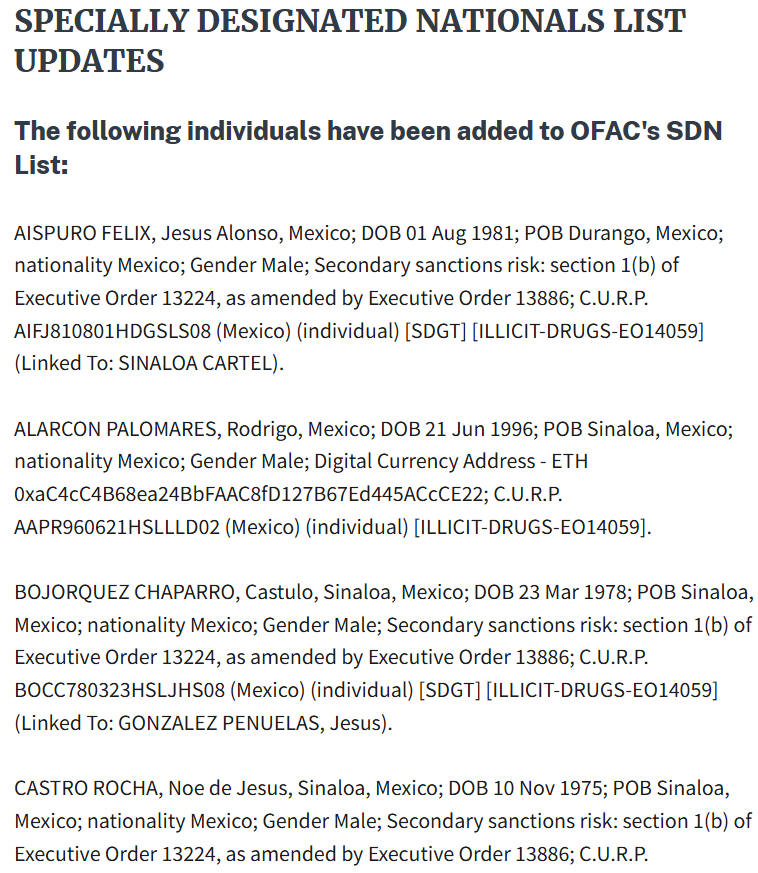
OFAC adds six new Ethereum addresses to sanctions list. Source: OFAC
Cartel cash moved into crypto
The Sinaloa Cartel is allegedly using blockchain technology to launder its illicit fiat money proceeds, according to OFAC.
Cointelegraph contacted OFAC for more details surrounding the Sinaloa Cartel’s money laundering operations.
Related: Kelp DAO attacker moves $175M in Ether after exploit: Arkham
Treasury did not identify which crypto platforms or protocols were allegedly used by the network. The listed Ethereum addresses, however, create sanctions exposure for exchanges, wallet providers and other crypto firms that screen blockchain transactions.
Looking at some of the biggest cryptocurrency hacks, attackers laundered the majority of the $1.4 billion stolen during the Bybit hack, or about $1.2 billion, through THORChain, swapping funds from Ether to Bitcoin, according to Bybit co-founder and CEO Ben Zhou.
Attackers behind the recent $293 million Kelp DAO hack also primarily used THORChain to swap the Ether for Bitcoin, generating about $910,000 in fee revenue for the protocol, Cointelegraph reported on April 23.
Magazine: 53 DeFi projects infiltrated, 50M NEO tokens could be ‘given back’: Asia Express


Subscribe to daily byte-sized crypto news from Cointelegraph
Cointelegraph is committed to independent, transparent journalism. This news article is produced in accordance with Cointelegraph’s Editorial Policy and aims to provide accurate and timely information. Readers are encouraged to verify information independently.
More on the subject