


 Written by Sam Bourgistaff editorEdited by Ana Paula Pereiraformer editor
Solana enters Brazil’s main exchange as Valour expands regulated crypto access
Latest NewsPublishedDec 16, 2025
The Solana-linked product expands Valour’s Brazil footprint as as Valour expands its regulated crypto offerings in the region.

Valour, a subsidiary of publicly listed digital asset company DeFi Technologies, has received approval to launch a Solana exchange-traded product (ETP) in Brazil, offering local investors regulated exposure to one of the largest cryptocurrencies by market capitalization as institutional interest in the region continues to grow.
The product, Valour Solana (VSOL), is scheduled to begin trading on Wednesday following approval from Brazil’s main stock exchange, Brasil, Bolsa, Balcão (B3 S.A.), DeFi Technologies announced Tuesday.
The Solana (SOL) product will join Valour’s expanding lineup of Brazil-listed ETPs, which already provide exposure to Bitcoin (BTC), Ether (ETH), XRP (XRP) and Sui (SUI).
Like Valour’s other offerings in the country, VSOL will be denominated in Brazilian reais and designed to track the performance of Solana, one of the most active layer-1 blockchain networks, within a traditional capital markets structure.
The launch reflects Valour’s broader strategy to expand beyond its core European markets, with Brazil emerging as a key focus for its international growth.
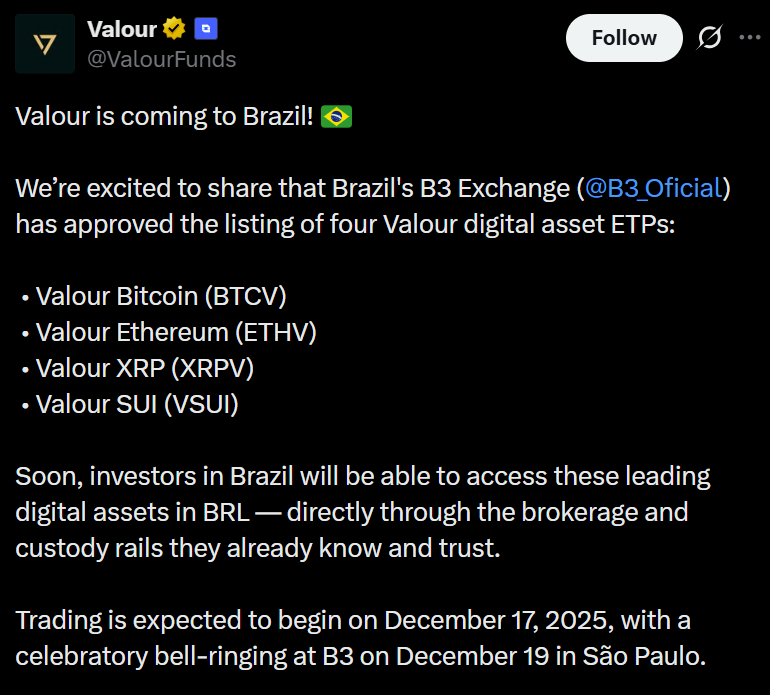
Source: Valour Funds
Related: Why Brazil is using Bitcoin as a treasury asset and what other nations can learn
Brazilian crypto adoption accelerates
Digital asset adoption in Brazil has been gaining momentum for several years, with the country ranking fifth globally in a recent Chainalysis report, behind only India, the United States, Pakistan and Vietnam.
Brazil scored strongly across multiple categories, including retail use of centralized services, decentralized finance activity and institutional access.
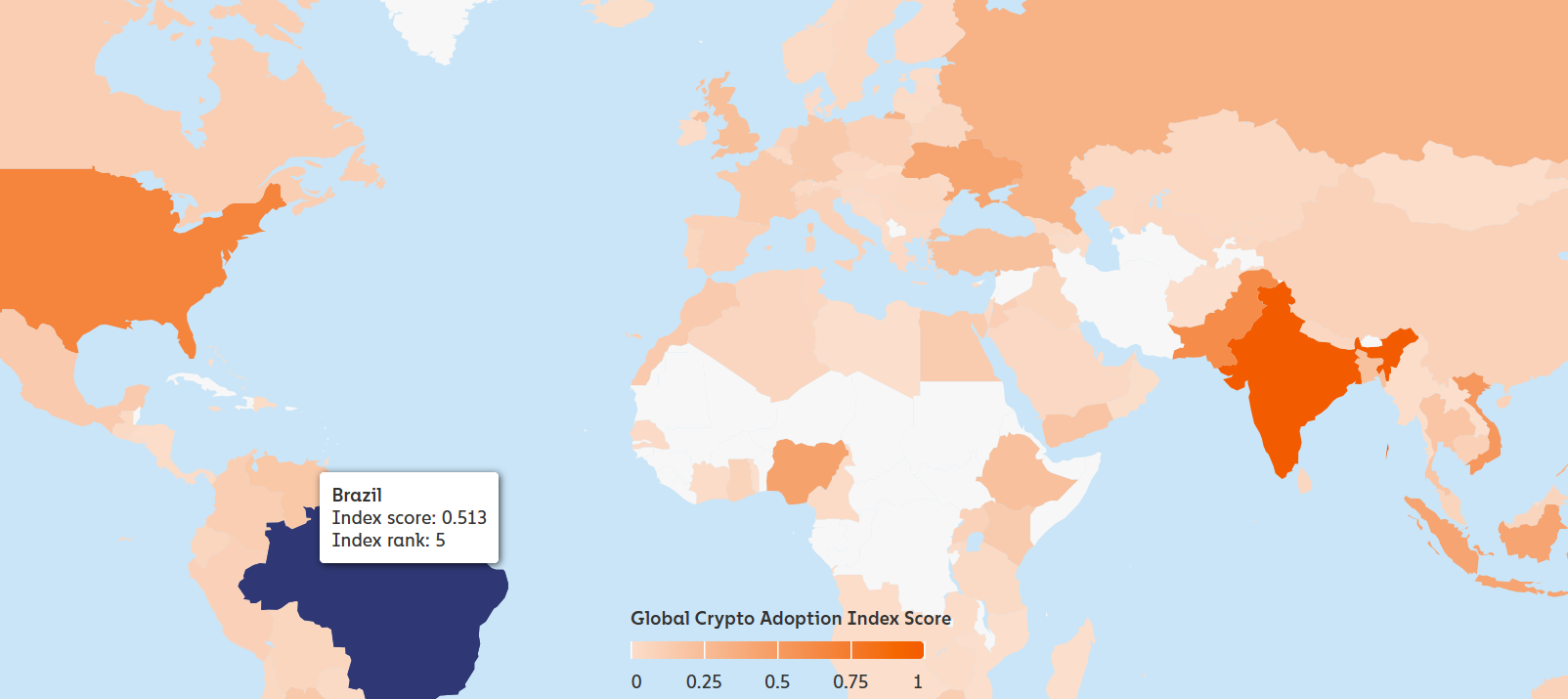
Brazil has emerged as a key hub for digital assets, driven by high transaction volumes and broad access to cryptocurrency services among both retail and institutional investors. Source: Chainalysis
A key driver of that growth has been the expansion of stablecoin-based payment rails. Brazil’s central bank has acknowledged the widespread use of stablecoins for payments, particularly in cross-border transactions.
As Cointelegraph reported, this trend enabled local fintech company Crown to raise capital for launching a real-denominated stablecoin aimed at institutional investors seeking exposure to Brazil’s fixed-income market.
Crypto exchanges have also contributed to the sector’s expansion. Mercado Bitcoin, one of Latin America’s largest digital asset platforms, has recently expanded its focus toward tokenizing real-world assets, positioning itself to meet institutional demand for blockchain-based financial products.
Related: Brazil classifies stablecoin payments as foreign exchange under new rules


Subscribe to daily byte-sized crypto news from Cointelegraph
Cointelegraph is committed to independent, transparent journalism. This news article is produced in accordance with Cointelegraph’s Editorial Policy and aims to provide accurate and timely information. Readers are encouraged to verify information independently.
More on the subject