


 Written by Martin Youngformer writerEdited by Felix Ngstaff editor
Buterin outlines 4-year roadmap to speed up and quantum-proof Ethereum
Latest NewsPublishedFeb 26, 2026
“The goal is to decouple slots and finality, to allow us to reason about both separately,” explained Ethereum co-founder Vitalik Buterin.

Ethereum co-founder Vitalik Buterin has added to a newly released roadmap outlining how Ethereum plans to speed up the production of new blocks and the confirmation of transactions.
Vitalik’s comments on Thursday offered more detail on a visual public roadmap called “Strawmap” released by the Ethereum Foundation’s Protocol team.
“Fast slots are off in their own lane at the top of the roadmap, and do not really seem to connect to anything,” said Buterin, noting that the rest of the roadmap is “pretty independent of the slot time.”
Slot time is the time it takes for Ethereum to produce new blocks, currently around 12 seconds. The roadmap aims to reduce this to two seconds to improve responsiveness.
“I expect that we’ll reduce slot time in an incremental fashion,” said Buterin, suggesting reductions following a roughly square-root-of-two formula from 12 seconds down through eight, six, four, and eventually as low as two seconds.
He also suggested that p2p improvements, or upgrades to how Ethereum nodes communicate with each other — such as sharing new blocks and data without the need to download repeated data — can greatly reduce block propagation time, “making shorter slots viable with no security tradeoffs.”
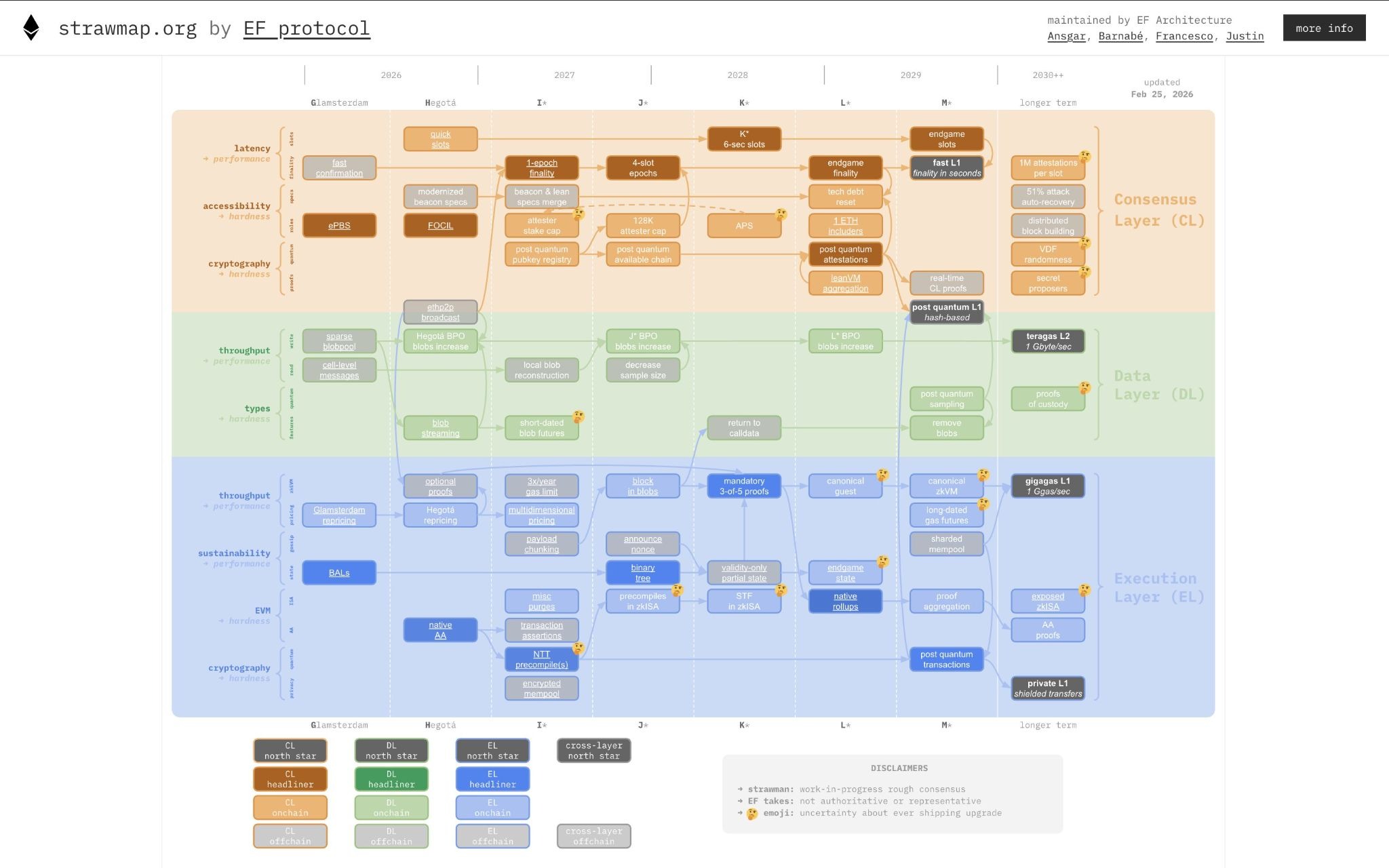
Ethereum Strawmap depicts a four-year roadmap. Source: Ethereum Foundation
Finality from minutes to seconds
The second major improvement in the roadmap is to finality, or the point at which a transaction is mathematically guaranteed to be irreversible, which is currently around 16 minutes.
The future goal is to achieve finality within six and 16 seconds, by replacing the current complex confirmation system with a cleaner, simpler one that’s also quantum-resistant.
Related: Ethereum Foundation lists ‘quantum readiness,’ gas limits as 2026 priorities
“The goal is to decouple slots and finality, to allow us to reason about both separately,” explained Buterin.
He said this was a “very invasive set of changes,” so the plan is to bundle the largest step in each change with a “switch of the cryptography, notably to post-quantum hash-based signatures.”
Quantum resistance of slots before finality
Buterin said that a consequence of this approach would be quantum-resistant slots before finality.
“One interesting consequence of the incremental approach is that there is a pathway to making the slots quantum-resistant much sooner than making the finality quantum-resistant.”
The network might “quite quickly” get to a regime where, if quantum computers suddenly appear, “we lose the finality guarantee, but the chain keeps chugging along,” he said.
“Expect to see progressive decreases of both slot time and finality time,” Buterin summarized.
The “component-by-component replacement” of Ethereum’s slot structure and consensus will produce a “cleaner, simpler, quantum-resistant, prover-friendly, end-to-end formally-verified alternative.”
The timescale for these changes is over the next four years, with seven forks planned roughly every six months. Glamsterdam and Hegotá are already confirmed and slated for later this year.
Magazine: Bitcoin may take 7 years to upgrade to post-quantum: BIP-360 co-author


Subscribe to daily byte-sized crypto news from Cointelegraph
Cointelegraph is committed to independent, transparent journalism. This news article is produced in accordance with Cointelegraph’s Editorial Policy and aims to provide accurate and timely information. Readers are encouraged to verify information independently.
More on the subject