


Written by Artem Gstaff writer
Edited by Rahul Nambiampurathstaff editorPaper losses and scrapped ETFs. What Trump Media’s 2,650 BTC transfer really means
MagazinePublishedMay 25, 2026
Digital asset treasuries (DATs) and the broader practice of building corporate Bitcoin reserves became hugely popular in 2024 and 2025, thanks in large part to the success of Strategy, whose "flywheel" many tried to replicate.

However, this model cuts both ways. On one hand, it lets companies raise capital on a wave of market optimism. On the other, it forces them to absorb the volatility of the underlying asset when prices fall.
For a public company, the situation is even more complicated. Accounting obligations mean financial losses quickly become public, and any asset movements against that backdrop attract intense scrutiny.
The recent discussion around Trump Media & Technology Group (TMTG) shows exactly that. Amid paper losses on its crypto strategy, the company moved 2,650 BTC to Crypto.com, having previously withdrawn applications to launch its own cryptocurrency ETFs.
The market absorbed this news fairly calmly, but the obvious question remains: is this part of a trading strategy, or preparation for a forced sale of digital assets?
Behind the $200 million move
Trump Media was not created as a financial or investment entity, but rather as a technology holding company. Its flagship product is Truth Social — a social network launched after Donald Trump was banned from major platforms.
In March 2024, the company went public through a SPAC merger. Until the following spring, TMTG remained strictly within the social media sphere, and only then did management decide to pivot, beginning the formation of a cryptocurrency reserve.
For these purposes, the company raised approximately $2.3 billion through equity sales and the issuance of zero-coupon convertible secured notes.
Initially, the organization stated that it wanted to establish a Bitcoin reserve, with Crypto.com and Anchorage Digital serving as its custodial partners. In practice, the model turned out to be broader than initially declared.
The company invested in the Cronos (CRO) token, which is affiliated with the aforementioned Crypto.com, and filed applications to launch several cryptocurrency ETFs at once.
However, the cryptocurrency strategy has apparently failed to pay off.
As of December 31, 2025, Trump Media disclosed holdings of 9,542 BTC with a cost basis of $1.131 billion and a fair value of $836.4 million, alongside 756 million CRO with a cost basis of $113.9 million and a fair value of $68 million.
The company's first-quarter 2026 report made the financial pressure even more evident. TMTG kept the same BTC and CRO balances on its books, but their fair value dropped to $647 million and $53 million, respectively.
Separately, TMTG disclosed an unrealized loss on digital assets of nearly $244 million (including pledged assets). Meanwhile, the company's net loss is estimated at $405.9 million.
A few days after the report's publication, the company also withdrew its applications to launch ETFs. Then, in late May, addresses linked by Arkham to Trump Media transferred 2,650 BTC to Crypto.com infrastructure — amounting to over $200 million at the market prices at the time of writing.
Some interpret such transactions as preparation for a sale or, at the very least, securing liquidity for over-the-counter (OTC) deals. However, the U.S. Securities and Exchange Commission (SEC) does not require companies to disclose public wallet addresses, which makes it difficult for outsiders to independently verify their intentions.
Companies often use such transfers to post collateral for fiat-denominated loans. In particular, TMTG said in its quarterly report that it had pledged 4,260 BTC as collateral for its convertible notes.
Another 2,000 BTC was transferred to a third-party partner as insurance for options trading. That partner also received the right to move those assets freely at its own discretion.

Excerpt from Form 10-Q. Source: SEC.
A TMTG representative also said the Bitcoin had been "transferred, but not sold," describing the move as part of a broader trading strategy.
The market reacted fairly calmly to both the loss data and the transfer of Bitcoin to the exchange. That is likely because such an adverse scenario had already been priced in.
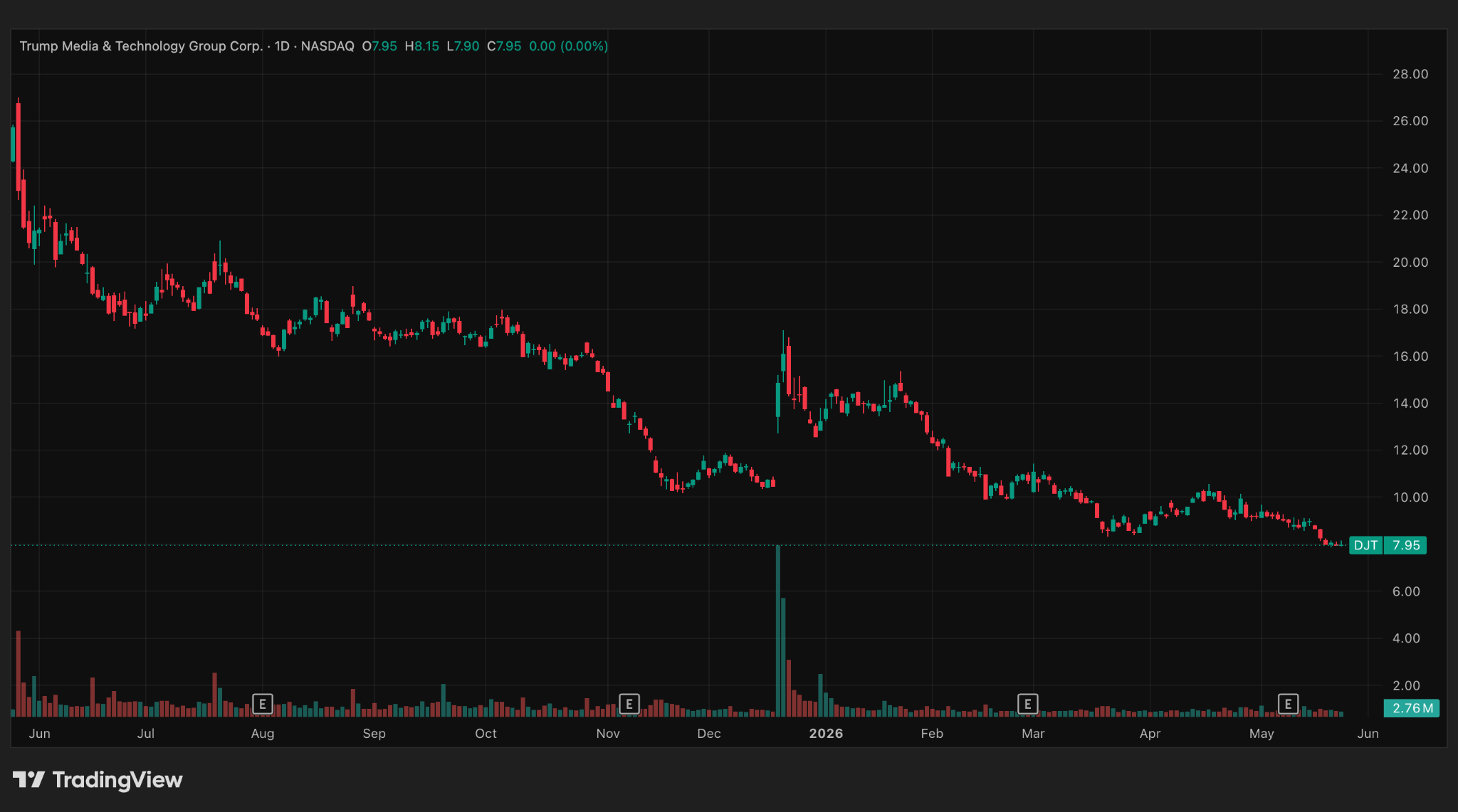
Since the beginning of 2026, the stock price of Trump Media & Technology Group (DJT) has fallen by nearly 40%. Source: TradingView.
From the outset, many analysts expressed skepticism over Trump Media's ability to secure a foothold in an overheated crypto ETF market dominated by giants like BlackRock and Fidelity.
The situation was further compounded by the fact that TMTG's proposed products featured virtually no structural differences from those of its competitors, relying instead primarily on marketing and the political brand.
The illusion of onchain transparency
The Trump Media case exposes a systemic issue: despite the transparency of the blockchain, tracking the actual state of corporate crypto reserves remains exceptionally difficult. A large onchain transfer can represent either a forced liquidation or a routine operational process with no underlying intention to divest the assets.
However, public company status dictates its own rules. To prevent panic among traditional investors, management is forced to explain nearly every movement of funds. Under these conditions, clear and timely communication becomes just as vital as the financial strategy itself.
Furthermore, such precedents bring a major regulatory dilemma to the surface. Should the SEC require public companies to disclose their blockchain addresses to enable a full independent audit? Or are wallets a trade secret, the disclosure of which would make executing corporate trading strategies impossible? This question remains unanswered for now.
As for TMTG specifically, the company's crypto business does not yet look like a sustainable operation with clear economics. The deal with Crypto.com's parent structure and the sudden withdrawal of ETF applications increasingly resemble an ad hoc search for a model to monetize a political brand, rather than a calculated, long-term strategy.
Ultimately, the main intrigue is not whether the company will sell its Bitcoin. The question is broader. Can such a structure, in principle, withstand the pressure of an aggressive crypto strategy over the long haul?


Subscribe to daily byte-sized crypto news from Cointelegraph
Cointelegraph publishes long-form journalism, analysis and narrative reporting produced by Cointelegraph’s in-house editorial team with subject-matter expertise. All articles are edited and reviewed by Cointelegraph editors in line with our editorial standards. Some articles contain affiliate links, from which Cointelegraph may earn a commission. These relationships do not influence which products we review or our editorial conclusions. Content published in here does not constitute financial, legal or investment advice. Readers should conduct their own research and consult qualified professionals where appropriate. Cointelegraph maintains full editorial independence.
More on the subject