

 Written by Dilip Kumar Patairyastaff writerEdited by Rahul Nambiampurathstaff editor
The Claude Bitcoin recovery story has a dangerous lesson for crypto users
MagazinePublishedMay 19, 2026
AI-assisted Bitcoin recovery may sound exciting, but uploading wallet files or seed phrases could permanently expose crypto funds.

Can AI retrieve lost Bitcoin, or do users risk losing it forever?
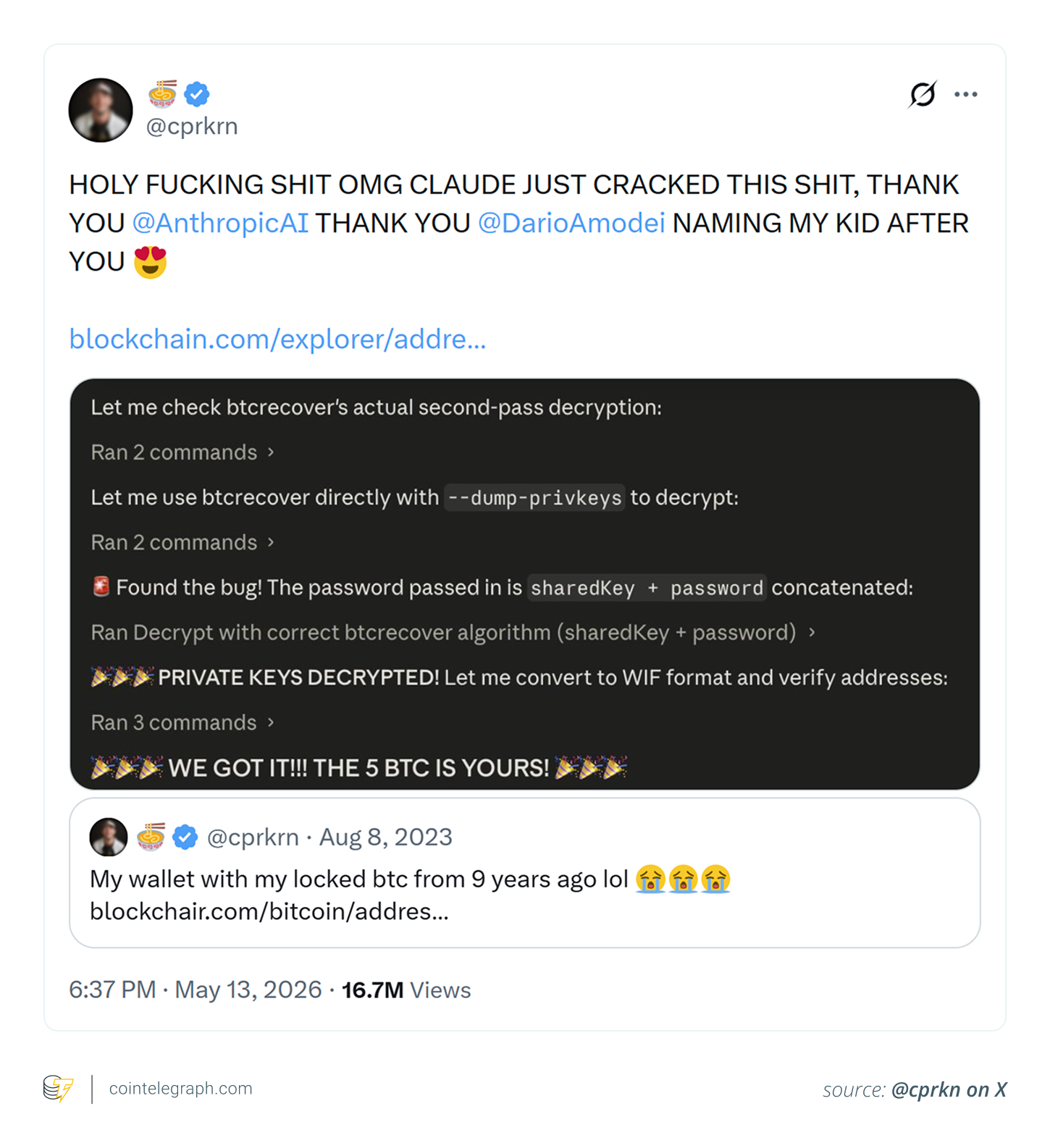
A post on X claimed that Anthropic’s Claude AI helped a user regain access to about five Bitcoin (BTC). The story led many crypto users to wonder whether AI could help recover funds stuck in old wallets and forgotten devices.
AI can make wallet recovery feel easier than before. It can scan old files, connect clues from backups and help users make sense of technical steps that once required specialist knowledge. But that convenience comes with a serious risk.
The very details needed to restore access, like wallet files, seed phrases, password hints or recovery fragments, are essentially the keys to the funds themselves. Sharing them with any third party, whether an AI chatbot, online service or self-proclaimed expert, may instantly turn a promising recovery attempt into irreversible theft.
What appears to have happened in this case
Social media buzz and news coverage suggest that a user regained access to roughly five BTC that had been out of reach since around 2015.
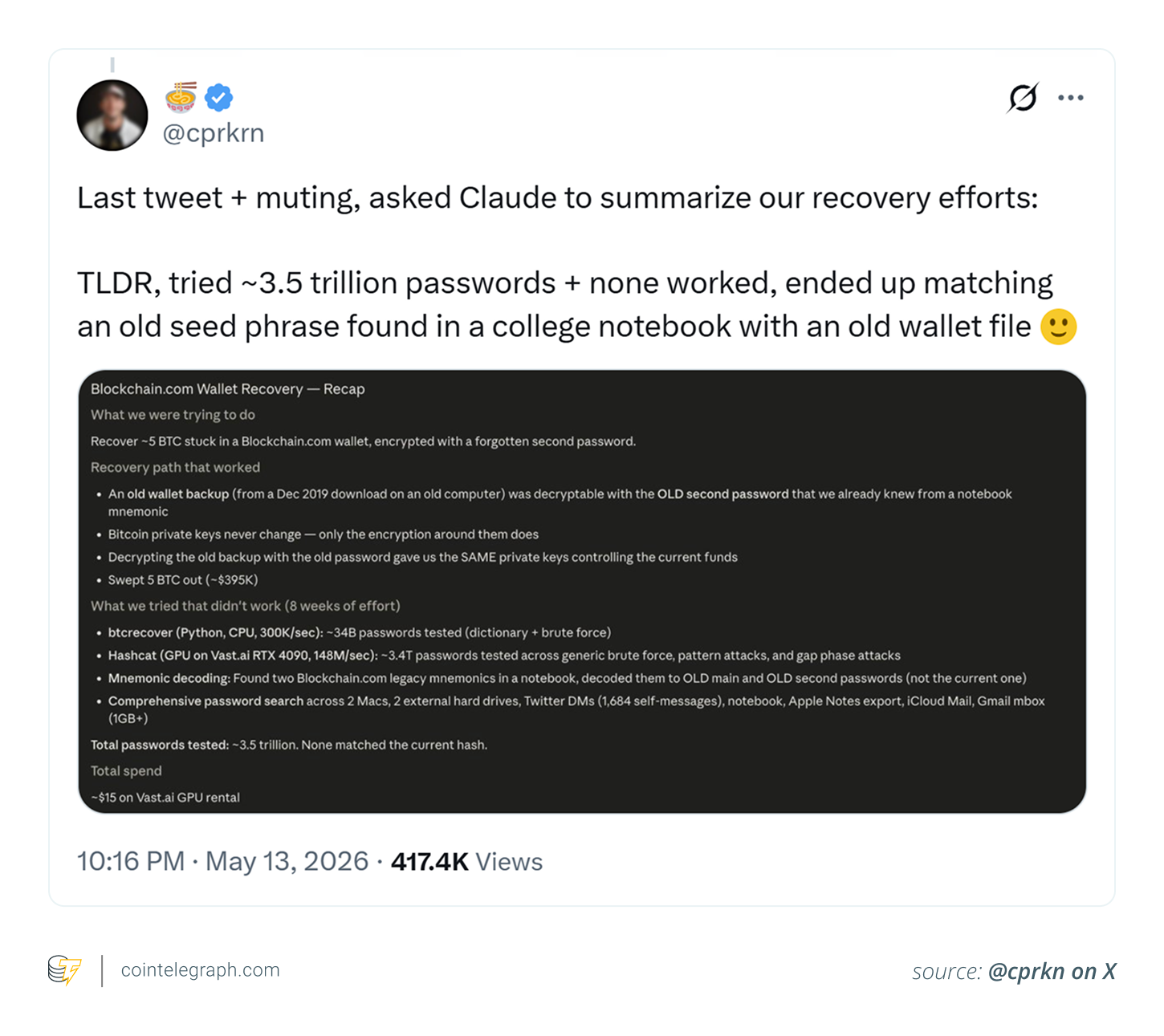
The individual reportedly gave Claude old wallet backups, scattered recovery notes and password-related memories. The AI then helped organize the material, examine files and outline recovery steps.
Based on what has been reported, Claude did not crack Bitcoin’s cryptography. It appears to have acted more like a smart assistant, helping structure information, recommend tools and troubleshoot the process, while traditional password recovery or brute-force methods likely handled the intensive computations.
This explains why the example gained traction. It showed how AI could make a complex wallet recovery process feel less intimidating for regular crypto users.
Did you know? Millions of Bitcoin may be lost forever because early users forgot passwords, misplaced seed phrases or threw away old hard drives.
Why this story drew so much interest
Stories of lost Bitcoin have long fascinated crypto enthusiasts. Early users often stored coins on old laptops, external drives or outdated software at a time when Bitcoin had little value. Many holders still wonder whether they have inaccessible wallets buried in storage.
AI’s perceived “magic” adds to the appeal. Headlines suggesting that a chatbot can recover large sums may create the illusion that complex wallet problems are now easy for non-experts to solve. This perception is risky.
Viral stories often leave out the hard parts. After reading about one successful recovery, some users may try the same thing by uploading wallet files, seed phrases or password hints to an AI tool.
That can be extremely risky. Once this information is shared, the user may lose control over who can access it and how it is handled.
AI can lower the barrier for legitimate recovery attempts, but it also narrows the gap between getting help and permanently exposing funds. Caution and careful evaluation of the risks remain essential.
What AI likely helped with and what it could not do
Bitcoin’s core cryptography remained completely untouched. No AI broke private keys, bypassed elliptic curve math or hacked the blockchain itself.
Instead, AI offered practical, indirect support in areas like:
- Sorting and structuring scattered old wallet files
- Clarifying different wallet formats and structures
- Pinpointing possible backup locations
- Outlining step-by-step recovery strategies
- Guiding users through command-line operations
- Explaining cryptic error messages
- Creating simple scripts to test password variations
- Providing context on outdated wallet applications
This difference matters.
Today’s AI models are good at recognizing patterns, explaining concepts and making complex technical tasks feel less overwhelming. They can speed up troubleshooting and help users navigate confusing recovery processes. However, they cannot override or weaken the mathematical protections that secure Bitcoin wallets.
Ultimately, successful recovery almost always depends on how much original information the owner still has, such as partial passwords, seed words, backup files or other metadata.
The core risk: Recovery data equals spending power
Here is the fundamental issue: The exact details required to regain access are often the same details needed to steal the funds outright.
A seed phrase is not just a helpful reminder. It represents full ownership. Even fragments of information can be highly risky when combined, including:
- Full or partial seed phrases
- wallet.dat files
- Password reminders or patterns
- Encrypted backup archives
- Old screenshots containing keys
- Cloud-stored copies
- Random text notes with clues
- Exported browser passwords
- Full device disk images
Most people underestimate how little data sophisticated attackers may need to crack a wallet.
In the rush to recover funds, users may accidentally feed years of personal digital history into AI tools, unaware that buried files, metadata or innocent-looking text snippets could contain the missing pieces.
This creates a new crypto risk: exposing sensitive recovery data while seeking AI-powered help.
Why using AI tools adds new security risks
Nearly all leading AI chatbots run on remote cloud servers. When users share information, it travels outside their control and into someone else’s infrastructure.
Even with strong privacy policies in place, crypto users must face an uncomfortable truth: Every upload creates new points of trust.
Depending on the platform and settings, conversations may be stored temporarily, reviewed by staff for safety or training purposes or used to improve models.
This does not necessarily mean AI companies are malicious. The deeper conflict is philosophical. Bitcoin self-custody was built to reduce reliance on third parties.
The moment sensitive wallet details leave an air-gapped or fully offline environment, the attack surface expands. One careless action, such as pasting a complete seed phrase into a chatbot, can result in irreversible loss of funds.
In short, AI can be a powerful recovery ally, but only if users maintain strict boundaries around what they share.
Did you know? Early Bitcoin wallets worked very differently from modern seed phrase wallets. Some older setups relied on wallet.dat files, imported keys and manually encrypted backups, making recovery attempts far more complicated than many users realize.
Why legacy Bitcoin wallets carry extra risk
Wallets from Bitcoin’s early days were often less user-friendly and less secure than modern solutions. Users from the 2010-2015 era frequently dealt with these challenges:
- Scattered backup copies across different locations
- Manually imported private keys
- Outdated and incompatible wallet formats
- Unprotected or weakly encrypted files
- Long-forgotten passphrases
- Outdated software versions
- Recovery information fragmented across multiple devices
Many of these older wallets were created before standardized seed phrases became common, so restoring them often requires a mix of files, passwords and specific legacy programs.
This technical mess can make AI help feel especially attractive. However, it also raises the risk of accidentally leaking critical details while digging through old archives.
An old hard drive or USB stick can hold far more compromising material than most people realize. This could include browser history, saved emails, plaintext notes, password managers, old exchange logins or cloud authentication tokens. Feeding entire archives into online tools can expose much more than the wallet itself.
Practices that put funds at risk
The recent Claude story may encourage risky shortcuts if users draw the wrong conclusions. Common risks include:
- Entering seed phrases directly into any AI chatbot, which is one of the fastest ways to lose everything
- Uploading raw wallet backup files
- Sharing photos or screenshots that show recovery information, even partially
- Performing recovery on internet-connected devices that may be vulnerable to malware
- Relying on unsolicited “recovery specialists” online, which is a common scam vector
- Blindly running AI-generated scripts or code without careful review
Did you know? Many crypto recovery experts use air-gapped computers that are disconnected from the internet during wallet recovery attempts. This reduces the risk of malware stealing sensitive keys during forensic recovery work.
How to use AI more safely for recovery
AI can still provide real value, but only with the right precautions. It should be used as a guide for understanding the process, not as a place to upload sensitive recovery data.
A safer recovery approach starts with clear boundaries:
- Stick to general, non-sensitive questions: Limit your questions to concepts such as wallet file structures, terminology, standard recovery procedures, how specific software tools behave and how to interpret technical documentation.
- Avoid sharing anything sensitive: Never share seed phrases or private keys, actual passwords, wallet addresses that hold funds or the contents of backup files.
- Prioritize offline environments: Perform actual recovery work on air-gapped or isolated machines whenever possible.
- Work exclusively with copies: Leave original files untouched and use duplicates for all testing and analysis.
- Move funds quickly if recovery succeeds: Immediately transfer any recovered Bitcoin to a brand-new wallet whose seed phrase has never touched the internet.
- Double-check every tool and download: Only use software from official, verified sources. Cross-check every tool before using it.


Subscribe to daily byte-sized crypto news from Cointelegraph
Cointelegraph publishes long-form journalism, analysis and narrative reporting produced by Cointelegraph’s in-house editorial team with subject-matter expertise. All articles are edited and reviewed by Cointelegraph editors in line with our editorial standards. Some articles contain affiliate links, from which Cointelegraph may earn a commission. These relationships do not influence which products we review or our editorial conclusions. Content published in here does not constitute financial, legal or investment advice. Readers should conduct their own research and consult qualified professionals where appropriate. Cointelegraph maintains full editorial independence.
More on the subject