


 Written by Vince Quillformer writerEdited by Sam Bourgistaff editor
Blockhain developer Paul Sztorc announces BTC hard fork eCash
Latest NewsPublishedApr 24, 2026
The hard fork will introduce a new, competing layer-1 blockchain and seven layer-2 scaling networks, according to Sztorc's announcement.

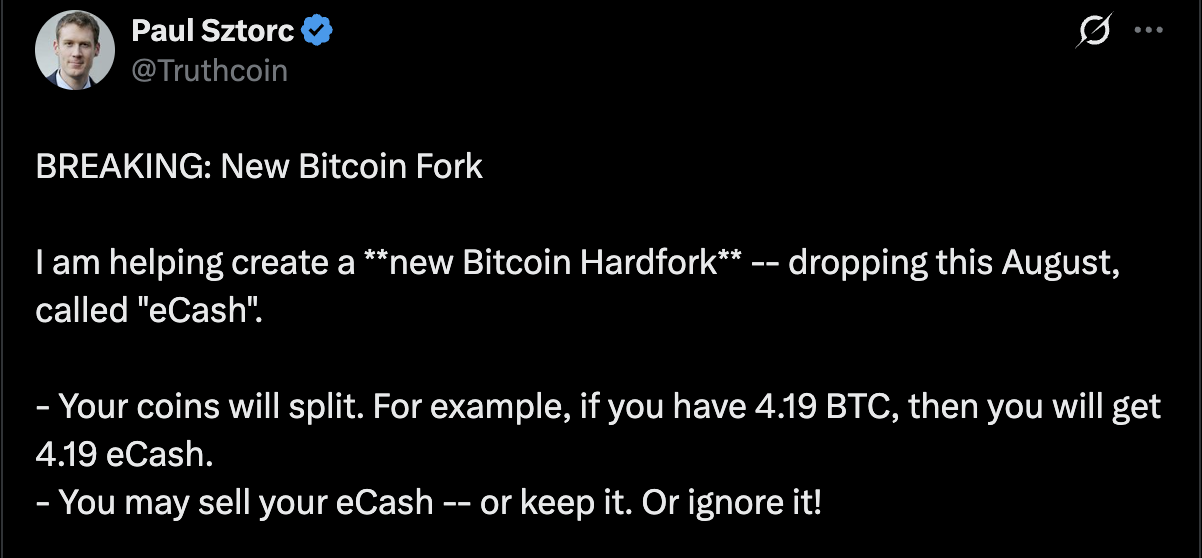
Bitcoin developer Paul Sztorc announced on Friday that a new hard fork of the Bitcoin network called eCash will be deployed in August.
Bitcoin holders will be able to exchange their BTC for eCash at a 1:1 ratio once the hard fork is live, Sztorc said in an X post.
He added that the layer-1 node software for the chain will be a “near-copy” of the BTC Core client software and will use the SHA-256 hashing algorithm used by the Bitcoin blockchain, with a reduced initial mining difficulty to make it easier for participants to mine blocks.
Source: Paul Sztorc
The new layer-1 hard fork will also have seven layer-2 scaling networks called “drivechains,” for increased transaction throughput and optional onchain privacy, he said.
Sztorc distanced the eCash hard fork from previous attempts to hard fork the Bitcoin protocol, including Bitcoin Cash (BCH), which was created in 2017 but failed to become the dominant chain. However, the announcement drew mixed reactions.
Related: US admiral calls Bitcoin an instrument for US ‘power projection’
Bitcoin community reacts to Sztorc’s announcement
“Unlike BCH, the 2017 fork, there is no ‘Bitcoin’ in the name,” Sztorc said, adding, “This is a permanent and sustainable fix to Bitcoin's problems.”
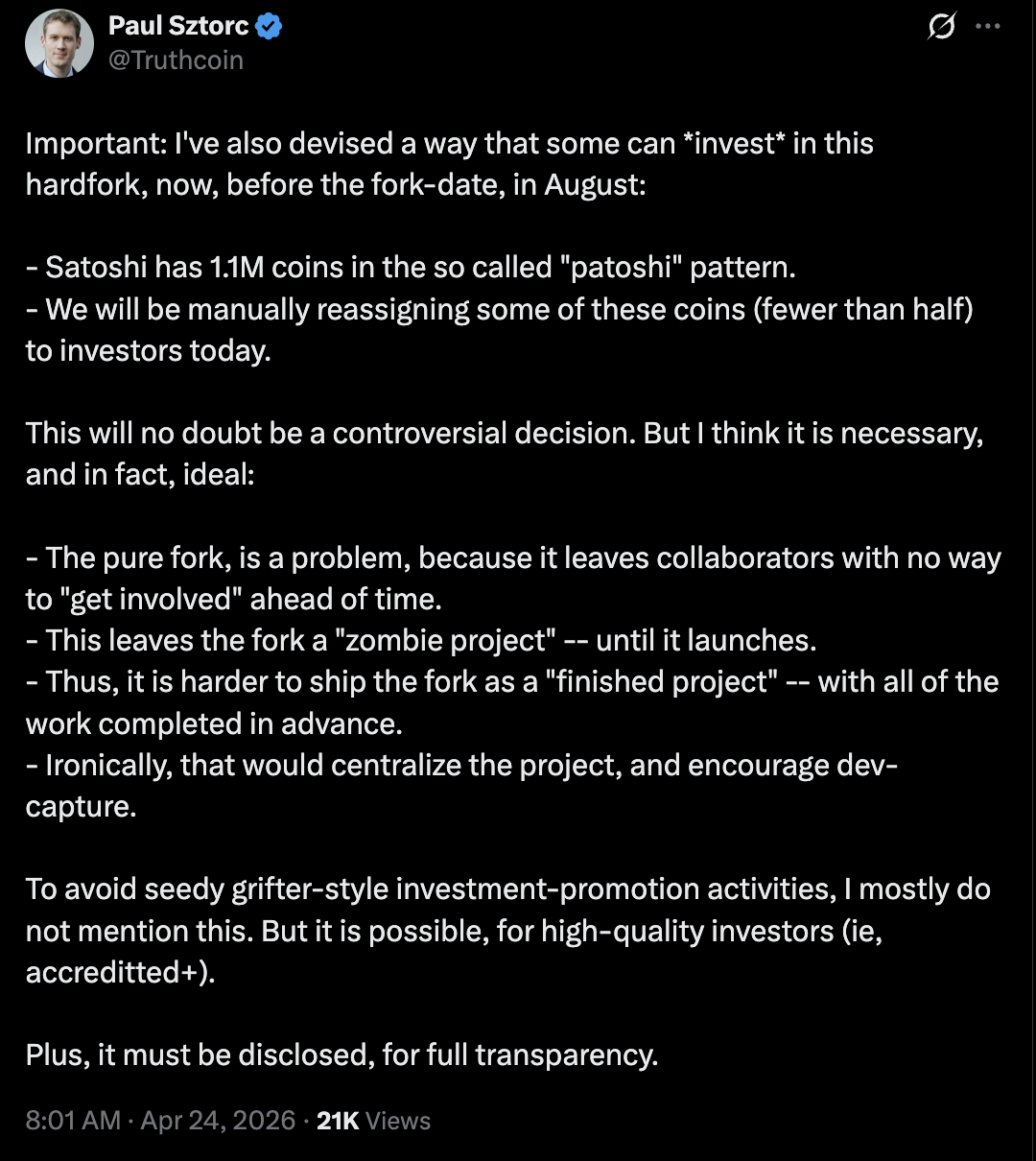
He added that the forked chain would “manually” reassign a portion of Satoshi Nakamoto’s 1.1 million BTC stash to early investors.
“Taking Satoshi coins is theft and disrespectful, and eCash is already used for Lightning payments with Cashu and Fedi. Those are poor choices,” Bitcoin advocate Peter McCormack said in response.
Source: Paul Sztorc
“I give you two or three years to fold completely,” Bitcoin advocate PakoVM said about the planned hard fork.
The announcement came amid a growing debate about Bitcoin’s tech stack and whether the protocol should introduce privacy-preserving features and post-quantum resistance.
“Back in 2017, the Bitcoin tech stack was strong, and expectations for Lightning were strong. Today, it is the reverse,” Sztorc said.
The Bitcoin Lightning Network is a layer-2 scaling solution for BTC that allows transactions to be processed within seconds, instead of waiting 10-minutes for transactions to settle to the main Bitcoin ledger.
Magazine: Bitcoin will not hit $1M by 2030, says veteran trader Peter Brandt


Subscribe to daily byte-sized crypto news from Cointelegraph
Cointelegraph is committed to independent, transparent journalism. This news article is produced in accordance with Cointelegraph’s Editorial Policy and aims to provide accurate and timely information. Readers are encouraged to verify information independently.
More on the subject