

 Written by Nate Kostarstaff writerEdited by Robert Lakinstaff editor
Business payments fast becoming dominant use for stablecoins: Paybis
Latest NewsPublishedJun 3, 2026
A new Paybis report found that stablecoins represented 86% of the crypto exchange and payments provider's platform activity in April, up from 12% in mid-2023.

Business payments are becoming a dominant use case for stablecoins, according to new data from Paybis, a crypto exchange and payments infrastructure provider.
The company said business customers accounted for nearly 98% of stablecoin payout volume processed through its platform in the first four months of 2026, up from 36% in 2023.
Paybis cited research from McKinsey estimating that global stablecoin payment volume reached $390 billion in 2025, with business-to-business transactions accounting for roughly 60% of that activity. The company also said stablecoins accounted for 86% of its crypto volume in April, up from 12% in July 2023.
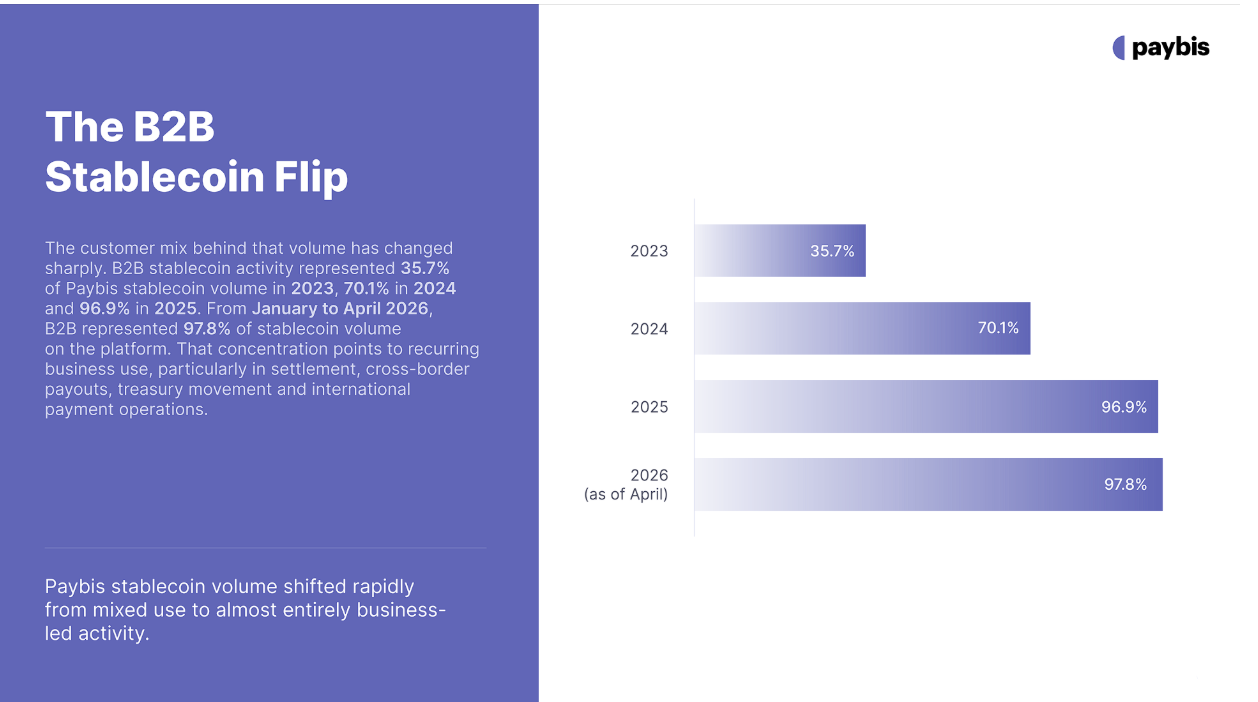
Source: Paybis report
The company said the largest sources of B2B stablecoin volume over the last two years were digital goods, virtual asset businesses, technology, retail and e-commerce, and financial technology, which together accounted for more than 78% of business stablecoin activity on the platform.
Paybis also found that 22.5% of surveyed businesses already use stablecoins for international payments or plan to do so within the next 12 months.
The survey also revealed that businesses are overestimating the cost and settlement time of stablecoin transfers. While stablecoin transactions typically settle within seconds or minutes depending on the network, nearly half of respondents expected transfers to take between one hour and one day, and roughly one-third expected fees of around 3%.
In market practice, stablecoin payment costs are generally benchmarked below 1%, the end-to-end cost usually depends on the blockchain network, payment provider, on/off-ramp fees and FX spread, a Paybis spokesperson told Cointelegraph.
Related: Mastercard expands support to USDC, PYUSD, RLUSD stablecoin settlement
Stablecoin market grows with new payments-focused tokens
Stablecoin adoption continues to expand across the broader financial sector. According to DefiLlama, the total stablecoin market capitalization has climbed to roughly $319.5 billion, up from around $247.3 billion a year ago. Tether's USDT (USDT) remains the largest stablecoin with nearly 59% market share, followed by Circle's USDC (USDC) at roughly $76 billion.
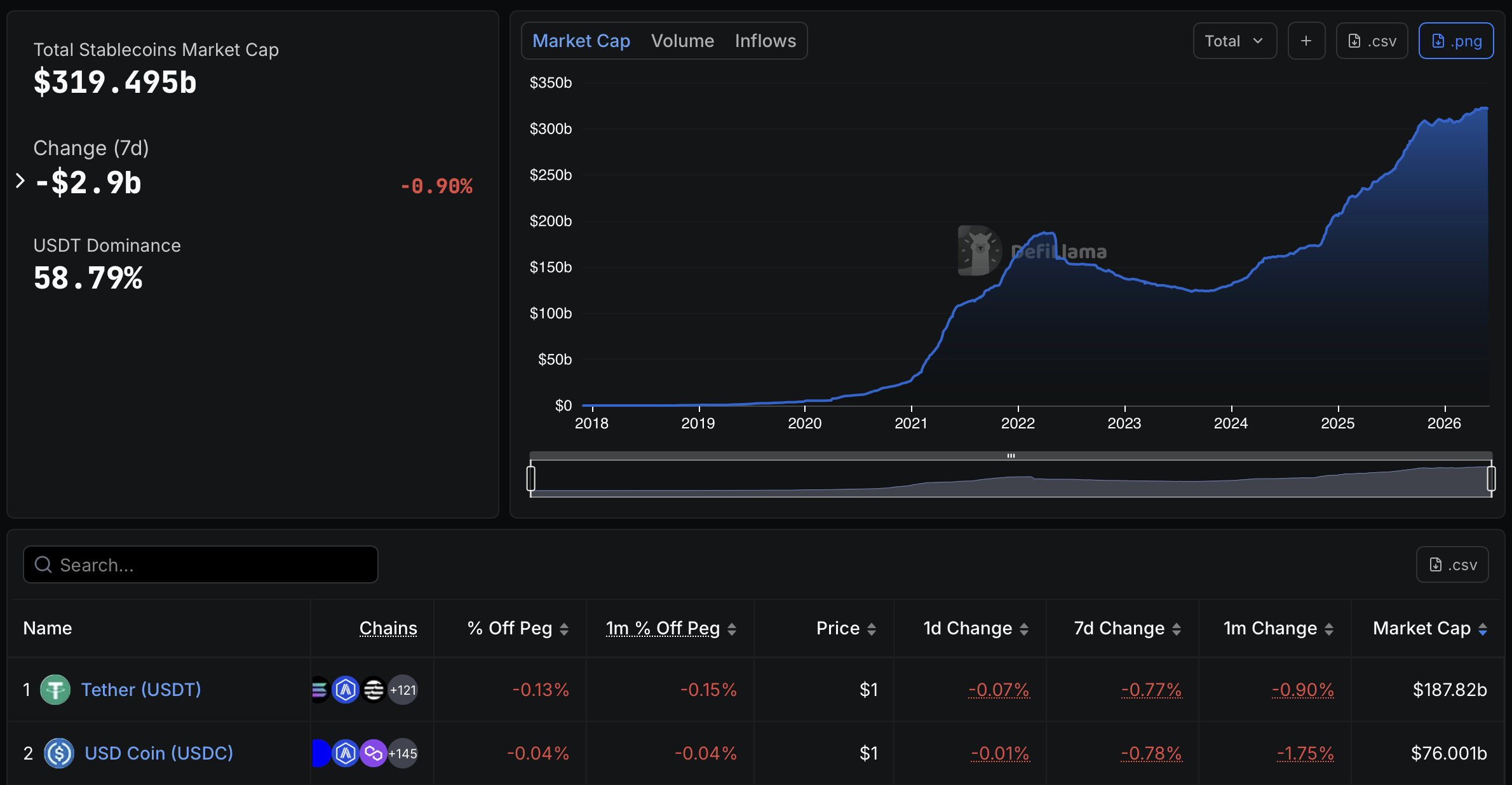
Source: DefiLlama
The growth has prompted a wave of new stablecoin launches aimed at payments and banking use cases. Last week, Falcon Finance introduced the institutional-focused fUSD stablecoin through Anchorage Digital's federally regulated issuance platform, while SoFi rolled out SoFiUSD to banking customers through its mobile app.
On Monday, MoneyGram launched MGUSD on Stellar for cross-border payments and digital-dollar balances, expanding its push into blockchain-based remittances and settlement services. The stablecoin is issued by Bridge, Stripe's stablecoin platform, and is integrated into the MoneyGram app through a self-custodial wallet.
Magazine: Korea’s first memecoin rug-pull case, China’s crypto rules review: Asia Express


Subscribe to daily byte-sized crypto news from Cointelegraph
Cointelegraph is committed to independent, transparent journalism. This news article is produced in accordance with Cointelegraph’s Editorial Policy and aims to provide accurate and timely information. Readers are encouraged to verify information independently.
More on the subject