


 Written by Sam Bourgistaff writerEdited by Robert Lakinstaff editor
CFTC proposes framework favoring sports event contracts over gambling
Latest NewsPublishedJun 10, 2026
The proposed rules would preserve election markets and allow many sports-based prediction contracts while limiting bets that could encourage manipulation.

The US Commodity Futures Trading Commission (CFTC) has proposed new rules for prediction markets, signaling that sports event contracts are generally not contrary to the public interest even though federal law classifies them as “gaming.”
Released on Wednesday, the proposal distinguishes sports event contracts from games of pure chance, saying markets based on final scores and win-loss records can aid price discovery. Contracts tied to player injuries, officiating decisions or other outcomes that could encourage manipulation, however, are unlikely to meet the public interest test.
The proposal also clarifies that election contracts are not considered “gaming” under the relevant federal laws. Reuters reported this could further ease regulatory uncertainty for platforms such as Kalshi and Polymarket, which rose to prominence during the 2024 US presidential election as traders increasingly turned to prediction markets to gauge the race’s outcome.
The draft rules are open for public comment for 45 days and could help define the future regulatory framework for US prediction markets.
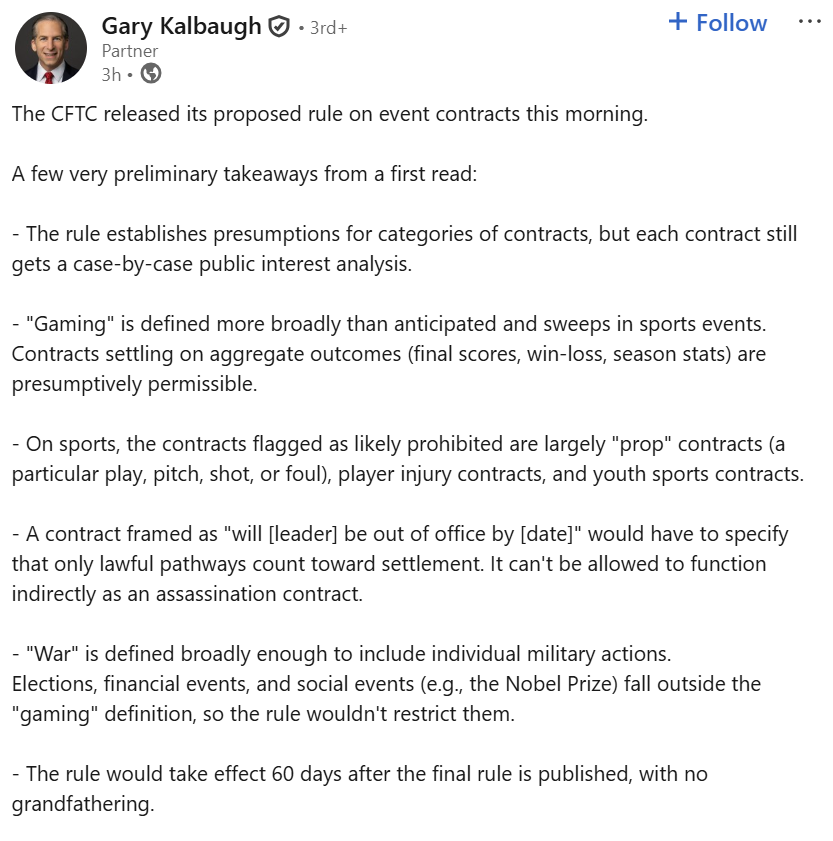
Gary Kalbaugh, a partner at Cahill Gordon & Reindel LLP in New York, said the proposal is principles-based rather than a blanket approval, noting that each contract would still be subject to a case-by-case public interest analysis.
“‘Gaming’ is defined more broadly than anticipated and sweeps in sports events,” Kalbaugh wrote on Wednesday. “Contracts settling on aggregate outcomes (final scores, win-loss, season stats) are presumptively permissible.”
Source: Gary Kalbaugh
Related: Anchorage backs Treasury’s GENIUS AML rules, seeks secondary-market sanctions clarity
Increased regulatory clarity comes as prediction markets see adoption surge
The proposed rules come as prediction markets — described as an “asset class” in the draft — continue to gain momentum, with Kalshi and Polymarket reaching multibillion-dollar valuations amid rising investor and institutional interest.
Both companies have expanded their ties to traditional financial markets. Kalshi recently partnered with Nasdaq to launch a new category of prediction markets that allows users to forecast the future valuations of private companies ahead of their initial public offerings.
Polymarket, meanwhile, has partnered with Dow Jones to integrate real-time prediction market data into its media brands, including The Wall Street Journal.
“The prediction markets continue to become more mainstream, with newly formed partnerships with news organizations and more firms moving quickly into this space,” said Melinda Roth, a professor of sports law and corporate finance at Georgetown University Law Center. “As these markets continue to grow, the unanswered question is if event contracts are financial instruments or are they simply gambling.”
Analysts at Bernstein say prediction markets are seeing growing institutional adoption as investors seek alternative macro-hedging tools through binary-outcome contracts.
Magazine: How to fix suspected insider trading on Polymarket and Kalshi


Subscribe to daily byte-sized crypto news from Cointelegraph
Cointelegraph is committed to independent, transparent journalism. This news article is produced in accordance with Cointelegraph’s Editorial Policy and aims to provide accurate and timely information. Readers are encouraged to verify information independently.
More on the subject