


 Written by Nancy Lubaleformer writerEdited by Fernando Quirósformer editor
Ethereum treasury demand collapses: Will it delay ETH’s recovery to $4K?
MarketsPublishedDec 3, 2025
Collapsed Ethereum treasury demand and stiff overhead resistance between $3,100 and $3,200 stood in the way of Ether’s recovery to $4,000.

Ether’s (ETH) price traded at $3,077, up 17% above its local lows of $2,620 reached on Nov. 21. However, reduced treasury buying and overhead resistance delayed sustained recovery toward $4,000.
Key takeaways:
- Ether treasury demand has collapsed 80%, raising concerns about their sustainability.
- Breaking the resistance at $3,200 is crucial for confirming the recovery.
- Ether’s falling wedge breakout targets $4,150 ETH if key support levels hold.
Ethereum treasuries have collapsed by 80%
Ether has seen a steep decline in demand from corporate treasury entities that had previously accumulated ETH as part of the “DAT” trend.
Data from Bitwise reveals that digital asset treasury (DAT) companies purchased just 370,000 ETH in November, down 81% from August’s peak of 1.97 million ETH.
Related: Digital asset treasury boom stalls as flows drop to $1.3B and stocks tumble
Bitwise’s Senior Research Associate, Max Shannon, warns that the structural bid for Ether will disappear if treasury buying continues to decline while supply remains constant.
“As more alternatives emerge, the same pool of capital cannot sustain demand.”
ETH DAT bear continues. pic.twitter.com/5YhOwqTICd— Max Shannon (@cornMaxy) December 2, 2025
This drop is not simply a slowdown, but reveals a structural decline driven by shrinking mNAV levels and vanishing purchasing power among smaller firms.
Additional data from Capriole Investments reveals that daily institutional buying, including both DATs and ETFs, has dropped from a peak of 121,827 ETH on Aug. 15. In fact, they are now selling at a rate of 5,520 ETH per day.
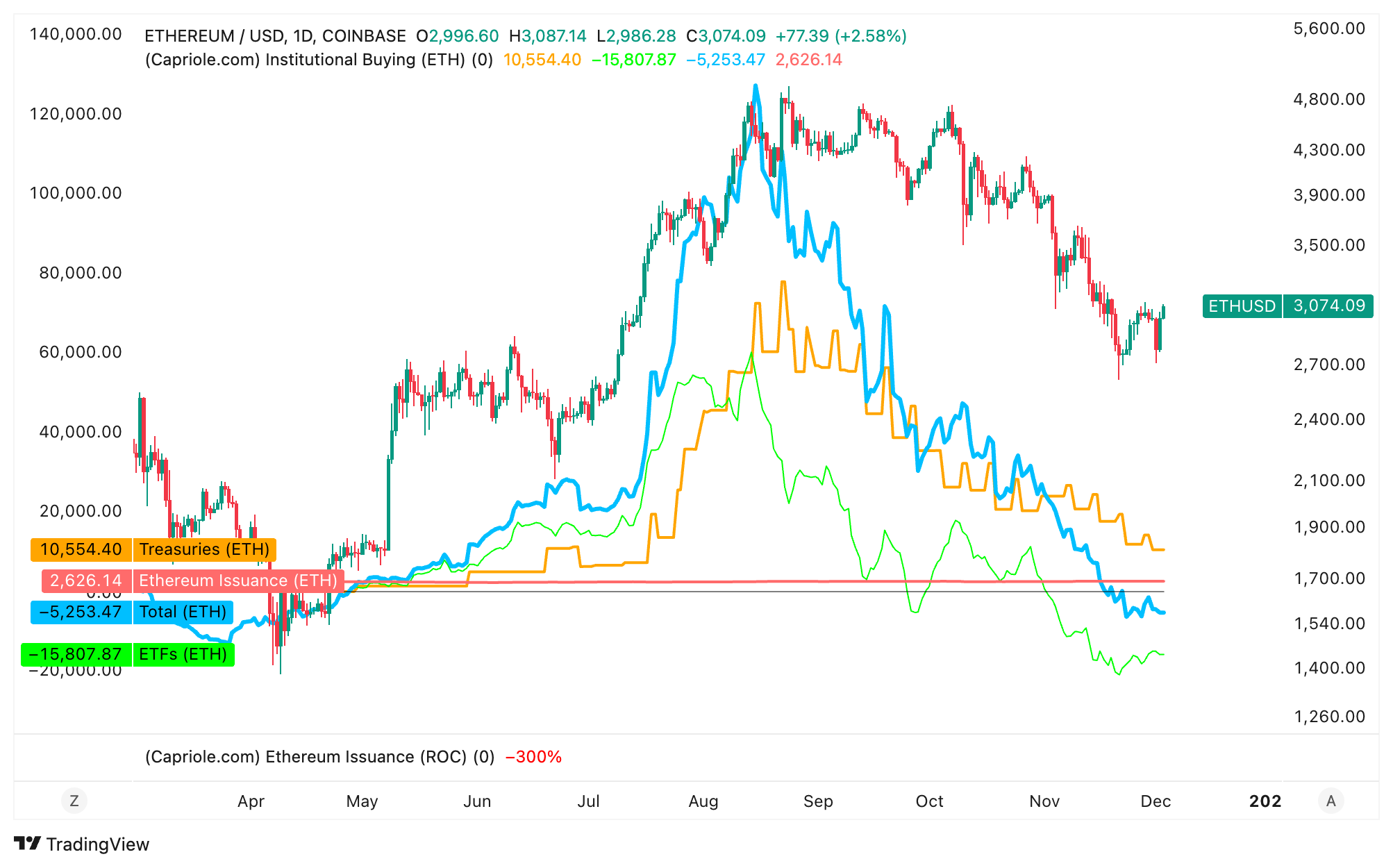
Ethereum: Daily rate of institutional buying. Source: Capriole Investments
Raising capital is becoming a problem, leaving only a handful of large players active. One of these is Bitmine, led by Wall Street strategist Tom Lee, which continues to add ETH; however, monthly and weekly volumes have declined, according to CryptoQuant analyst Maartunn.
Yes, Bitmine continues to add new Ethereum to its treasury, but the monthly USD values have been declining:
July 2025: $2.6B
August 2025: $4.3B
September 2025: $3.4B
October 2025: $2.3B
November 2025: $892M pic.twitter.com/w1k3FdXIXy— Maartunn (@JA_Maartun) December 3, 2025
While treasury purchases still exceed Ethereum’s monthly supply of about 80,000 ETH, the narrowing pool of active buyers signals that the DAT model is collapsing.
As Cointelegraph reported, Ether treasury companies are sitting on millions of dollars of unrealized losses, raising concerns about their sustainability.
Ether faces resistance above $3,200
The latest recovery in ETH price has seen it reclaim a key support area around $3,080, where the 50-week and 100-week SMAs appear to converge, according to data from Cointelegraph Markets Pro and TradingView.
A daily candlestick close above this level would be a bullish sign that the buyers are back in control.
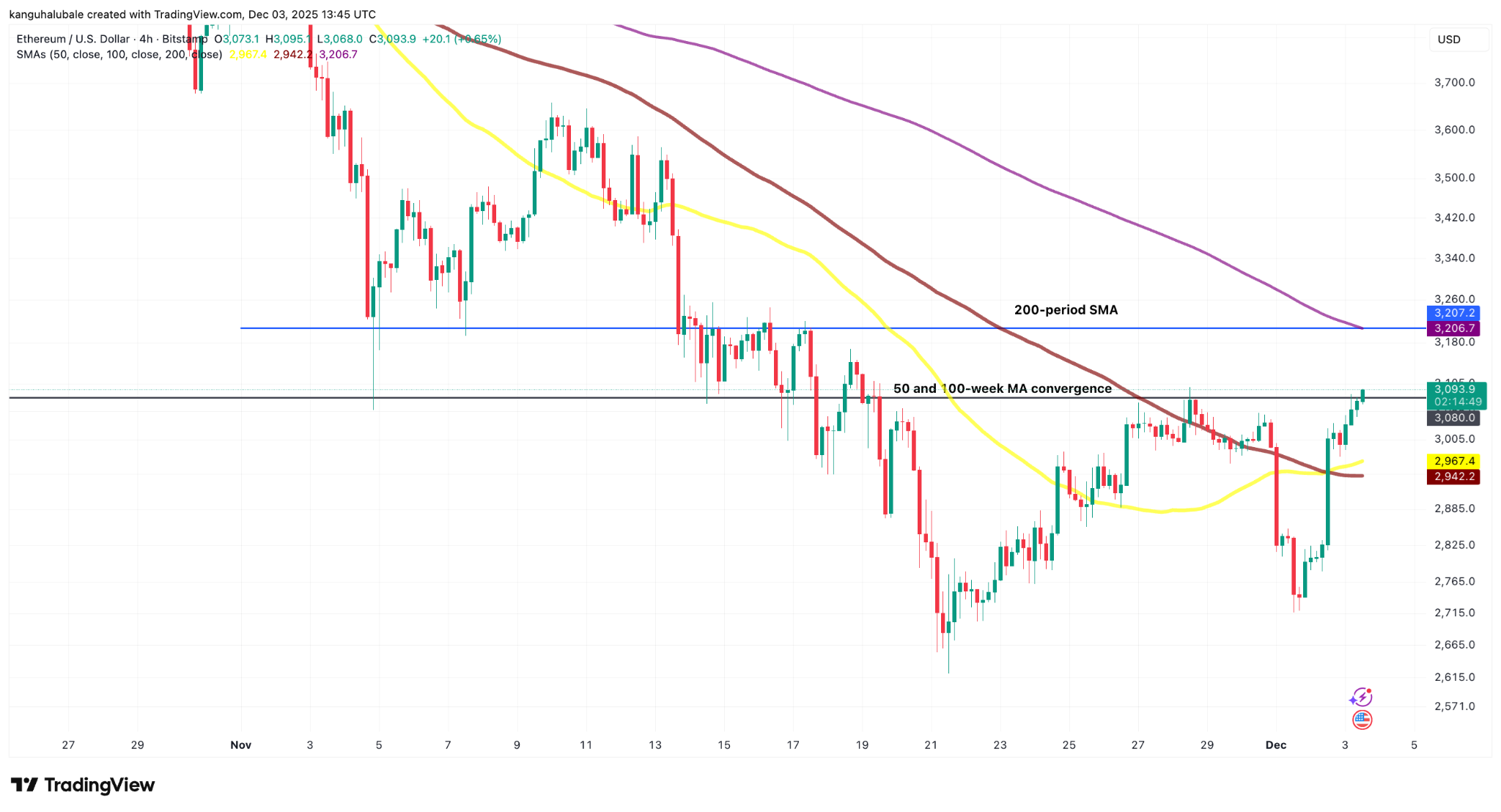
ETH/USD four-hour chart. Source: Cointelegraph/TradingView
If this level holds, “then we’re eager for an upside,” MN Capital founder Michael van de Poppe said in a recent X post, adding:
“On the upside, $3,000-3,100 remains a crucial resistance zone to break through.”
Note that this area of resistance coincides with the 200-period SMA, which has suppressed the price since Oct. 28.
This is where investors acquired about 5.1 million ETH, according to Glassnode’s cost basis distribution heatmap.
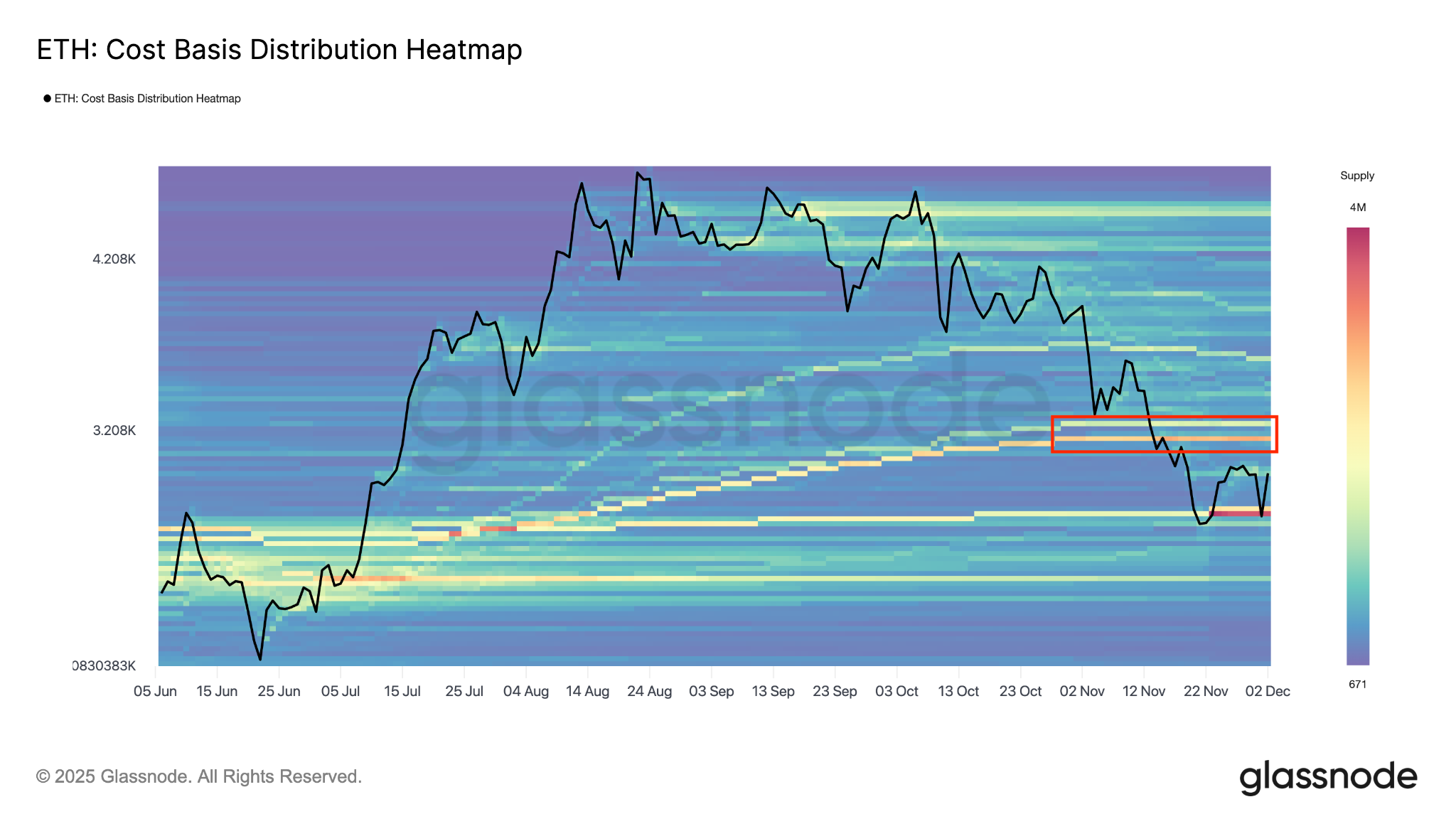
Ethereum: Cost basis distribution heatmap. Source: Glassnode
As Cointelegraph reported, a close above the 20-day EMA at $3,100 would suggest that the selling pressure is reducing, clearing the way for a climb toward the 50-day SMA around $3,500.
Ether’s falling wedge breakout targets $4,150
The daily chart shows the ETH/USD pair breaking above the upper trend line of a falling wedge pattern at $3,000.
A daily close above this level would confirm the breakout, opening the way for Ether’s rise toward the wedge’s target at $4,150, representing a 36% increase from the current price.
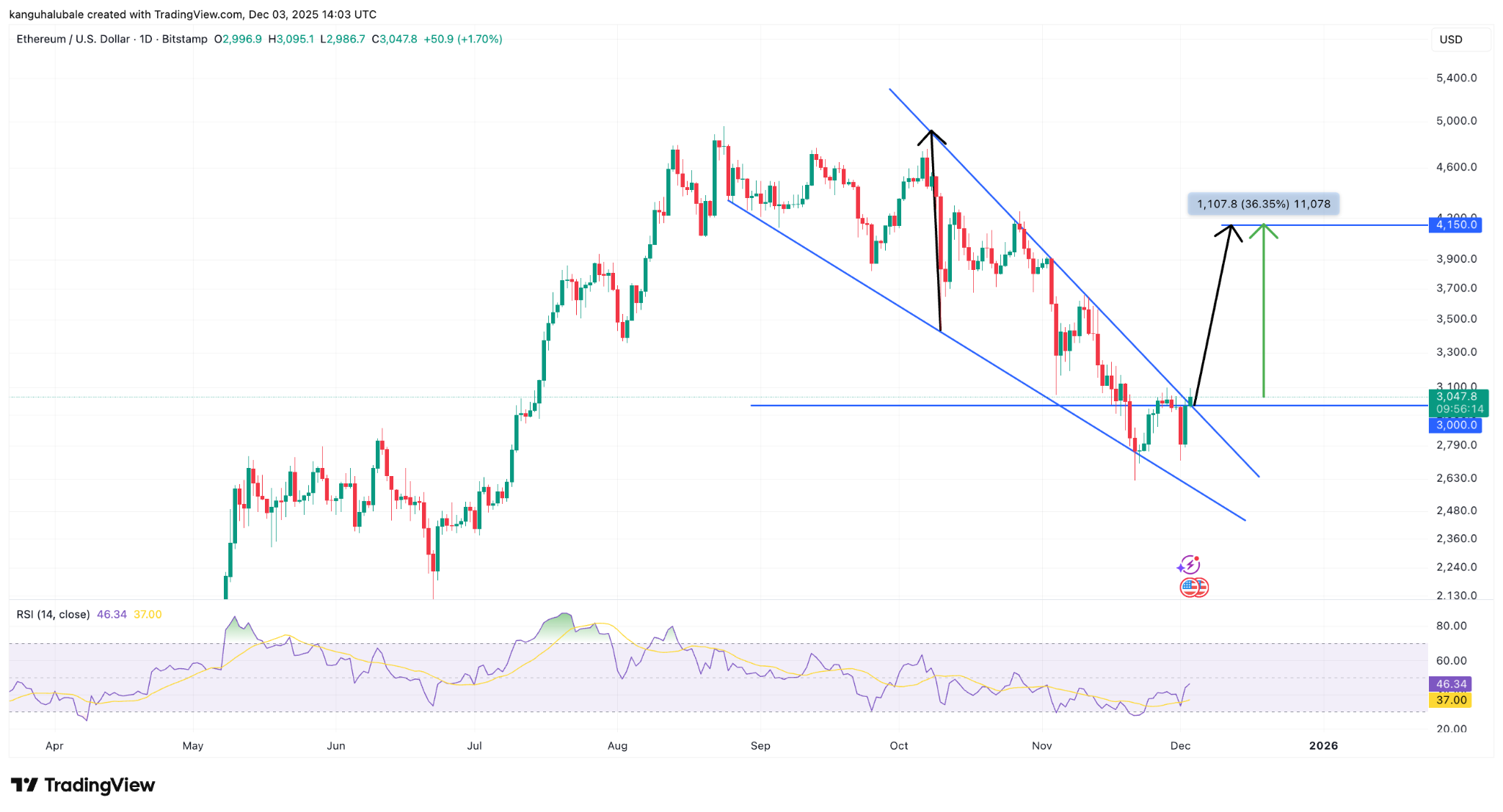
ETH/USD daily chart. Source: Coitelegraph/TradingView
This upside target aligns with the ETH price predictions made by multiple analysts, as valuation models suggest that the altcoin is significantly “undervalued.”


Subscribe to daily byte-sized crypto news from Cointelegraph
This article is produced in accordance with Cointelegraph's Editorial Policy and is intended for informational purposes only. It does not constitute investment advice or recommendations. All investments and trades carry risk; readers are encouraged to conduct independent research.
More on the subject