


 Written by Ezra Reguerrastaff writerEdited by Yohan Yunstaff editor
Hungary to reverse crypto trading crackdown after EU scrutiny
Latest NewsPublishedJun 11, 2026
Hungary’s government said it will unwind crypto trading restrictions that required approved validation for conversions and exposed users and service providers to criminal liability.
Hungary is set to decriminalize crypto trading, reversing restrictions that imposed potential jail terms for certain crypto-to-fiat and crypto-to-crypto transactions, according to Tisza government spokesperson Anita Köböl.
Speaking at a Thursday press conference, Köböl said Hungary would unwind rules introduced last year that required approved validation for crypto conversions and attached criminal penalties to violations. She said the restrictions contributed to a decline in crypto trading activity in the country.
“This was an unnecessary piece of legislation. It made practical operation impossible and frightened the market participants,” Köböl said, according to a translation by Cointelegraph. “The criminal consequences also negatively impacted several hundred thousand people.”
The rules also prompted several digital asset platforms, including Revolut, to suspend crypto services in the country, Köböl said. She added that regulation had also led to a European Union probe into whether Hungary's restrictions were compatible with the bloc's rules.
The reversal would mark a policy shift for Hungary after its 2025 crypto framework created a restrictive approval system around crypto, exposing users and service providers to criminal liability.

Hungary’s officials speaking at a press conference. Source: Péter Magyar/YouTube
Hungary’s 2025 crypto rules threatened traders with prison time
The restrictions stemmed from a legislative package passed in 2025 that amended Hungary’s Criminal Code and its Act VII of 2024 on the crypto market, known as the Crypto Act.
Under the amendments that took effect on July 1, 2025, exchanging crypto may be carried out only with a compliance certificate issued by an authorized crypto asset conversion validation service provider.
Transactions lacking that certificate were treated as “unauthorised crypto-transactions,” with linked asset transfers deemed invalid and unable to produce legal effect.
Related: European Commission calls on 12 countries to implement crypto tax rules
The framework also created a new type of entity, a crypto conversion validation service provider, which required authorization from Hungary’s Supervisory Authority of Regulated Activities.
These providers were tasked with checking the origin of crypto assets, identifying wallet or device ownership, assessing user profiles and verifying transactions against external databases before issuing compliance certificates.
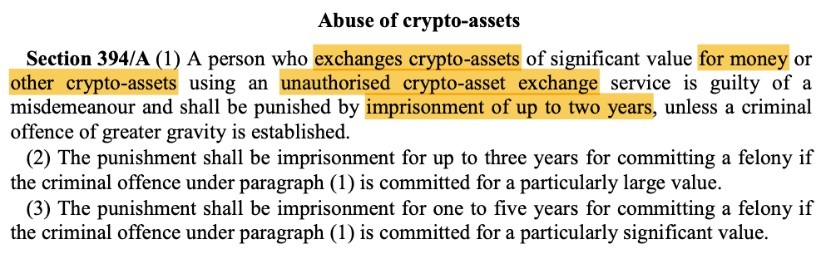
A highlighted excerpt of Hungary’s updated Criminal Code with the new penalties for using unauthorized crypto exchanges. Source: National Legislation Database of Hungary
Individuals or entities exchanging crypto worth between 5 million Hungarian forint and 50 million forint (about $16,000 to $160,000) through an unauthorized exchange service could face up to two years in prison.
Penalties increased to five years for transactions between 50 million forint and 500 million forint, and up to eight years for transactions above 500 million forint.
The crypto reversal comes after Hungary’s April 12 parliamentary election, which ended the 16-year rule of longtime nationalist Prime Minister Viktor Orban and brought Peter Magyar’s pro-European Tisza Party into government, with the new administration moving to ease tensions after years of conflict between Hungary and the EU.
With additional reporting from Zoltan Vardai
Magazine: Does ‘Paper Bitcoin’ mean there’s an unlimited supply of BTC?


Subscribe to daily byte-sized crypto news from Cointelegraph
Cointelegraph is committed to independent, transparent journalism. This news article is produced in accordance with Cointelegraph’s Editorial Policy and aims to provide accurate and timely information. Readers are encouraged to verify information independently.
More on the subject