


 Written by Christina Combenstaff writerEdited by Bryan O'Sheastaff editor
Tempo’s ‘Zones’ spark debate over privacy in crypto infrastructure
Latest NewsPublishedApr 17, 2026
Tempo’s new “Zones” feature offers private, permissioned stablecoin transactions on its layer-1 for enterprises, but critics warn the operator‑controlled design adds back centralized trust.

Tempo unveiled a new “Zones” feature Thursday aimed at giving enterprises bank-style privacy on public stablecoin rails, but not everyone in crypto is convinced the trade-offs are worth it.
The payments-focused layer-1, co-developed with backing from Stripe and Paradigm, said Zones will let companies run transactions in permissioned environments while still tapping public blockchain liquidity. The pitch targets a long-standing issue for institutions: sensitive data like payroll, merchant volumes or treasury activity being exposed on public ledgers.
Some privacy-focused developers argue that the design sacrifices too much. Because each Zone is controlled by an operator that can see full transaction data and suspend a user’s ability to transfer or withdraw funds based on its own compliance rules, critics say it introduces centralized trust assumptions closer to an exchange than a trust-minimized blockchain.
The debate reflects a broader divide in crypto infrastructure as projects compete for institutional adoption. While Tempo is betting on simplicity and interoperability, rivals are leaning into advanced cryptography to keep transaction data confidential end-to-end.
Tempo’s Zones aim to hide enterprise flows
Tempo says that Zones are structured as parallel, permissioned chains attached to Tempo’s main network, designed for use cases such as payroll, fund management and B2B settlements. Companies can transact inside these environments while assets remain interoperable with the public chain, other Zones and shared liquidity pools.
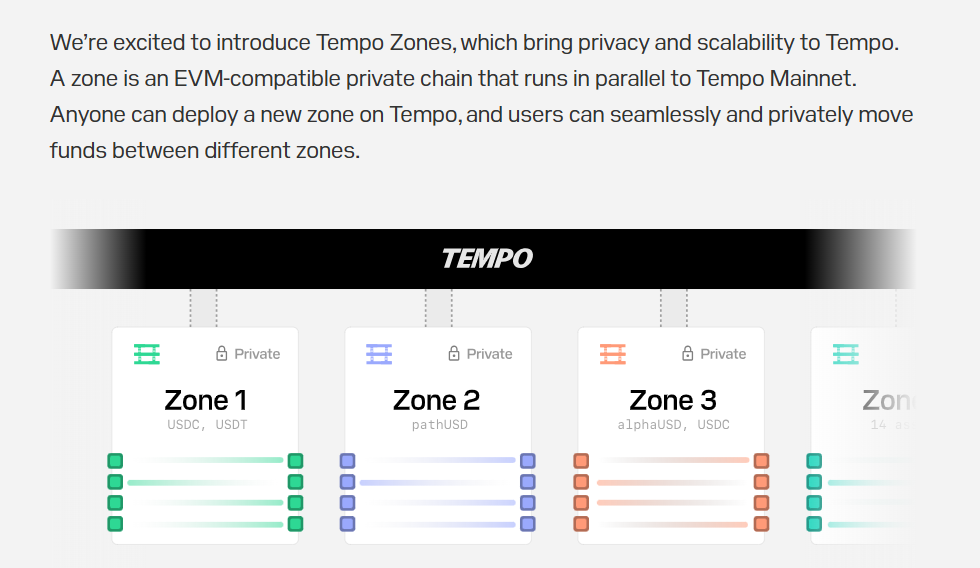
Tempo Zones. Source: Tempo
Each Zone is run by an operator that controls access and has visibility into transactions, while the public network verifies batched state updates and proofs. Tempo says this approach preserves the benefits of a public blockchain while offering the compliance and auditability enterprises expect from traditional financial systems.
Related: XRP Ledger taps Boundless for bank-grade privacy on public blockchains
While some projects rely on advanced cryptography to hide transaction data and provide user anonymity, Tempo argues that these approaches “introduce unnecessary operational complexity and usability tradeoffs.”
Some rivals prefer cryptographic privacy
Tempo’s operator-centric model has drawn criticism from some builders, who argue it weakens both privacy and self-custody. If a single party can access transaction data and control availability, they say, users are effectively trusting an intermediary rather than relying on cryptographic guarantees.
Projects like ZKSync, for example, rely on private chains anchored to public networks using zero-knowledge proofs. Arcium is exploring distributed models where data remains encrypted across nodes and only verified outputs are revealed, and Zama uses fully homomorphic encryption to enable computation on encrypted data.
Ghazi Ben Amor, senior vice president, business development at Zama, told Cointelegraph that, while the underlying cryptographic algorithms are “indeed extremely complex,” Zama abstracts that complexity and allows developers to code the smart contracts using Solidity and without any prior knowledge of cryptography.
He said that enterprises using Zama Protocol “don’t even notice any cryptography is operating behind the scene,” and argued that Tempo’s Zones are essentially private blockchains, no different from existing centralized payment systems, which have proven their limitations in terms of scalability.
Tempo did not immediately respond to Cointelegraph’s request for additional comment.


Subscribe to daily byte-sized crypto news from Cointelegraph
Cointelegraph is committed to independent, transparent journalism. This news article is produced in accordance with Cointelegraph’s Editorial Policy and aims to provide accurate and timely information. Readers are encouraged to verify information independently.
More on the subject