

 Written by Christina Combenstaff editorEdited by Andrew Fentonstaff editor
Is Robinhood Chain’s success bullish or bearish for ETH the asset?
MagazinePublishedJul 15, 2026
Surging volumes on Robinhood Chain could be very good for Ethereum, but only if the “ETH is money” crowd turn out to be right.

Robinhood Chain’s explosive launch this month has reignited one of Ethereum’s longest-running debates: Do successful layer-2 networks increase demand for ETH, the asset, or do the new entrants capture all of the value for themselves?
The retail brokerage’s Arbitrum-based Ethereum L2 has become one of Ethereum’s busiest rollups since its launch on July 1.
More than $141 million in Ether was bridged onto the chain in its first two weeks. DeFiLlama data shows more than half a million wallets now hold ETH on the network, and a memecoin frenzy saw Robinhood Chain surge past the Ethereum L1 and Coinbase’s Base L2 in 24-hour DEX trading volume.
Ether has pumped on the news, gaining around 15% from $1,582 on July 1 to $1,825 by July 13, according to Coingecko data, following a wave of bullish comments.
World Liberty Financial’s Eric Trump posted on July 11, “ETH is pumping hard! Great to see!” while Tom Lee, chairman of BitMine Immersion Technologies, argued the launch reinforces the thesis that “ETH is money,” pointing to the asset’s role as the chain’s native gas token and the L2’s finality on Ethereum’s mainnet.
Ethereum investors have heard similar arguments before.
Related: Robinhood L2 sparks ETH optimism, Saylor ‘muddies waters.’ Hodler’s Digest, July 5-12, 2026
Arbitrum, Optimism and Base each drove waves of users and activity onto Ethereum’s L2 ecosystem, but failed to move the needle meaningfully in Ether’s price, as most of the economic activity remained on the rollups themselves.
Robinhood Chain’s launch is arguably different. Unlike previous rollups built by crypto-native firms, the network was developed by a publicly listed retail brokerage with tens of millions of customers to support tokenized stocks and other real-world assets.
Within days of launch, it already accounted for 6.9% of all tokenized stockholders, according to data from Token Terminal.
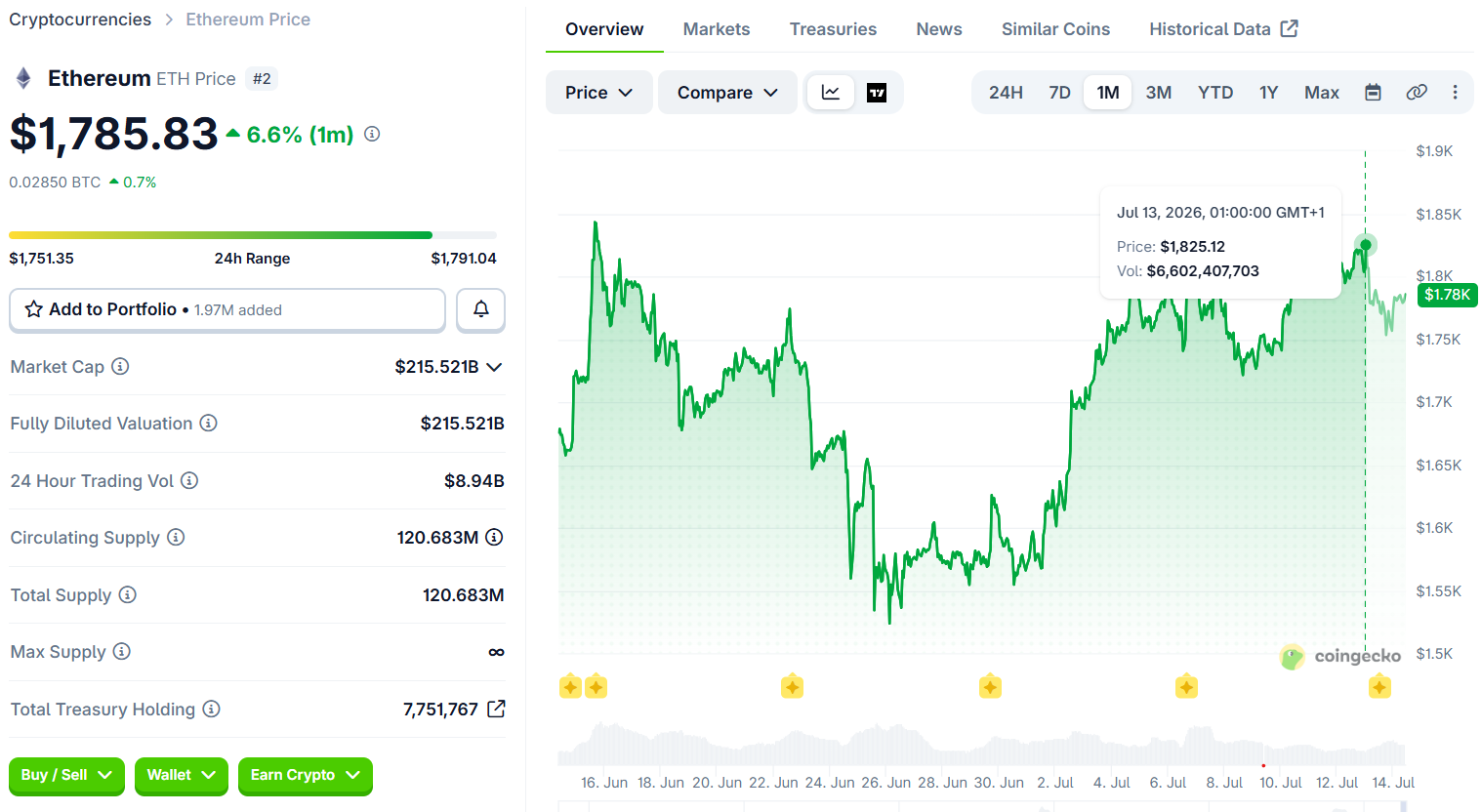
Ether price response to Robinhood Chain’s launch. Source Coingecko
And, if Robinhood’s model succeeds, it could encourage banks, brokers and asset managers to build L2s of their own, and cement Ethereum as the default blockchain for TradFi. Deutsche Bank is already in the process of building a ZK-powered Ethereum L2 called DAMA 2, focused on institutional finance.
Why Robinhood could be a turning point
Ethereum’s L2 networks use rollup technology to process transactions away from Ethereum’s main chain and periodically settle them back to the network. Robinhood Chain uses Arbitrum technology and is compatible with Ethereum’s wider ecosystem.
But what has caught the industry’s attention isn’t the technology itself, as much as who is using it.
“It’s a real milestone,” Alex Gluchowski, founder and chief executive of Matter Labs, the developer behind Ethereum L2 zkSync, told Cointelegraph.
“It shows Ethereum L2s have gone from something crypto-native teams experiment with to infrastructure a regulated, publicly listed company will run its business on.”
Rather than building a blockchain from scratch, as Stripe has opted to do with Tempo, Robinhood chose to tailor an Ethereum rollup to its own needs “for privacy, compliance and performance, while still inheriting Ethereum’s security and connecting to its liquidity,” he added.
Max Shannon, senior research analyst at Bitwise, told Cointelegraph that Robinhood Chain’s success is more significant than previous L2 deployments.
“It represents the growth of the Ethereum ecosystem, particularly among major institutions,” he said. “It also arrives at a time when Ethereum has more broadly repositioned itself toward institutions through Eth Labs and Ethereum Institutional.”
Does Robinhood Chain change the investment case for ETH?
For Shannon, Robinhood’s launch strengthens the investment case for Ethereum because it reinforces the network’s position as the leading blockchain for institutional adoption.
He said ETH has the “network characteristics” to become the reserve asset for a growing network of institutional L2s. But like many, he believes Ethereum’s tokenomics need to be improved so that increased network activity is reflected more clearly in demand for ETH.
Ethereum has been criticized frequently for its decision to lower fees for L2s as a way to spark adoption and gain network effects. Ark Invest’s Lorenzo Valente posted on July 14 that Robinhood Chain had generated $816,000 in revenue since launch, with Arbitrum taking a 10% cut, but only 0.15% of the total being paid back to Ethereum.
“If your thesis is ‘ETH is money,’ Robinhood building here is ultra bullish. More activity, more ETH collateral, more lindyness. If your thesis is ‘ETH is a revenue generating asset,’ this is the ultra-bear case.”
GrowThePie said that Valente’s figures for Eth’s share of the revenue were off by a factor of four and argued “0.6% of revenue is the correct figure.” But even the higher figure is not a meaningful driver of revenue to the L1. Robinhood Chain generated more gas fees than any other L2 in the past week, but Ethereum only saw $4,400 of that.
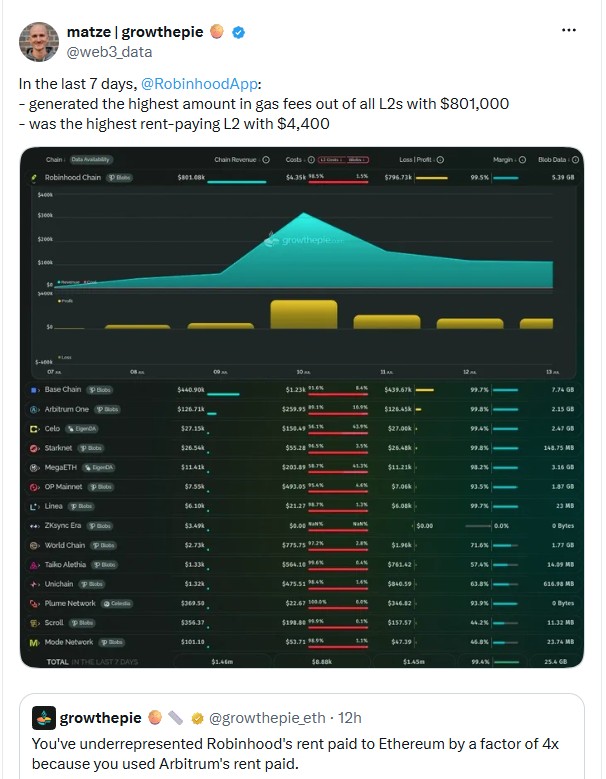
Source: Matze, GrowThePie
Gluchowski said ETH’s appreciation would not be based on fee revenue, but would likely come from becoming widely accepted money throughout the L2 ecosystems.
“People might pay fees in stablecoins or never think about gas at all,” he said. “But as more value settles through Ethereum, ETH starts to look less like a fee token and more like a base monetary asset for this system.”
Related: Robinhood says its AI agent feature will ‘soon’ be assisting crypto traders
Even ETH bears like Mike Dudas from 6th Man Ventures, have described Robinhood Chain as “the single most bullish thing I’ve seen in eth-land in years.”
But after Dudas saw Valente’s post, he added the proviso that “Eth cooked unless ‘eth is money’ takes off or the price of l1 settlement increases.”
The value accrual question remains
While Robinhood’s success may have bolstered the case for Ethereum’s scaling strategy, it has yet to settle one of the network’s biggest unanswered questions: how does growing L2 activity ultimately translate into value for ETH?
Shannon said that recent upgrades like Fusaka have improved Ethereum’s scaling capabilities, but despite transaction activity reaching record levels, demand has yet to translate into meaningfully higher fees or increased ETH burn.
“Robinhood will not solve this problem,” Shannon said, and the collective growth of L2s will likely not either… It requires a wholesale change in developer mindset and in ETH’s token economics.”
Another uncertainty is how much ETH institutional users will actually hold directly. As tokenized stocks and other RWAs increasingly trade against stablecoins, many users may rarely interact with ETH, even though it underpins the network behind the scenes.
Robinhood may have shown that a major financial institution is willing to build on Ethereum’s infrastructure, but whether that ultimately translates into stronger demand for ETH remains to be seen.
Magazine Ethereum’s much-hated staking ‘tax’ may already be obsolete


Subscribe to daily byte-sized crypto news from Cointelegraph
Cointelegraph publishes long-form journalism, analysis and narrative reporting produced by Cointelegraph’s in-house editorial team with subject-matter expertise. All articles are edited and reviewed by Cointelegraph editors in line with our editorial standards. Some articles contain affiliate links, from which Cointelegraph may earn a commission. These relationships do not influence which products we review or our editorial conclusions. Content published in here does not constitute financial, legal or investment advice. Readers should conduct their own research and consult qualified professionals where appropriate. Cointelegraph maintains full editorial independence.
More on the subject