



 Written by Dilip Kumar Patairyastaff writerEdited by Rahul Nambiampurathstaff editor
Why Strategy’s 32 Bitcoin sale became a bigger crypto debate
MagazinePublishedJun 8, 2026
Did Strategy abandon its Bitcoin strategy? Here are the facts behind the 32 BTC sale and why social media reacted so strongly.

Why the 32 BTC sale drew such a strong reaction
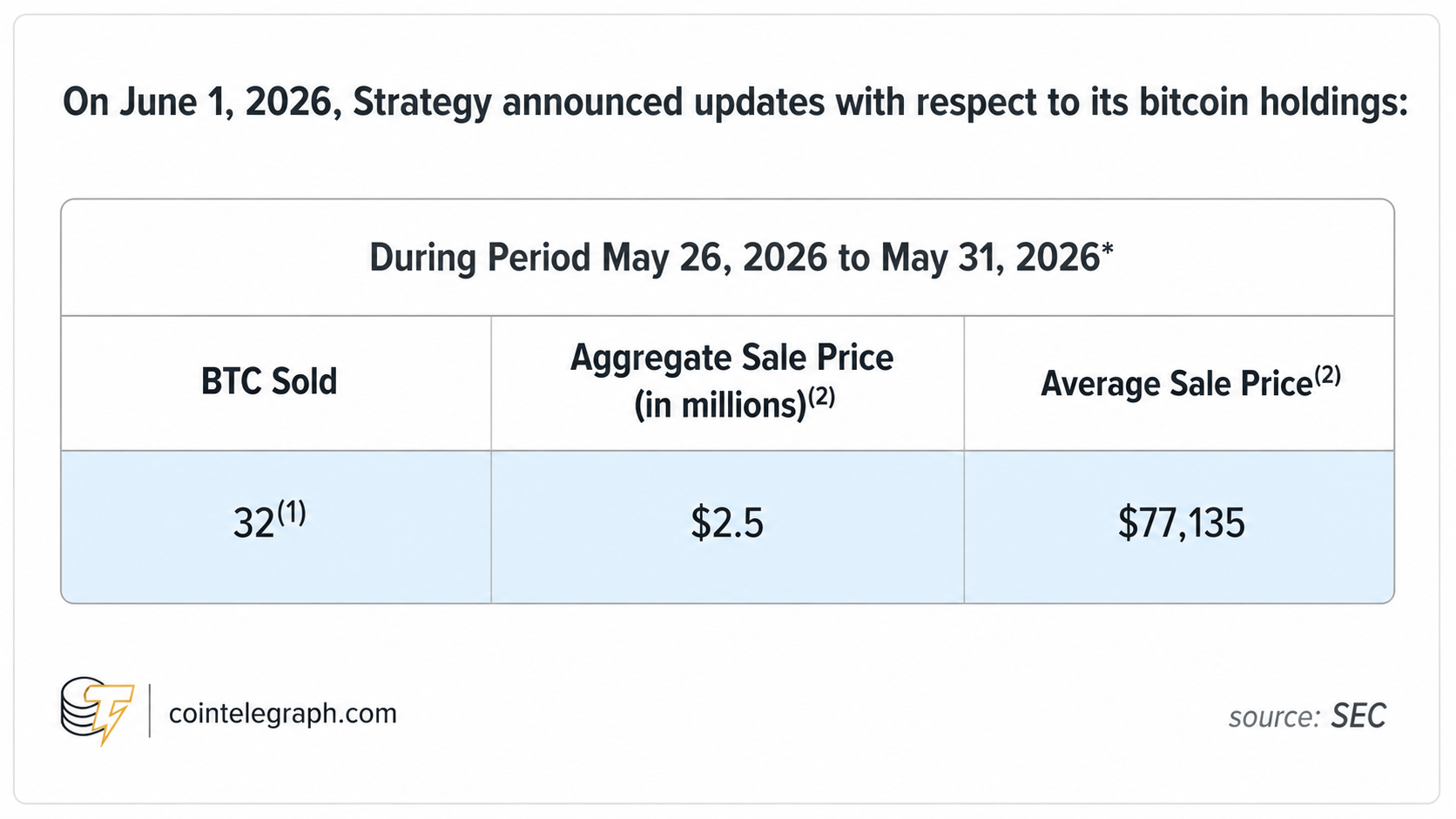
When Strategy, previously known as MicroStrategy, revealed it had sold 32 BTC for around $2.5 million, the reaction across crypto was fast and intense. Barron’s, The Wall Street Journal and MarketWatch all covered the news prominently because it challenged Strategy’s long-running hold-or-accumulate image.
Some observers saw it as a break from Michael Saylor’s longstanding commitment to Bitcoin. Others wondered whether the firm’s Bitcoin treasury approach was starting to show signs of pressure. Discussions spread quickly on X, Reddit and other platforms, often focusing on the simple fact that Strategy had sold Bitcoin.
Yet the actual trade was modest in scale. The company still held well over 843,000 BTC as of June 8, 2026, remaining by a wide margin the largest corporate holder of Bitcoin globally.
The real source of debate was not the 32 BTC sale itself. It was what the move appeared to represent and whether it signaled any meaningful change in one of the industry’s most closely watched Bitcoin strategies.
What exactly happened when Strategy sold 32 BTC?
Strategy sold 32 BTC between May 26 and May 31, raising roughly $2.5 million. In the context of Strategy’s total BTC holdings, this was a minor transaction. It accounted for less than 0.004% of the company’s total Bitcoin holdings.
For comparison, an investor holding 10,000 BTC would have sold the equivalent of less than half a coin.
Even so, the sale attracted wide attention because Strategy has come to represent long-term Bitcoin accumulation. Over several years, the firm has raised debt and equity to steadily build its Bitcoin position.
As a result, even a small reduction in its holdings was always likely to make headlines.
When Strategy first sold Bitcoin
While many online discussions described this event as entirely new, it was not Strategy’s first Bitcoin sale. The company had earlier sold 704 BTC in December 2022.
That sale took place during difficult market conditions after the failure of several major crypto firms. At the time, Strategy described it as a tax-loss harvesting measure. The company then quickly resumed buying Bitcoin and later increased its overall position.
Because the earlier sale was quickly followed by a larger Bitcoin purchase, later coverage has generally framed it as a tax-loss harvesting move rather than a strategic reduction in exposure.
The recent sale is different because it was not linked to tax-loss harvesting. Instead, it appears to be connected to the firm’s wider funding needs.
Did you know? Some investors buy Strategy shares instead of buying Bitcoin directly. This has made the company one of the most closely watched publicly traded firms tied to crypto, even though its original business was enterprise software.
Why Strategy sold Bitcoin this time
According to regulatory filings, funds from the sale are meant to support commitments tied to Strategy’s preferred stock programs.
Over the past year, the company has moved beyond simply acquiring Bitcoin. It has introduced several financing structures, including preferred shares aimed at investors seeking yield along with exposure to its Bitcoin holdings.
These shares come with ongoing obligations, such as dividend payments.
As a result, Strategy sometimes needs liquidity to meet those commitments. Limited Bitcoin sales may be needed at times to cover preferred-stock distributions. The latest sale appears to fit that approach.
The sale, therefore, looks more like a treasury management step than a broad retreat from Bitcoin.
Strategy sold 32 BTC but bought far more just days earlier
One reason many analysts viewed the reaction as overstated is that the sale came alongside much larger company activity.
Strategy reported selling 32 BTC between May 26 and May 31 to support dividend payments on its preferred shares. Yet just 13 days earlier, it had bought 24,869 BTC for about $2.01 billion. The firm was still a major net buyer of Bitcoin overall.
Analysts noted that the 32 BTC sale was not significant when compared with the company’s overall Bitcoin activity. Strategy continued to add Bitcoin in very large amounts, including a 24,869 BTC purchase in May 2026.
Together, the disclosures suggest a distinction between Strategy’s long-term Bitcoin accumulation strategy and smaller liquidity actions tied to its preferred-share programs.
Did you know? Long before Strategy became known for its Bitcoin purchases, Michael Saylor described Bitcoin as digital property. He argued that selling Bitcoin too early could be like selling prime Manhattan real estate before a major population boom.
Why social media reacted strongly to Strategy’s Bitcoin sale
The strong media response shows the unusual role Strategy plays in the broader Bitcoin market.
For years, Michael Saylor has stood out as one of Bitcoin’s most visible supporters. His public comments have often stressed the value of holding Bitcoin for the long term and viewing it as a strong store of value.
This has made many investors closely link the company with a firm Bitcoin accumulation approach. When reports of the Bitcoin sale appeared, some viewed it against those earlier positions. Critics said it clashed with years of public messaging, while others noted that the firm had kept nearly all its holdings intact.
The discussion soon moved away from the transaction details and toward questions of consistency, trust and what long-term commitment really means.
Social media further increased the attention. Simple headlines stating that Strategy had sold Bitcoin spread widely, often overshadowing details about the limited size of the sale and the reason behind it.
Does this signal a change in Strategy’s Bitcoin approach?
Based on the available filings, there is no clear evidence that Strategy is abandoning its Bitcoin-centered strategy.
Strategy remains the largest publicly traded corporate Bitcoin holder, with more than 843,000 BTC. The company has repeatedly said that Bitcoin serves as its primary treasury reserve asset on an ongoing basis, subject to market conditions and anticipated business cash needs.
The firm has also continued to raise capital through different channels as part of its Bitcoin acquisitions and capital management strategy.
The recent sale, by itself, does not prove a shift toward reducing reserves or cutting long-term exposure. Instead, the stated use of proceeds suggests that even a company focused on Bitcoin accumulation may sometimes use limited sales to meet financial obligations.
This difference matters because public companies face constraints that individual investors do not.
Did you know? When Strategy announced its first Bitcoin purchase in August 2020, very few public companies held Bitcoin as a treasury asset. The move helped popularize the idea of companies adding Bitcoin to their balance sheets.
Can a Bitcoin treasury firm truly follow a never-sell policy?
The transaction has prompted a wider discussion about whether any public company can realistically follow an absolute never-sell policy.
Unlike individual holders, companies must manage liabilities, financing costs, dividend requirements, debt payments and shareholder expectations.
Even when leadership remains strongly bullish on Bitcoin, there may be times when selling a small portion is the most reasonable way to meet those needs.
The recent move shows the gap between a guiding philosophy and the practical side of treasury management.
Strong belief in Bitcoin does not remove the operational demands of running a listed company.
As Strategy’s financial structure becomes more complex, investors may pay closer attention to how well the firm manages its commitments while preserving its Bitcoin position.
What matters beyond the transaction itself
For many observers and investors, the key issue is not the 32 BTC sale itself. It is whether the company’s overall Bitcoin exposure continues to grow over time.
The transaction had almost no effect on total holdings. Strategy’s Bitcoin position remains substantial, and the sale did not meaningfully change shareholder exposure.
Attention will likely center on continued Bitcoin accumulation, any further sales needed for preferred-stock commitments and how management balances liquidity needs with its broader Bitcoin strategy.
These factors may ultimately matter more than the sale alone.


Subscribe to daily byte-sized crypto news from Cointelegraph
Cointelegraph publishes long-form journalism, analysis and narrative reporting produced by Cointelegraph’s in-house editorial team with subject-matter expertise. All articles are edited and reviewed by Cointelegraph editors in line with our editorial standards. Some articles contain affiliate links, from which Cointelegraph may earn a commission. These relationships do not influence which products we review or our editorial conclusions. Content published in here does not constitute financial, legal or investment advice. Readers should conduct their own research and consult qualified professionals where appropriate. Cointelegraph maintains full editorial independence.
More on the subject