


 Written by Dilip Kumar Patairyaformer writerEdited by Rahul Nambiampurathformer editor
Why ZEC fell 40% even after Zcash patched a shielded pool bug
MagazinePublishedJun 5, 2026
ZEC fell 40% after Zcash disclosed and fixed a critical Orchard pool bug. Markets reacted strongly despite no confirmed exploitation.

Why ZEC fell after the Zcash bug fix
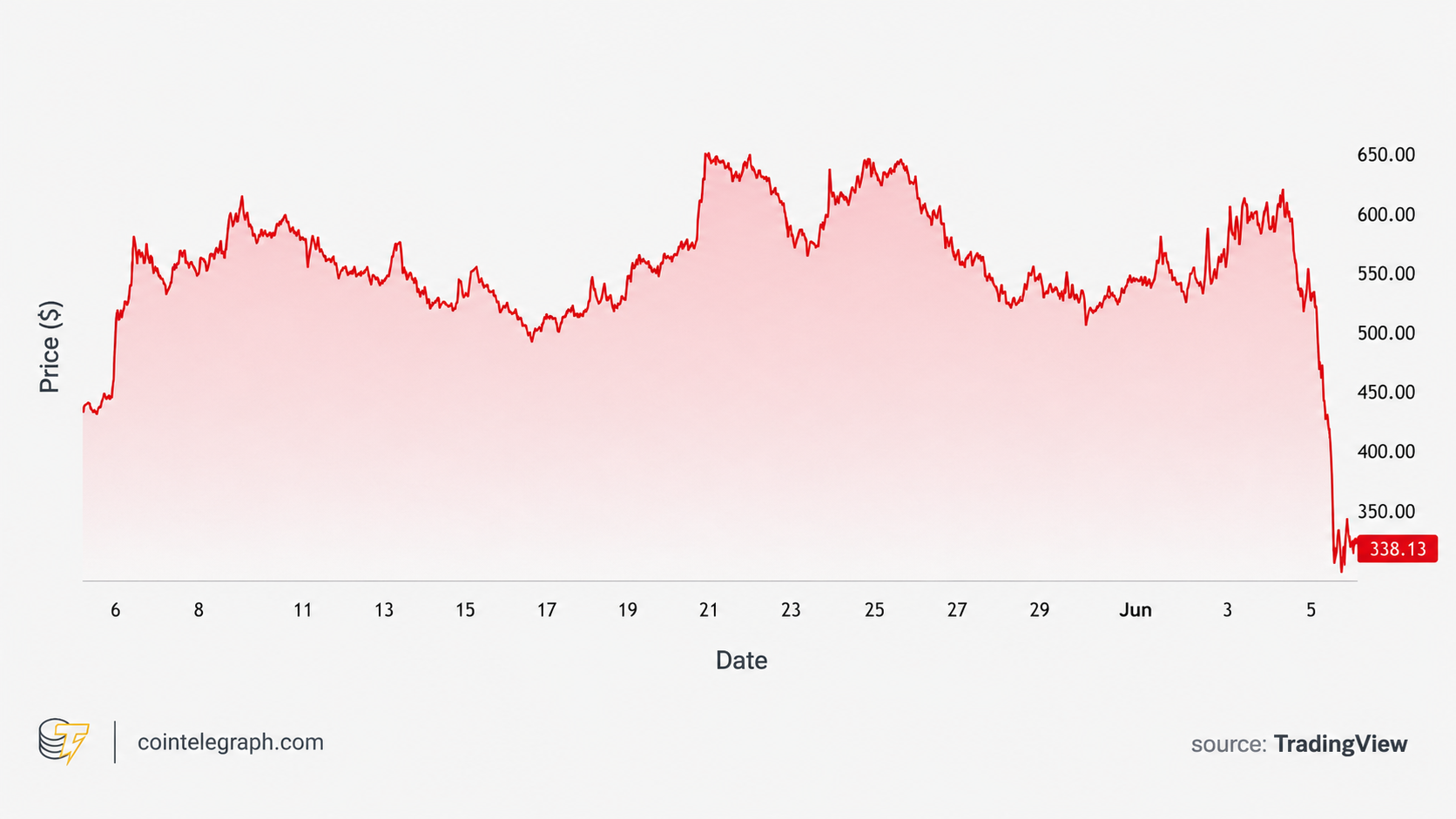
Zcash (ZEC), a major privacy-focused digital asset, fell around 40% after Zcash fixed a private pool bug in the first week of June 2026.
The cryptocurrency fell further, slipping below $350 and losing more than $3 billion in total market value. The crash followed Zcash’s official disclosure of a serious security vulnerability in the Orchard shielded pool.
The bug, a “soundness” vulnerability in the zero-knowledge proof circuit, may have existed since the Orchard pool was activated in 2022. In a protocol like Zcash, soundness refers to the network’s ability to validate only genuine ledger transactions and state changes. A soundness vulnerability is a structural flaw that can allow the system to approve state changes or operations that do not meet the required verification rules.
The vulnerability was found through an AI-assisted code review. It was reported through formal disclosure channels and quickly addressed through an urgent soft fork, followed by a permanent hard fork, NU6.2.
Although investigations found no signs of active exploitation and the network’s internal turnstile controls prevented unauthorized supply expansion, the event caused broad market concern. The case showed how difficult it can be to balance strong transaction privacy with security checks that users and markets can trust.
Zcash privacy and the Orchard pool
Zcash relies on zero-knowledge cryptography, specifically zk-SNARKs and later halo2_gadgets, to support confidential transactions. This technology hides transaction values and the cryptographic identities of both parties.
Over time, Zcash introduced several shielded pools: Sprout, Sapling and Orchard. Orchard was activated through NU5 on May 31, 2022, and brought improved efficiency, security and privacy features.
As the main infrastructure for private transactions on the network, the Orchard pool held a large volume of confidential assets. Estimates indicate that more than 4.5 million ZEC were subject to operational limits during the brief stabilization phase. Transparent transactions and Sapling-based transactions continued to work normally throughout the event.
However, the issues in Orchard weakened broader market confidence in the network’s core goal of private asset transfers.
Zcash has managed serious protocol flaws before through a preventive approach. For example, an earlier inflation risk in the Sprout pool was fixed without any loss of funds. That past case shaped mixed views within the ecosystem during the latest resolution process.
Did you know? The vulnerability was found with help from Claude Opus 4.8. It became one of the most high-profile examples of AI helping identify a critical blockchain security flaw before any known exploitation.
How the Zcash vulnerability was detected
On May 29, 2026, Taylor Hornby found the flaw while conducting ongoing Zcash security research commissioned by Shielded Labs. The review used Anthropic’s Claude Opus 4.8 along with a custom AI-powered analysis suite.
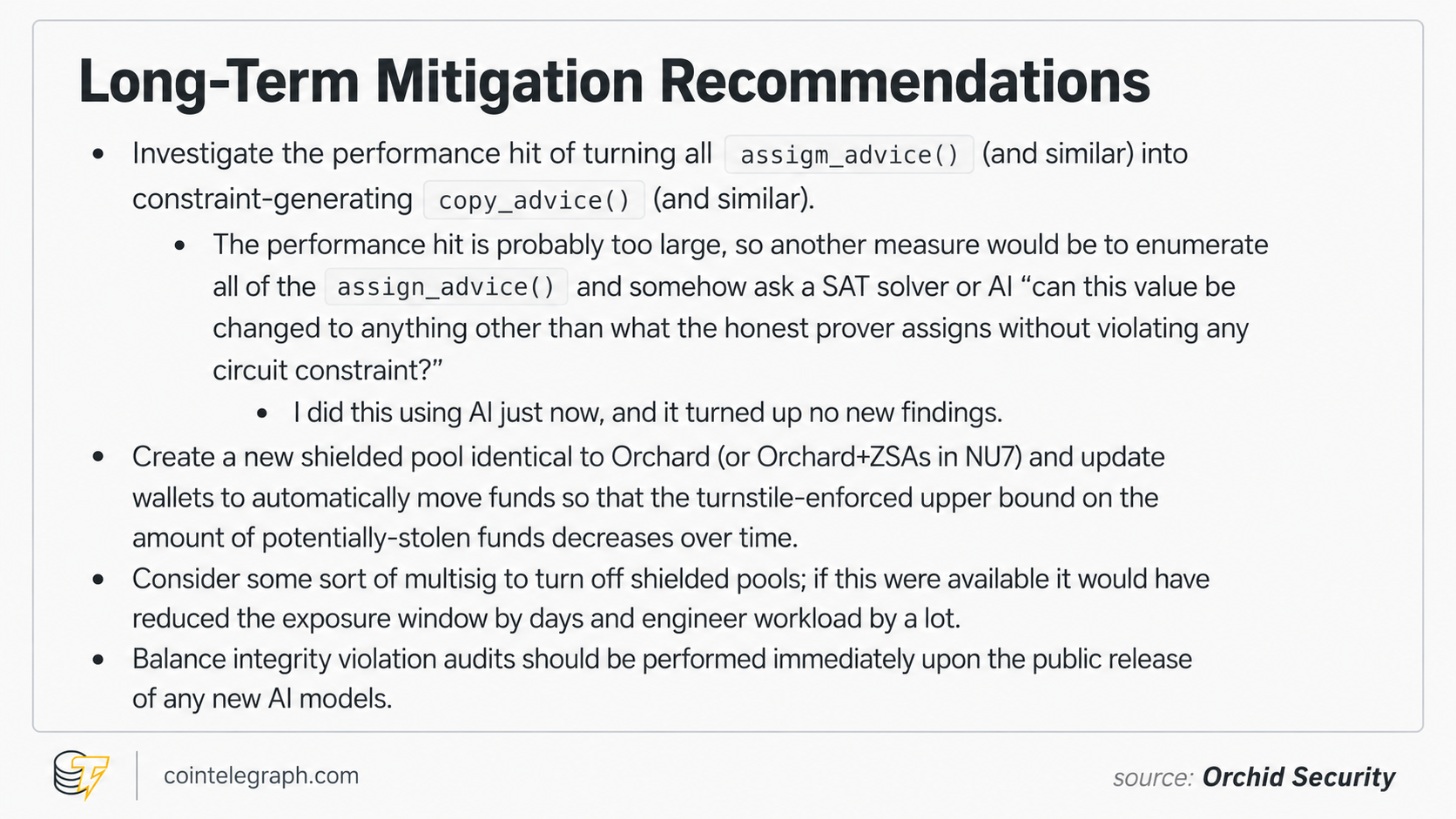
The main vulnerability was in the Orchard Action transaction logic. More specifically, it was in the halo2_gadgets component that handles variable-base scalar operations. The flaw came from using the assign_advice() function where the stricter copy_advice() function was required.
The flaw could have allowed Orchard to accept invalid state transitions, potentially enabling double-spending or counterfeit ZEC within the Orchard pool. Shielded Labs said Hornby, with help from Opus 4.8, wrote a complete exploit that generated unlimited, undetectable counterfeit ZEC in a local regtest environment.
A working proof-of-concept exploit was developed quickly. In a regtest environment, it could create large counterfeit amounts. However, the network’s turnstile invariant prevented unlimited total supply inflation and limited the impact to the shielded pool. Prior audits by top cryptographers and earlier AI models had missed the flaw.
Did you know? Zcash’s Orchard pool was introduced in 2022 as the network’s most advanced privacy system. It replaced older designs with better efficiency while preserving the project’s core goal of confidential transactions.
Zcash’s coordinated fix
Zcash Open Development Lab (ZODL), the Zcash Foundation (ZFND) and other ecosystem participants coordinated a response to address the vulnerability.
Key actions included:
- Promptly notifying core development teams about the issue.
- Deploying an emergency soft fork through Zebra 4.5.3, which activated near block 3,363,426 on June 2. The soft fork temporarily suspended Orchard-related actions to remove the immediate attack path.
- Activating the NU6.2 network upgrade on June 3 at block 3,364,600 through Zebra 5.0.0. This upgrade introduced a revised circuit, a replacement verifying key known as FixedPostNu6_2 and additional consensus safeguards. After these changes, Orchard functionality was restored.
A hard fork was required because fixing a zero-knowledge proof circuit bug meant updating the pinned verifying key. This could not be done through a regular node software patch alone. Node operators were urged to upgrade to Zebra 5.0.0 quickly. Throughout the process, the Zcash Foundation said there was no known exploitation, no evidence of unauthorized value creation, the total ZEC supply remained intact and user privacy was not affected.
On June 4, Zooko Wilcox, Jason McGee and Taylor Hornby released a detailed public explanation of the incident. They acknowledged that, because of Orchard’s privacy properties and the nature of the bug, there is no definitive cryptographic way to determine whether the vulnerability had been exploited before discovery and remediation. Still, they assessed prior exploitation as unlikely because the flaw had evaded years of expert review, was found through a deliberate white-hat effort and was fixed quickly.
Shielded Labs also outlined long-term plans. These included a possible new shielded pool with turnstile accounting to improve supply verification. It also planned continued AI-assisted security work with Hornby, a formal verification project for the Orchard circuit and hiring for security and cryptography roles.
Did you know? Even though the Orchard flaw could, in theory, have created counterfeit ZEC within the shielded pool, Zcash’s separate turnstile mechanism helped protect the overall ZEC supply from uncontrolled inflation by tracking balances and enforcing value-flow rules across pools.
What drove ZEC’s post-fix sell-off
Selling pressure increased around the disclosure and later protocol upgrades. Some market observers noted that ZEC initially showed resilience and briefly traded above $600 despite broader market weakness. However, sentiment shifted once details of the vulnerability became widely known. The asset later fell below $350.
Several factors contributed to the crash:
- Uncertainty over whether the flaw had ever been exploited.
- The inability to fully verify past activity within a privacy-preserving system.
- Reports that Arthur Hayes had liquidated his ZEC position in response to the incident.
- Renewed concerns about the complexity and perceived risks of privacy-focused cryptocurrencies.
The turnstile helped confirm that more ZEC did not leave Orchard than entered it. However, it does not make every internal movement inside the shielded pool publicly visible. That is why some observers remained concerned: A private-pool exploit could, in theory, distort balances inside Orchard while still staying within the pool’s public entry-and-exit limits. This does not prove exploitation occurred, but it explains why the market remained uneasy even after the fix.
Online discussion added to these concerns. In the Monero community, some participants argued that the temporary suspension of private transaction functionality exposed weaknesses in Zcash’s privacy and decentralization model. Comparisons were often made with Monero’s design.
On broader crypto forums, users focused on the temporary disruption affecting a major shielded pool. They also debated what the incident meant for confidence in the project.
Reactions within the Zcash community were more balanced. Some members stressed that the network had not been fully halted and noted that the vulnerability had been addressed before any confirmed exploitation. Others pointed to the transparent handling of the incident and the proposed supply-verification improvements as positive developments.
Some users acknowledged the short-term inconvenience caused by wallet and exchange upgrade requirements. However, many viewed the event as a major operational test that ultimately showed the network’s ability to respond effectively under pressure.
What comes next for Zcash
The incident highlights several broader themes that go beyond Zcash and are relevant to the wider crypto sector:
- The growing role of AI in cybersecurity: Advanced AI tools are making it easier to find highly complex vulnerabilities. While this strengthens defensive work, it also raises concerns that malicious actors could use similar tools to find vulnerabilities more efficiently.
- The tension between privacy and transparency: Systems designed to maximize privacy can make it difficult to determine whether certain exploits have occurred. This challenge has renewed discussion around how privacy-focused networks can improve supply verification without compromising their core principles.
- The importance of effective crisis management: The quick deployment of both temporary and permanent fixes showed that multiple ecosystem participants could coordinate under pressure and implement protocol changes within a short period.
- The influence of perception on asset prices: Market behavior is often driven by uncertainty and sentiment, not just technical factors. As a result, security concerns can quickly affect valuations even when fixes are already in place.
From a technical perspective, Zcash has addressed the underlying vulnerability, maintained the integrity of its monetary base and outlined additional investments in security research. These factors may help rebuild confidence over time. Still, market sentiment toward privacy-focused digital assets continues to fluctuate, and future developments will likely remain closely watched. Planned initiatives include expanded formal verification work and ongoing AI-assisted security assessments.
For users and investors, keeping software up to date and following announcements from official project channels remains essential. The situation also serves as a reminder to weigh both the potential benefits of privacy-enhancing technologies and the risks of complex cryptographic systems before taking financial exposure


Subscribe to daily byte-sized crypto news from Cointelegraph
Cointelegraph publishes long-form journalism, analysis and narrative reporting produced by Cointelegraph’s in-house editorial team with subject-matter expertise. All articles are edited and reviewed by Cointelegraph editors in line with our editorial standards. Some articles contain affiliate links, from which Cointelegraph may earn a commission. These relationships do not influence which products we review or our editorial conclusions. Content published in here does not constitute financial, legal or investment advice. Readers should conduct their own research and consult qualified professionals where appropriate. Cointelegraph maintains full editorial independence.
More on the subject