

 Written by Stephen Kattestaff writerEdited by Felix Ngstaff editor
Dorsey shares AI-integrated workplace vision weeks after Block’s 40% staff cut
Latest NewsPublishedApr 1, 2026
Block cut 4,000 of its staff in February as part of its AI-driven pivot. A new post by Block's Jack Dorsey has shed light on how the company and others might operate in the future.

Block co-founder Jack Dorsey has shared his vision of a future workplace where artificial intelligence could take the role of middle managers, weeks after the company cut around 4,000 employees because of AI.
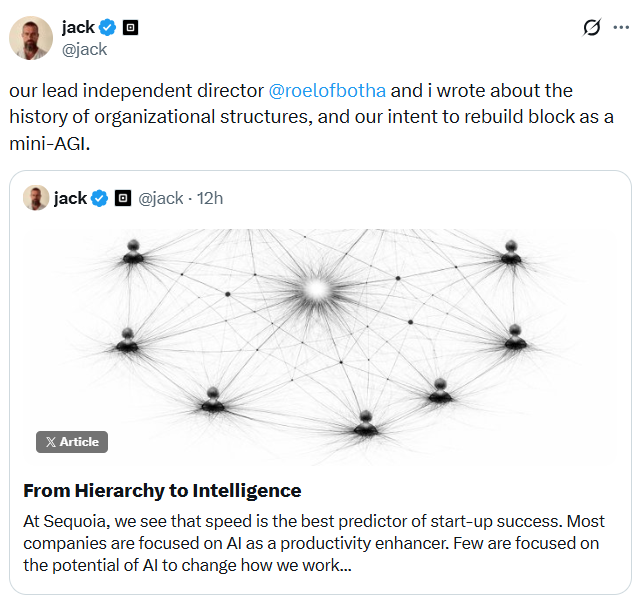
In a blog post on Tuesday, Dorsey and Block’s lead independent director, Roelof Botha, said AI can track projects, identify issues, assign work and share critical information faster than humans, adding that Block is in the “early stages” of transitioning toward a model where the technology performs these tasks.
“We're questioning the underlying assumption: that organizations have to be hierarchically organized with humans as the coordination mechanism,” they said.
“Instead, we intend to replace what the hierarchy does. Most companies using AI today are giving everyone a copilot, which makes the existing structure work slightly better without changing it. We're after something different: a company built as an intelligence, or mini-AGI.”
Many tech companies have been trimming roles, citing AI as the reason. Block cut roughly 40% of its staff in a major shake-up in February, a decision Dorsey attributed to the rapid acceleration of AI at the company and the need to stay competitive.
Source: Jack Dorsey
People will still play a key role
In March, some staff who lost their jobs at Block in February were quietly brought back.
Dorsey and Botha said that while AI may play a large role in the proposed company model, people will still be involved in making key business and ethical decisions.
Employees would also be reorganized into three roles: “individual contributors,” who build and maintain operating systems and “directly responsible individuals,” who are tasked with solving specific problems and have the freedom to use any resources needed.
“Player-coaches” will perform some manager-like duties, such as mentoring and supporting other workers, but they will also continue to write code and build.
Source: Roelof Botha
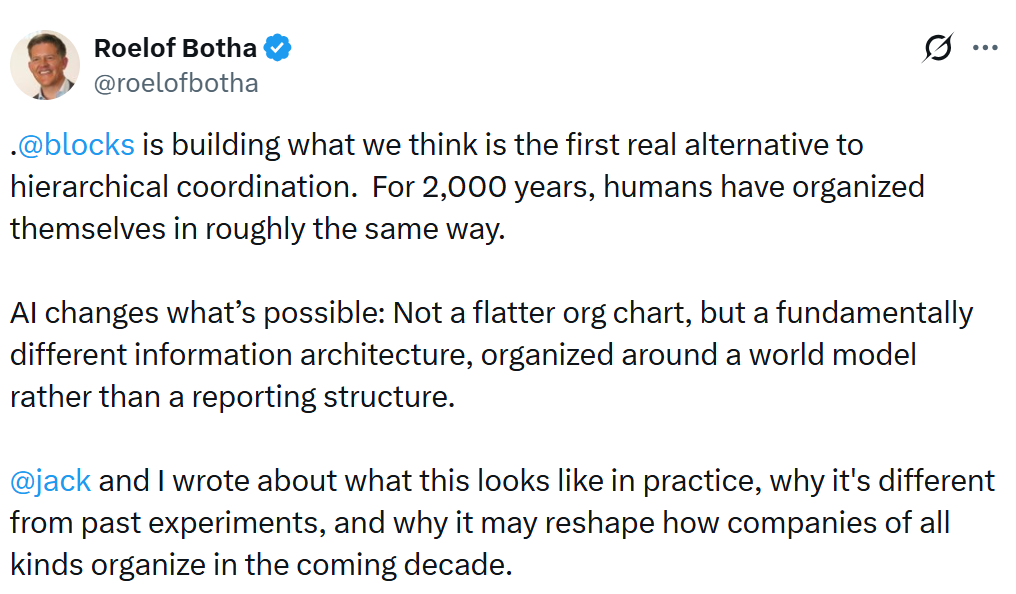
“We believe the pattern behind this, a company organized as an intelligence rather than a hierarchy, is significant enough that it will reshape how companies of all kinds operate over the coming years,” Dorsey and Botha said.
Human management is too slow, Dorsey and Botha say
Most companies operate using a hierarchy; information flows from workers to managers and then to executives and back down the chain in the same way.
Dorsey and Botha argue that this structure has proven effective in the past; however, AI can perform these tasks much more efficiently and provide benefits such as a real-time picture of how a product is performing rather than waiting for managers to pull reports and make decisions.
“In a remote-first company where work is already machine-readable, AI can build and maintain that picture continuously. What's being built, what's blocked, where resources are allocated, what's working and what isn't,” they said.
Related: Square rolls out Bitcoin payments at POS for eligible US merchants
“Companies move fast or slow based on information flow. Hierarchy and middle management impede information flow,” Dorsey and Botha added. “The question was never whether you needed layers. The question was whether humans were the only option for what those layers do. They aren't anymore.”
Magazine: Ripple joins Singapore sandbox, Bhutan’s big Bitcoin selloff: Asia Express


Subscribe to daily byte-sized crypto news from Cointelegraph
Cointelegraph is committed to independent, transparent journalism. This news article is produced in accordance with Cointelegraph’s Editorial Policy and aims to provide accurate and timely information. Readers are encouraged to verify information independently.
More on the subject