


 Written by Amin Haqshanasformer writerEdited by Bryan O'Sheastaff editor
Daily crypto liquidations nearly triple as leverage overheats: Glassnode
Latest NewsPublishedDec 3, 2025
Daily futures wipeouts are surging as leverage builds, with a record unwind in October exposing how deeply derivatives now shape Bitcoin’s market cycle.

Daily crypto liquidations have nearly tripled this cycle as rising open interest and broader exchange activity fuel a more heavily leveraged market.
According to a new report from Glassnode and Fasanara, average daily futures wipeouts have risen from about $28 million in long positions and $15 million in shorts in the last cycle to $68 million long and $45 million short this time around.
This was most evident on Oct. 10, during the reset researchers called “Early Black Friday.” During the sell-off, more than $640 million per hour in long positions were liquidated as Bitcoin (BTC) slid from $121,000 to $102,000. Open interest collapsed 22% in under 12 hours, from $49.5 billion to $38.8 billion, in what Glassnode called one of the sharpest deleveraging events in Bitcoin’s history.
Futures activity has expanded sharply, with open interest climbing to a record $67.9 billion. Trading volumes in futures markets have also surged, reaching as high as $68.9 billion in daily turnover in mid-October, with perpetual contracts making up more than 90% of activity, according to the report.
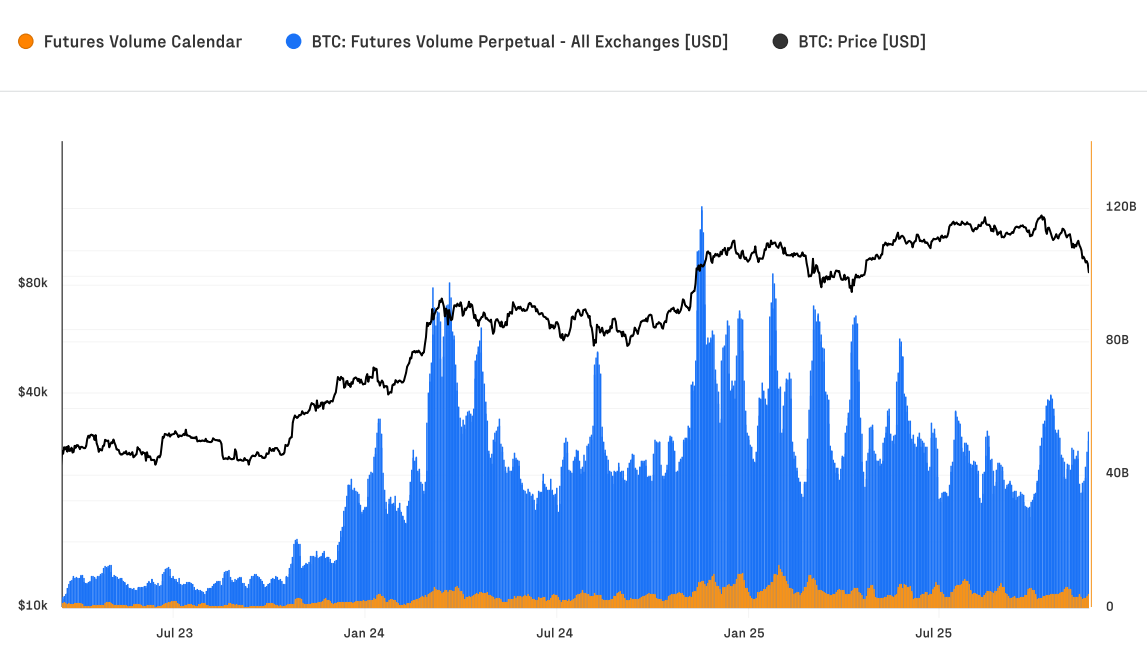
Bitcoin Futures market. Source: Glassnode
Related: $19B crypto market crash: Was it leverage, China tariffs or both?
Bitcoin spot volume doubles
Notably, Bitcoin’s spot trading volume has also doubled compared with the prior cycle, climbing into an $8 billion to $22 billion daily range, according to Glassnode. During the Oct. 10 crash, hourly spot volume spiked to $7.3 billion, more than triple recent peaks, as traders moved in to buy the dip rather than flee the market.
The report claimed that since US spot exchange-traded funds (ETFs) launched in early 2024, Bitcoin’s price discovery has shifted toward the cash market, while leverage has been increasingly built into futures. This shift has drawn capital into major assets, helping push Bitcoin’s market share from 38.7% in late 2022 to 58.3% today.
Capital flows tell the same story. Monthly inflows to Bitcoin have ranged from $40 billion to $190 billion, lifting its realized capitalization to a record $1.1 trillion and bringing more than $732 billion into the network since the 2022 cycle low, more than all previous cycles combined.
“This highlights a more institutionally anchored and structurally mature market environment,” Glassnode said.
The current market cycle covers the period from the November 2022 market bottom until now. The old cycle mainly refers to market behavior during the 2021 bull market until the 2022 crash.
Related: Bitcoin's lack of price strength due to sheepish spot buyers
Bitcoin competes with Visa as settlement rail
The report also pointed out Bitcoin’s role as a settlement network, which is now rivaling the world’s largest payment rails. Over the past 90 days, the Bitcoin network processed $6.9 trillion in transfers, surpassing volumes handled by Visa and Mastercard over the same period.
Meanwhile, Bitcoin’s supply is steadily shifting away from retail trading venues and into institutional hands. According to Glassnode, about 6.7 million BTC is now held across ETFs, corporate balance sheets and centralized and decentralized treasuries. Since early 2024, ETFs alone have absorbed about 1.5 million BTC, while balances on centralized exchanges have declined.
Magazine: 2026 is the year of pragmatic privacy in crypto — Canton, Zcash and more


Subscribe to daily byte-sized crypto news from Cointelegraph
Cointelegraph is committed to independent, transparent journalism. This news article is produced in accordance with Cointelegraph’s Editorial Policy and aims to provide accurate and timely information. Readers are encouraged to verify information independently.
More on the subject