

 Written by Turner Wrightstaff writerEdited by Robert Lakinstaff editor
Gaming groups urge Congress to ban prediction markets sports betting in CLARITY Act
Latest NewsPublishedJun 17, 2026
Gambling industry groups want the US Senate to step in to clarify that the Commodity Futures Trading Commission does not have the authority to oversee prediction markets.

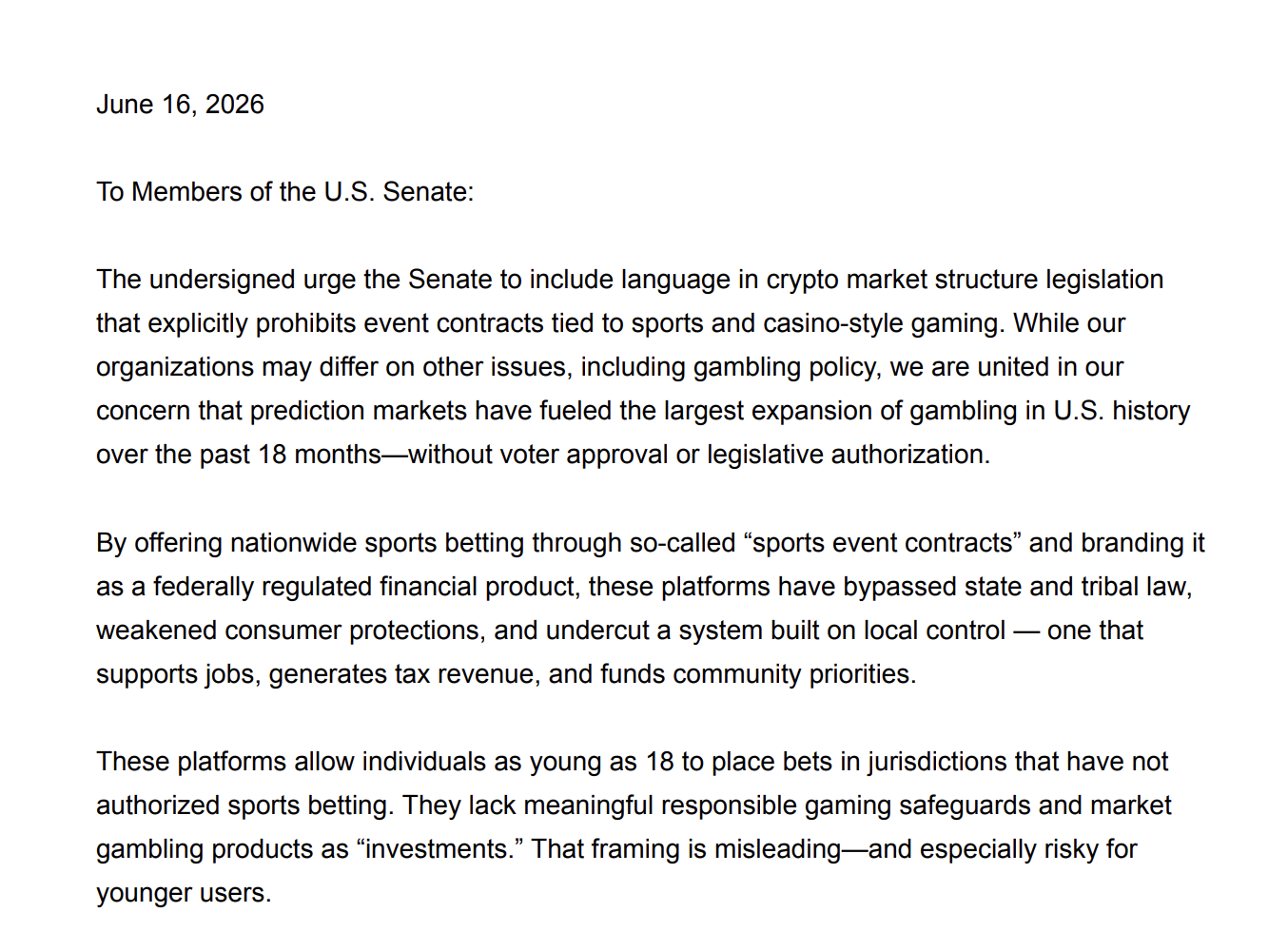
Several national gaming and tribal organizations and labor groups have reportedly called on the US Senate to add language “that explicitly prohibits event contracts tied to sports and casino-style gaming” in the Digital Asset Market Clarity (CLARITY) Act.
According to a Wednesday Semafor report, groups tied to sports betting, including the Indian Gaming Association and American Gaming Association have united against what they called gambling on prediction markets. They requested that the US Congress use the CLARITY Act now under consideration in the Senate to affirm that “sports betting falls outside the [Commodity Futures Trading Commission’s] remit and cannot be offered through prediction market platforms.”
“While our organizations may differ on other issues, including gambling policy, we are united in our concern that prediction markets have fueled the largest expansion of gambling in US history over the past 18 months — without voter approval or legislative authorization,” said the letter.
Source: Semafor
The pushback from the groups comes as the Commodity Futures Trading Commission (CFTC) under Chair Michael Selig has claimed “exclusive jurisdiction” over prediction markets. Selig has led the financial regulator in supporting platforms like Kalshi and Polymarket against lawsuits by state-level gaming authorities.
“The CFTC was created to oversee commodities and derivatives markets, not gambling and not sports wagering,” said the letter. “It lacks both the expertise and the infrastructure to police nationwide sports betting, particularly when robust state and tribal regulatory systems already exist.”
The American Gaming Association reported that as of Wednesday, state gaming authorities had lost about $1.08 billion in tax dollars “since prediction markets began offering sports event contracts.”
Related: Kalshi adds software partner as it looks to boost prediction market surveillance
Some lawmakers expect the CLARITY Act, aimed at transferring some of the authority in regulation and enforcement of digital assets from the Securities and Exchange Commission (SEC) to the CFTC, to be passed out of Congress by August. The bill passed the House of Representatives in July 2025, but has faced delays due to concerns over stablecoin yield, ethics and tokenized equities.
Legal fight could land in US Supreme Court
Some experts and industry advocates anticipate that with Selig and the CFTC threatening to take any state-level authorities to court over crackdowns on prediction markets, the dispute between federal and state regulators could eventually be heard by the US Supreme Court.
The country’s highest court gave individual states the authority to regulate sports gambling in its 2018 decision in Murphy v. National Collegiate Athletic Association. However, Kalshi, Polymarket and the CFTC have largely argued that event contracts on prediction market platforms are “swaps” only subject to the agency’s jurisdiction.
Magazine: The end of anon? AI could unmask crypto’s hidden identities


Subscribe to daily byte-sized crypto news from Cointelegraph
Cointelegraph is committed to independent, transparent journalism. This news article is produced in accordance with Cointelegraph’s Editorial Policy and aims to provide accurate and timely information. Readers are encouraged to verify information independently.
More on the subject