


 Written by Turner Wrightstaff writerEdited by Robert Lakinstaff editor
CFTC sues Minnesota, Governor Tim Walz over prediction markets ban
Latest NewsPublishedMay 19, 2026
About 24 hours after Minnesota Governor Tim Walz signed a bill into law passed by the state’s legislature to effectively ban prediction markets in the state, the CFTC pushed back with its own lawsuit.

The US Commodity Futures Trading Commission (CFTC), under Chair Michael Selig, has filed a lawsuit against the state of Minnesota and its officials after lawmakers passed a bill “prohibiting prediction markets-related activities.”
In a Tuesday filing in the US District Court for the District of Minnesota, the CFTC said that Minnesota, Governor Tim Walz, Attorney General Keith Ellison and the state’s director of the department of public safety, Jon Anglin, had passed the “first outright ban” on prediction markets in the country with Senate File (SF) 4760.
Signed into law by Walz on Monday, the bill amended Minnesota’s statutes to prohibit advertising, creating, operating or otherwise facilitating prediction market platforms, effectively banning them in the state. The law, set to go into effect on Aug. 1, specifically said that the event contracts on prediction markets platforms like Kalshi and Polymarket, including sporting events, military conflicts and weather were effectively “wagers” and therefore prohibited.
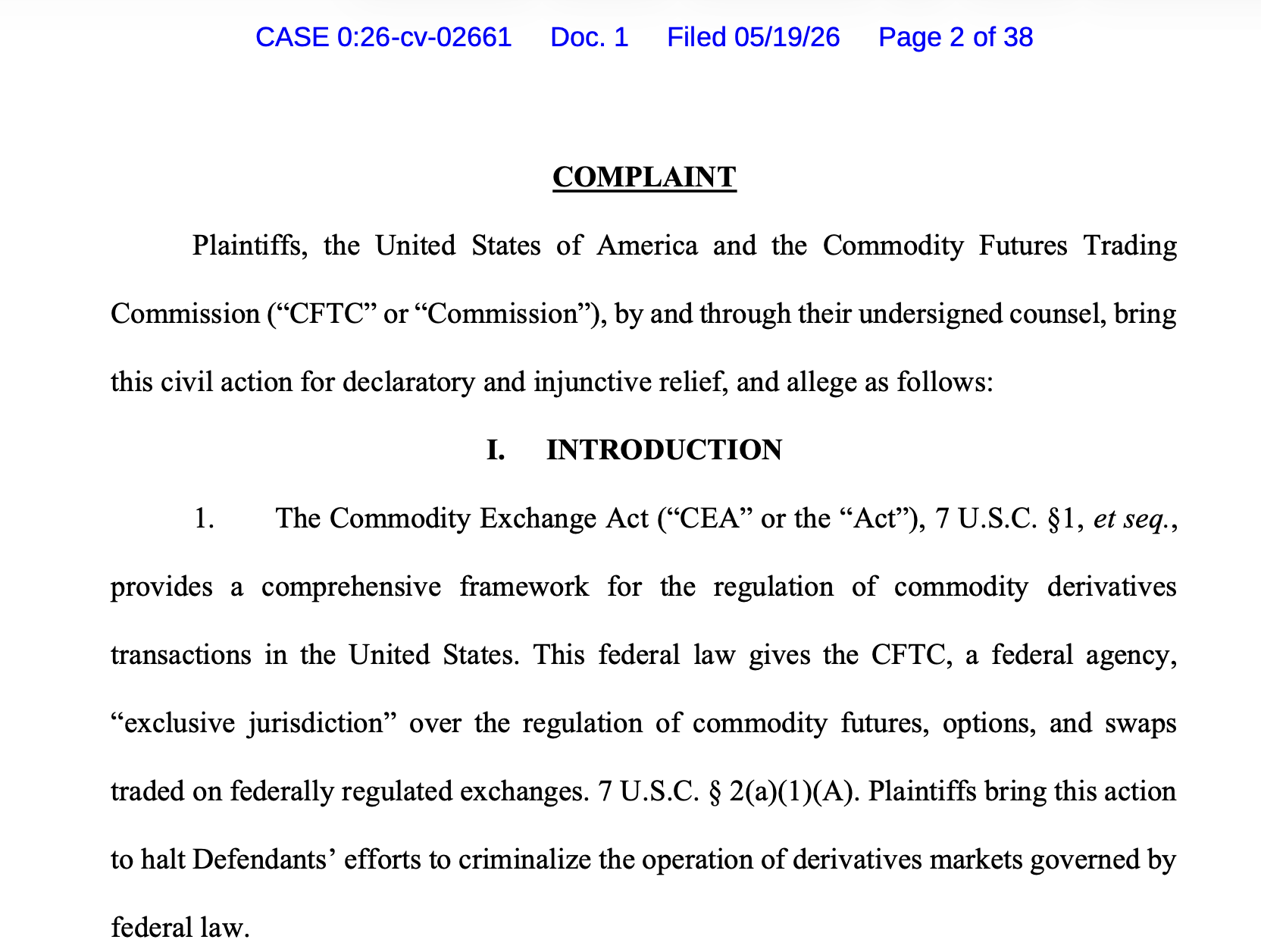
Source: CFTC
The CFTC claims in its lawsuit that it has “exclusive jurisdiction” to oversee prediction markets under the Commodity Exchange Act. The commodities regulator asked a court to “preliminarily and permanently” block the Minnesota law based on the legal premise that event contracts on the platforms were “swaps” to be regulated exclusively by the CFTC.
“If permitted to go into effect, Minnesota law will criminalize exchanges that the Commission has expressly approved, as well as event contracts that have been self-certified to the Commission and that the Commission has permitted to be listed,” said the lawsuit. “These consequences directly harm the federal government’s legally protected interest in enforcing federal law.”
Related: Crypto’s CLARITY Act faces partisan fight over ethics on Senate floor
Selig, who currently serves as the sole commissioner in the absence of nominations from US President Donald Trump, has repeatedly claimed that state-level actions against prediction market platforms would be challenged in court. Lawmakers have pressed Trump to nominate additional commissioners to form a five-person bipartisan panel at the CFTC, but the president had not announced any picks as of Tuesday.
Several state authorities have filed complaints challenging prediction market platforms’ activities, specifically alleging illegal sports betting and other prohibited actions, but Minnesota’s law appeared to be the first outright ban passed by lawmakers. The CFTC has recently sided with Kalshi in a state-level action filed in Ohio, as well as against authorities in Connecticut, Illinois, and New York over similar actions against prediction markets.
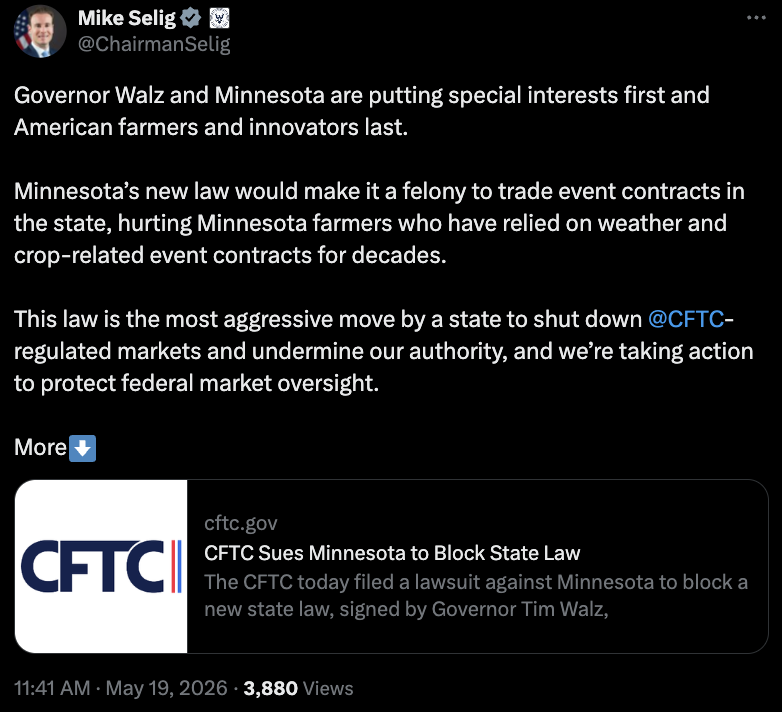
Source: Michael Selig
Cointelegraph sought comment from Polymarket but did not receive an immediate response. A Kalshi spokesperson said that the Minnesota law was “unenforceable” and a “blatant violation of the constitution and federal law.”
Minnesota passing other laws covering crypto users, investors
On Friday, Walz signed a bill into law permitting Minnesota-based banking institutions and credit unions to offer and perform “certain virtual-currency custody services.” Like the prediction markets ban, the law is set to go into effect on Aug. 1.
Minnesota lawmakers also worked to ban crypto kiosks and ATMs across the state in response to incidents of residents being scammed. Walz signed the bill into law on May 5.
Magazine: Crypto scammers face death, Aussie CGT makes Asian hubs attractive: Asia Express

Subscribe to daily byte-sized crypto news from Cointelegraph
Cointelegraph is committed to independent, transparent journalism. This news article is produced in accordance with Cointelegraph’s Editorial Policy and aims to provide accurate and timely information. Readers are encouraged to verify information independently.
More on the subject