


 Written by Xin YancontributorEdited by Cath Jenkinformer editor
Governments need CBDCs to improve financial inclusion among citizens
OpinionPublishedMar 25, 2026
CBDCs bridge the 1.3 billion unbanked cash-digital divide. Governments must actively promote them as trusted, low-cost gateways to formal financial inclusion.

Opinion by: Xin Yan, co-founder and CEO of Sign.
Financial exclusion remains one of the most persistent challenges for national governments. World Bank data highlights how more than 1.3 billion adults remain unbanked, without access to a financial account. These people rely on cash, creating a ‘cash-digital divide’, which excludes them from the formal economy.
To bridge the divide, governments need to promote CBDCs actively. As a trusted, risk-free alternative to physical cash, CBDCs are ideal instruments for the financially excluded demographic. With a seamless entry point to the financial ecosystem, mass adoption of CBDCs is a vital catalyst and a foundational pillar for achieving universal financial inclusion.
Wider access to financial institutions is key to stimulating a country’s growth. As more people invest and participate in the formal economy, the total capital base will expand, leading to greater financial stability. Further, bringing people within the formal economy ensures the benefits of policy rate changes reach the masses, bolsters regulatory oversight and prevents fraud.
Most people within the low-income demographic depend on cash payments because cash is easy to use, accepted everywhere, does not incur transaction charges and functions as a trusted medium of exchange.
The infrastructure needed to handle cash creates a gap between the unbanked population and the formal economy.
Financial inclusion as government policy
Establishing physical touchpoints to manage, store and handle cash at remote locations is resource-intensive. That’s why most service providers back out of offering cash-dependent financial services due to the high operational expenses.
Cash transactions also don’t leave a digital record, leading to an information vacuum for financial service providers. Consequently, institutions club the entire unbanked population as a high-risk group, denying access to insurance and credit markets.
Related: US lawmakers warn temporary CBDC ban isn’t enough, demand ‘permanent’ block
The lack of access to affordable digital payments and the absence of transaction history erode financial well-being and hinder a country’s economic growth. In this scenario, widespread access to formal financial services becomes an important government agenda.
Some central banks consider financial inclusion to be a key component of their mandate and adopt policies to ensure universal access to the formal economy. To this end, some central banks have considered issuing CBDCs to fast-track the process of developing an inclusive financial ecosystem.
CBDCs can accelerate financial inclusion
According to a 2023 study by Kosse and Mattei referenced by the IMF, about 60% of emerging and low-income countries consider financial inclusion to be one of the top three motivations for issuing a CBDC. The high confidence in CBDC stems from its properties to become the ideal bridge to the formal economy for the unbanked demographic.
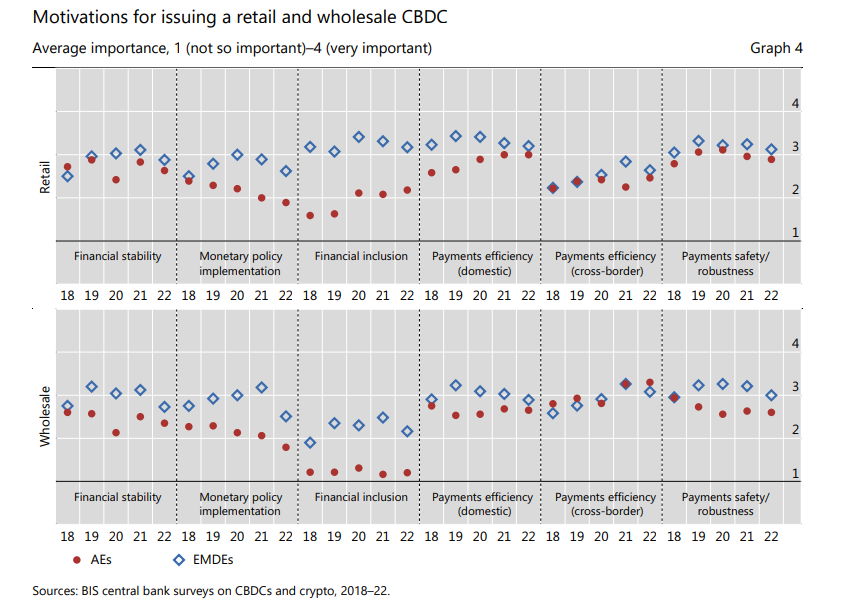
Source: BIS Central Bank Surveys on CBDCs and Crypto.
CBDCs can operate via a two-tier distribution model. This model allows both commercial banks and non-banking entities to reach the financially excluded demographic. Besides expanding the financial ecosystem’s reach, non-banking intermediaries lower the high overhead costs of legacy branch-based banking.
As a significant portion of the unbanked population doesn’t have stable internet or mobile connectivity, offline transaction support is necessary. Experts have noted how CBDCs are being designed to support robust offline capabilities. Exploring high-potential technologies for short-range communication ensures resilient CBDC payments in remote areas where there is limited connectivity.
As a public-sector digital infrastructure, CBDCs are designed to prioritize public welfare over commercial profit. Stripping away the bloated overhead of legacy intermediary layers, CBDCs enable a highly optimized cost structure.
Instead of burdensome charges, users benefit from marginalized transaction costs that are de minimis, ensuring the network remains both accessible to the unbanked and economically resilient for the sovereign issuer.
Moreover, the underbanked population is more likely to trust CBDCs as a digital alternative to cash because they are aided by a credible institution. Unlike the liquidity constraints of private financial entities, CBDCs will always remain a direct liability of the central bank, making them somewhat safe.
Most importantly, CBDCs provide a portal for the financially excluded population to participate in the formal economy. It happens through the smooth exchange of transaction data between CBDCs and the broader financial services industry.
CBDCs can support privacy-preserving data sharing, allowing users to voluntarily share their transaction history to build credit scores to access savings, credit, and insurance services.
In the absence of formal credit history, lenders can use CBDC transaction data as a legitimate source to evaluate financial behavior and creditworthiness. Service providers would therefore be able to measure a customer’s risk profile and verify identity to offer credit and other financial products.
Toward CBDC mass adoption
CBDC usage is subject to digital literacy, electricity infrastructure, and access to hardware. Data shows that nations have already made enormous progress on all these fronts.
The 2025 Global Findex Database from the World Bank Group has reported that 86% of adults now own a mobile phone. Also, 79% of adults now have a bank account, and 61% are making digital payments across low and middle-income economies.
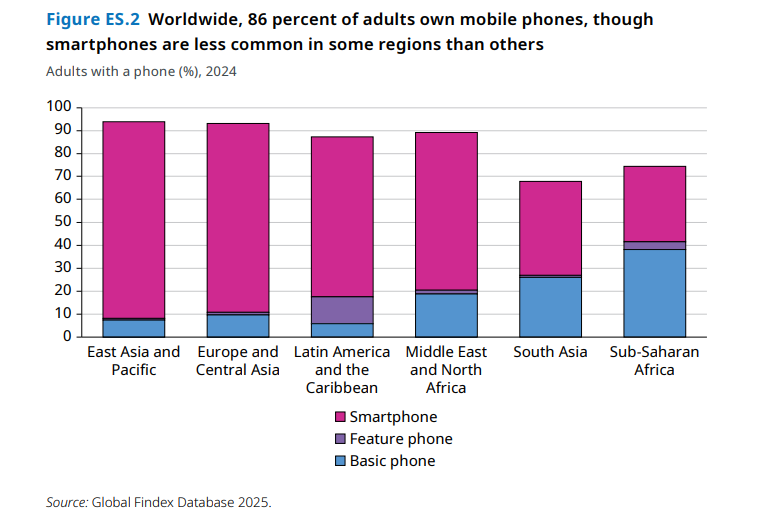
Source: Global Findex Database, 2025.
The report interestingly states that “despite high mobile phone ownership and growth in account ownership, 1.3 billion people still lack financial accounts.” This group of people have phones, personal ID, and SIM cards, which are necessary for a digitally enabled account.
Yet, they remain financially excluded from the formal economy.
In this situation, CBDCs remain one of the primary products that can offer safe, affordable, and convenient financial services to consumers.
Central banks and national governments must adopt a holistic approach and use CBDCs to help the financially inexperienced demographic integrate with the formal economy.
Opinion by: Xin Yan, co-founder and CEO of Sign.


Subscribe to daily byte-sized crypto news from Cointelegraph
The views, thoughts and opinions expressed here are the author’s alone and do not necessarily reflect or represent the views and opinions of Cointelegraph.
More on the subject