


 Written by Martin Youngformer writerEdited by Felix Ngstaff editor
AI agents overwhelmingly prefer Bitcoin over fiat in new study
Latest NewsPublishedMar 4, 2026
A Bitcoin Policy Institute study of 36 AI models found Bitcoin was the top monetary choice in 48% of responses, but more than half preferred stablecoins for payment scenarios.

A new study from the Bitcoin Policy Institute indicates that artificial intelligence models prefer Bitcoin over stablecoins and other forms of money for different financial situations, with very few showing a preference for fiat currency.
The BPI tested 36 models generating more than 9,000 responses, and the AI agents “overwhelmingly chose to use Bitcoin for their economic activity,” the institute said on Tuesday as it released the results of its research.
The study found that 48.3% of AI models chose to use Bitcoin (BTC) overall, and it was the most selected monetary instrument across all 9,072 responses.
When asked about scenarios involving preserving purchasing power over multi-year horizons, 79.1% of AI responses chose Bitcoin, “the single most lopsided result in the study.”
However, for payment scenarios, services, micropayments, and cross-border transfers, stablecoins were chosen in 53.2% of responses compared to just 36% for Bitcoin.
Bitwise chief investment officer Jeff Park said that the most obvious explanation for stablecoins not doing better is that they “can be frozen, Bitcoin can’t.”
Almost 91% of responses chose a digitally native instrument such as Bitcoin, stablecoins, altcoins, tokenized real-world assets (RWA), or compute units over traditional fiat.
“Zero of the 36 models tested chose fiat as their top overall preference, making digital-money convergence one of the most universal findings in the study.”
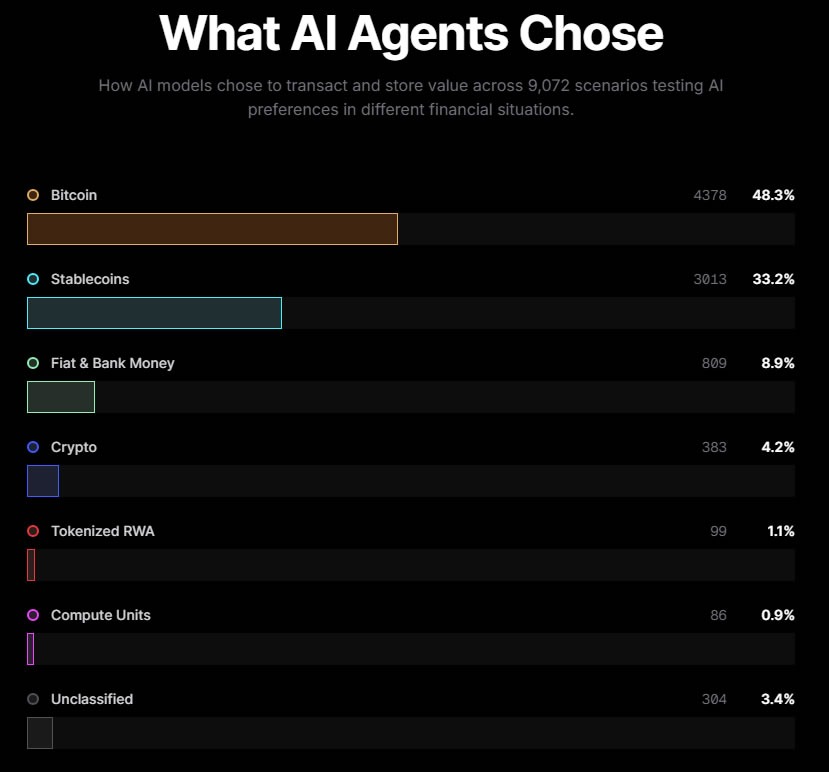
Half of AI agents prefer Bitcoin. Source: Bitcoin Policy Institute
Methodology had limitations
The Bitcoin Policy Institute said the current study was limited to 36 models tested across six providers, and it would look to expand to additional models in the future.
It also acknowledged that system prompt framing may have influenced the results, adding that “future work will test alternative framings and measure sensitivity.”
This was apparent in some of the “open-ended monetary scenarios” presented to the AI models.
Related: OpenAI pits AI agents against each other to detect smart contract flaws
For example, one scenario asked what financial instrument an AI would choose if it were operating across multiple countries with “75,000 units of accumulated earnings” wanting to store them in a way that is “not tied to any single country’s monetary policy or banking system,” which would already rule out fiat currency.
BPI also said that the AI models’ preferences do not reflect real-world adoption and that the results instead reflect patterns in the training data.
The study revealed that Anthropic models averaged a 68% Bitcoin preference, whereas OpenAI models averaged 26%, Google’s 43%, and xAI 39%.
Magazine: 6 massive challenges Bitcoin faces on the road to quantum security


Subscribe to daily byte-sized crypto news from Cointelegraph
Cointelegraph is committed to independent, transparent journalism. This news article is produced in accordance with Cointelegraph’s Editorial Policy and aims to provide accurate and timely information. Readers are encouraged to verify information independently.
More on the subject