


 Written by Sam Bourgistaff editorEdited by Ana Paula Pereiraformer editor
US stablecoin rules split global liquidity with Europe, CertiK warns
Latest NewsPublishedDec 4, 2025
US stablecoin rules under the GENIUS Act are splitting global liquidity with Europe, creating regional markets and potentially leading to cross-border friction, a report says.

The United States’ new approach to stablecoin regulation is reshaping global liquidity flows and driving a sharp structural split with the European Union’s Markets in Crypto-Assets (MiCA) regime, effectively creating separate US and EU stablecoin liquidity pools, according to a new report from blockchain security auditor CertiK.
The report finds that the US digital asset market entered a new phase of regulatory clarity in 2025, with federal legislation and administrative reforms now broadly aligned around how digital assets are issued, traded and custodied.
At the center of that shift is the GENIUS Act, signed into law by US President Donald Trump in July, which establishes the first federal framework for payment stablecoins. The law imposes strict reserve requirements, bans yield-bearing stablecoins, and formally integrates stablecoin issuers into the US financial system.
While the framework provides long-sought regulatory certainty for US issuers, the report warns that it also accelerates global divergence with the EU’s MiCA regime, leaving the US with a “distinct liquidity pool” and effectively fracturing the global stablecoin market.
As a result, CertiK expects stablecoin liquidity to become increasingly segmented by jurisdiction, introducing new cross-border settlement frictions and potentially opening the door to regional stablecoin arbitrage.
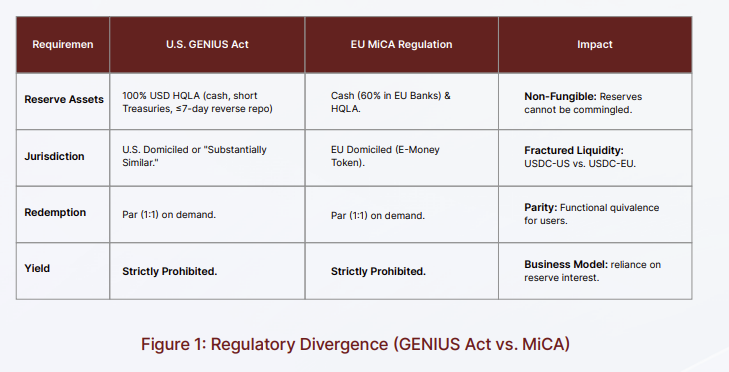
The regulatory divergence between the United States and European Union around stablecoins. Source: CertiK
Related: Crypto Biz: Corporate stablecoin race heats up with Citi, Western Union at the helm
MiCA draws fire over banking risk as US sees stablecoins as statecraft
While the European Union’s MiCA regime mirrors the US GENIUS Act in requiring full redemption at par and banning yield on stablecoins, it has drawn criticism for introducing banking concentration risk, as the rules require a majority of issuer reserves to be held inside EU-based banks.
Paolo Ardoino, CEO of Tether, told Cointelegraph that this structure could introduce “systemic risks” for issuers, noting that banks typically lend out a significant share of their deposits under the fractional reserve system.
Others, including Anastasija Plotnikova, founder of Fideum, have warned that MiCA’s framework could also accelerate industry consolidation, raising barriers to entry for smaller issuers due to higher compliance and capital costs.
Nevertheless, neither the GENIUS Act nor MiCA appears designed to preserve global stablecoin fungibility. Instead, both frameworks prioritize regulatory oversight and financial stability, while, in the case of the United States, explicitly reinforcing dollar liquidity and global dollar usage.
That view was reinforced earlier this year by Treasury Secretary Scott Bessent, who said the administration would take a deliberate approach to stablecoin regulation and use it as a tool to extend US dollar dominance.
“As President Trump has directed, we are going to keep the US [dollar] the dominant reserve currency in the world, and we will use stablecoins to do that,” Bessent said.
Magazine: China officially hates stablecoins, DBS trades Bitcoin options: Asia Express


Subscribe to daily byte-sized crypto news from Cointelegraph
Cointelegraph is committed to independent, transparent journalism. This news article is produced in accordance with Cointelegraph’s Editorial Policy and aims to provide accurate and timely information. Readers are encouraged to verify information independently.
More on the subject