

Written by Nihatcan YanikCommissioned Content
Written by Nihatcan YanikCommissioned Content
BNB Chain year-in-review: Key 2025 upgrades laying the foundation of 2026 roadmap
CommissionedPublishedJan 23, 2026
A series of technical upgrades, capped by the Fermi hard fork, reduced block times as BNB Chain continued adjusting its infrastructure to higher transaction volumes.
Commissioned byBNB Chain
Disclaimer. This content is part of a paid partnership. The text below is a sponsored article that is not part of Cointelegraph.com editorial content. The material is written by our advertorial team and has undergone editorial review to ensure clarity and relevance, it may not reflect the views and opinions of Cointelegraph.com. Readers are encouraged to conduct their own research before taking any actions related to the company. Disclosure.

BNB Chain’s 2025 review shows how blockchain infrastructure is increasingly shaped by production demand, with reliability, cost efficiency and predictable performance taking precedence over theoretical peak metrics.
In 2025, expectations for blockchain infrastructure have shifted. Networks are no longer evaluated mainly on peak throughput claims or short-term growth metrics. For chains used in trading, payments and asset issuance, sustained reliability became the defining measure of success.
That context frames how decentralized blockchain ecosystem BNB Chain evolved over the past year, with changes driven largely by production usage rather than experimental targets.
A year of constant traffic
Throughout 2025, which marked the network’s fifth anniversary, BNB Chain processed increasing transaction volumes without recorded downtime. Daily activity rose steadily across decentralized finance (DeFi), trading and stablecoin transfers, with total value locked increasing by roughly 40% over the year. At its peak, the network recorded approximately 31 million transactions in a single day.
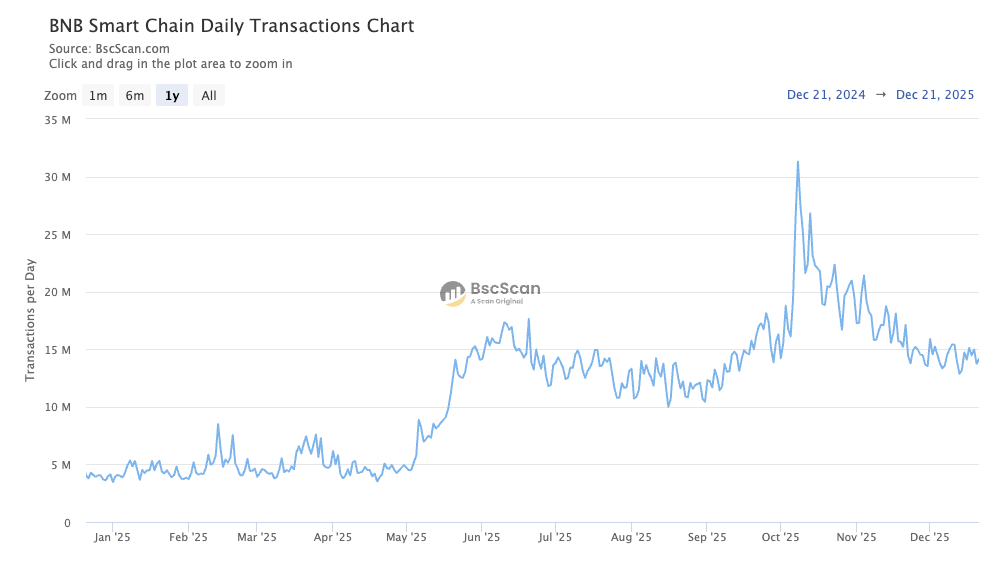
BNB Smart Chain daily transactions chart. Source: BscScan
Trading activity accounted for a large share of this usage. Swaps represented more than half of all transactions during several high-activity periods, including times of elevated market volatility. Despite these conditions, block production and confirmation remained consistent.
By the end of the year, BNB Chain ranked among the largest networks by DeFi total value locked (TVL), with approximately $6.6 billion locked. The total number of unique addresses exceeded 700 million, while daily active users across BNB Smart Chain and opBNB reached more than 4 million during peak periods.
A week in numbers for BNB Chain:
🔸 4.1M+ average DAU
🔸 141M+ transactions
🔸 $11B+ in TVL
🔸 $54B+ in trading volume
BNB Trenching Szn, USD1 Trading Competition, 34th BNB Burn and more. pic.twitter.com/gpR40kufS6— BNB Chain (@BNBCHAIN) January 20, 2026
Stablecoins and RWAs enter the picture
Stablecoins moved from a supporting role to a core part of onchain activity in 2025. Their combined market capitalization on BNB Chain roughly doubled over the year, peaking at around $15 billion, as usage shifted toward everyday settlement.
During periods of heavy network traffic, stablecoins were increasingly used as a practical rail for moving value, underscoring the importance of predictable fees and confirmation times.
Stablecoin market cap on BNB Chain just crossed $15B! 🌠
Source: https://t.co/iPjOSc6Jehhttps://t.co/kiEAoD7I0j pic.twitter.com/kmS67I7xUB— BNB Chain (@BNBCHAIN) January 13, 2026
A similar pattern played out in tokenized real-world assets (RWAs), but at a much steeper pace. RWA market capitalization on BNB Chain grew from roughly $3.7 million at the start of the year to more than $2 billion by year’s end, driven by issuances from institutional names such as BlackRock, Franklin Templeton and VanEck.
Unlike speculative DeFi flows, these assets placed sustained demands on infrastructure, requiring consistent finality, stable costs and operational reliability, and became a clear signal of how production-grade use cases were shaping network priorities.
Changes that followed demand
Several protocol upgrades during 2025 focused on execution efficiency rather than headline performance. Major upgrades including Pascal, Lorentz and Maxwell reduced block times and improved finality while maintaining network stability under load.
That work carried into early 2026 with the Fermi hard fork, which lowered block times from 0.75 seconds to 0.45 seconds and completed a multi-phase effort to shorten confirmation times without compromising stability. The intent is to reduce latency for everyday interactions without introducing variability during periods of congestion.
The Fermi hard fork occurs in just a few hours so here's everything you need to know to be ready 🎥
For the full information, check out our blog below 👇 https://t.co/SMzh6jdeZy pic.twitter.com/kqCYIBi9rj— BNB Chain (@BNBCHAIN) January 13, 2026
Fee reductions followed a similar pattern. Average gas prices declined over the year, achieved through execution optimizations rather than reduced demand. Validator incentives were maintained by improving processing efficiency instead of limiting throughput.
Alongside performance and cost, fairness became a priority. Coordinated changes across the ecosystem reduced malicious MEV activity by an estimated 95%, addressing a long-standing source of hidden cost for users during periods of heavy trading.
Looking ahead to 2026
The 2026 technical roadmap builds on these outcomes. Near-term work includes further execution optimization, updates to storage architecture to manage long-term state growth, and broader deployment of Rust-based clients to improve node performance and synchronization times.
Additional research areas include parallel execution, compiler improvements and database restructuring, aimed at reducing operational overhead for node operators and simplifying performance tuning for developers.
Longer-term planning includes the design of a separate trading-focused chain intended to support workloads with stricter latency requirements. While still in early stages, this direction reflects increasing demand from applications that require consistent confirmation times rather than occasional peak capacity.
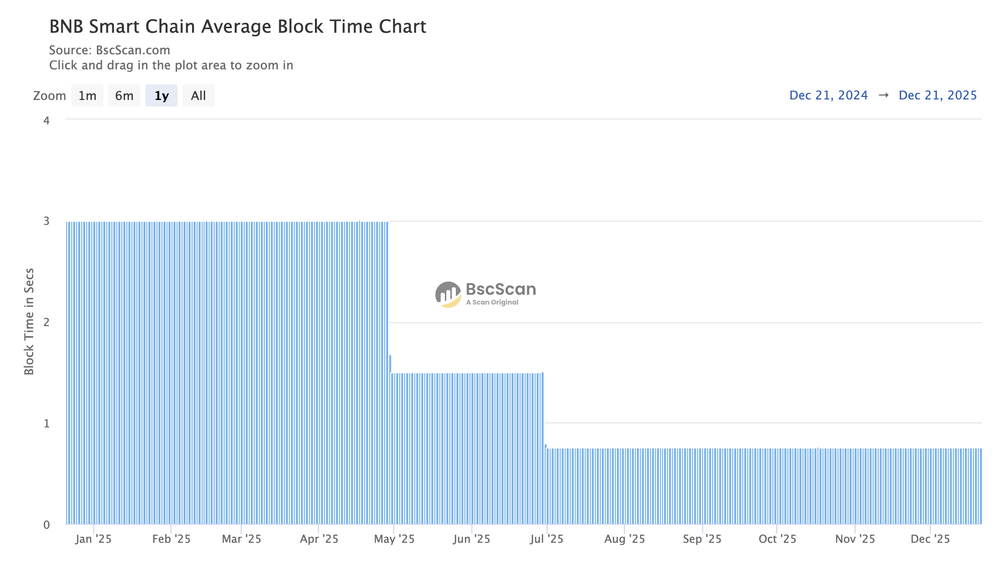
BNB Smart Chain average block time chart. Source: BscScan
BNB Chain’s recent activity illustrates how network development is increasingly shaped by operational realities rather than theoretical limits. As onchain use expands across trading, payments and asset issuance, predictable performance under routine conditions is likely to remain a baseline requirement for infrastructure across the industry.


Subscribe to daily byte-sized crypto news from Cointelegraph
This content is part of a paid partnership. The text below is a commissioned article that is not part of Cointelegraph editorial content. The material is written by our advertorial team and has undergone editorial review to ensure clarity and relevance, it may not reflect the views and opinions of Cointelegraph.com. Readers are encouraged to conduct their own research before taking any actions related to the company. Disclosure.
More on the subject