

 Written by Ayse Karamanstaff writerReviewed by Erhan Kahramanstaff editor
How WhatsApp is becoming Latin America's consumer fintech interface
Sponsored articlePublishedMay 22, 2026
A WhatsApp-based payment model brings crypto closer to daily life in Latin America by pairing familiar chat flows with escrow protection.

Sponsored byKustodia

The debate about whether cryptocurrencies will go mainstream is an old one, as they have already secured a solid position in the modern financial system. The number of crypto owners worldwide has gone from 106 million to 741 million over the last five years, which represents approximately 9% of the world population.
The growth shows that crypto ownership is no longer niche. Yet, its integration into daily life still remains limited, as handling it usually requires a certain degree of technical knowledge and awareness about the platforms, while safety mechanisms are often absent for those lacking it.
How WhatsApp can be an answer
The modern human turns to messaging apps for communication. These apps have been deeply ingrained in daily life over the past two decades.
WhatsApp, for example, has more than 3 billion active users worldwide. The prevalence is much higher in Latin America. According to the latest estimates, over 530 million people in the region use WhatsApp, equaling to more than 80% of the population.
A messaging app with a huge user base can be an effective tool in integrating crypto into daily life.
Meta, the parent company of WhatsApp, released a cloud-based API in 2022. This API allows businesses to develop a wide range of services directly on WhatsApp, including onboarding, payments and customer support. Blockchain projects can also build on this infrastructure and bring complex crypto services in with a simplified touch to millions of readily available users.
Crypto payments arrive in WhatsApp
Kustodia, a Mexico-based payment platform, built a blockchain infrastructure that operates within WhatsApp. The platform brings bank payments, stablecoin settlements and onchain escrow under one roof, in a familiar environment.
WhatsApp’s inclusion keeps the crypto layer mostly out of the user’s way. Users can start and manage a transaction through a WhatsApp bot, a channel already widely used worldwide. There is no separate app to install and no assumption that either party understands stablecoins or smart contracts.
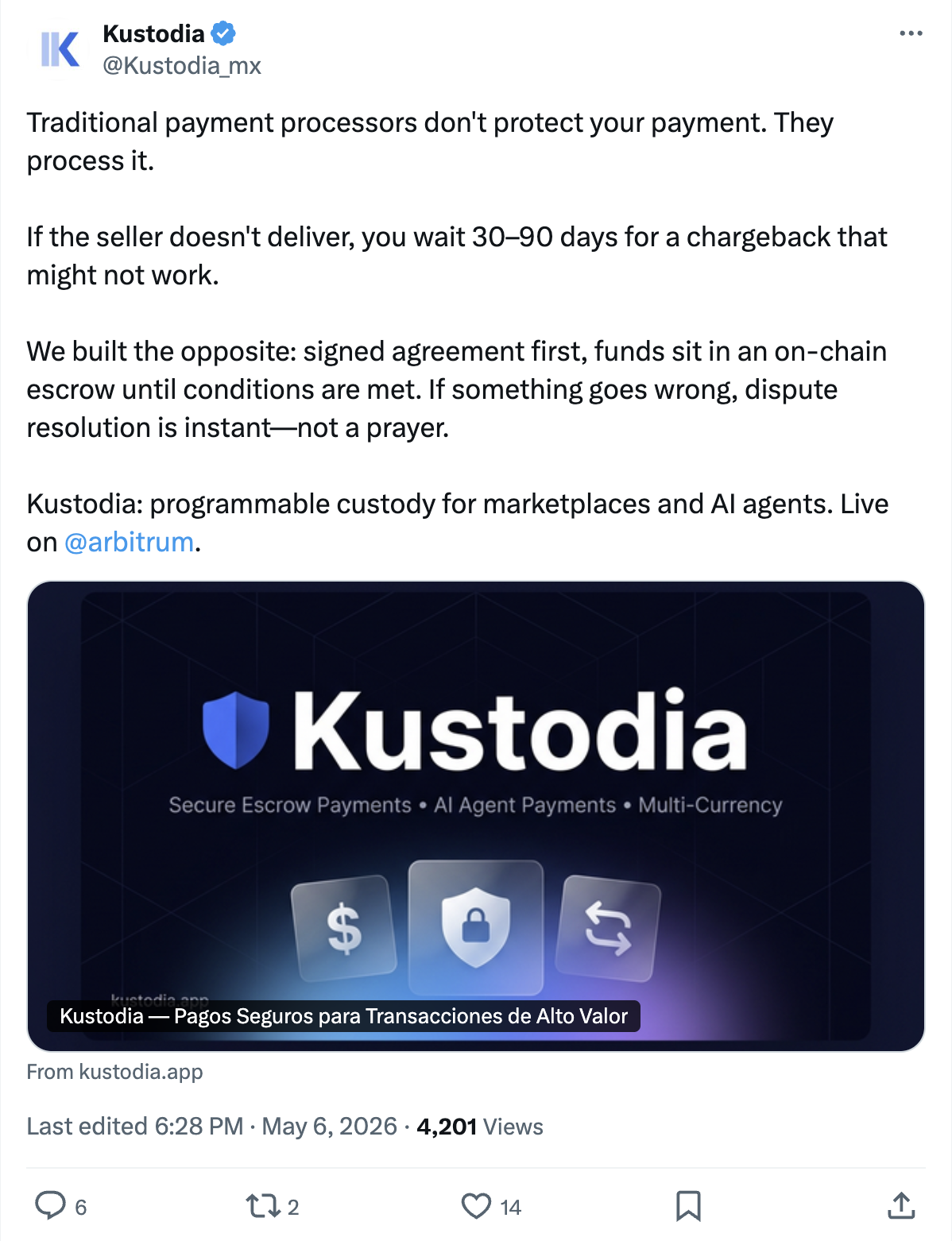
While WhatsApp simplifies crypto for mainstream users, the escrow mechanism of the platform adds a safety layer. When a buyer pays, the funds are not released directly to the seller. The platform holds them until the agreed conditions are met, with custody backed onchain across networks such as Arbitrum, Base and Polygon. Both parties can track the status of the funds.
A safety layer for LATAM
The escrow is especially relevant for markets where fast payment rails are already common. In Latin America, for example, SPEI and Pix transfers are useful because they settle quickly and are difficult to reverse. But the same feature becomes a problem when the counterparty disappears after receiving the money. Kustodia’s escrow adds a pause between payment and final release.
Source: Kustodia
For higher-value transactions, Kustodia adds checks before funds move. Identity verification, document review, lien checks and vehicle history checks help reduce fraud risk, while agreements can be signed through OTP-verified cryptographic signatures. Marketplaces can also embed the same process through an API, adding escrow without rebuilding their payment stack.
Kustodia also handles the currency mismatch that often blocks crypto payments from becoming practical. A buyer can pay in local currency, while the seller receives fiat or stablecoins. FX conversion and settlement happen inside the flow rather than through a separate exchange account.
A bad deal sparked an idea
Kustodia grew out of a personal bad experience. The founder, Rodrigo Jimenez, engaged in a P2P transaction back in 2021, but lost all the assets as the counterparty vanished into thin air after receiving the money.
The incident became more than a source of distress for Jimenez; it became a moment of realization. Crypto needed an escrow mechanism that was already present in traditional finance. This realization became the fuel for Jimenez, who spent the next three years building Kustodia.
The platform targets a real pain point in Latin America. The region loses around 20% of e-commerce revenue to fraud each year, and Kustodia offers a blockchain-based way to reduce those losses without slowing transactions down.
For a region where fraud cuts into a large share of online commerce, that change matters. Crypto does not need to be visible at every step to be useful. Sometimes, its role is simply to make a risky transaction less dependent on trust.
This content is part of a paid partnership. The text below is a sponsored article that is not part of Cointelegraph.com editorial content. The material is written by our advertorial team and has undergone editorial review to ensure clarity and relevance, it may not reflect the views and opinions of Cointelegraph.com. Readers are encouraged to conduct their own research before taking any actions related to the company. Disclosure.
More on the subject