

Written by Ayse KaramanCommissioned Content
Written by Ayse KaramanCommissioned Content
Hybrid governance program gives tokenholders a voice on this platform
CommissionedPublishedJan 27, 2026
Tokenholders can influence key decisions on product direction, tokenomics and ecosystem priorities via hybrid voting, adding a new layer of transparency.

Commissioned byCoinDepo
Disclaimer. This content is part of a paid partnership. The text below is a sponsored article that is not part of Cointelegraph.com editorial content. The material is written by our advertorial team and has undergone editorial review to ensure clarity and relevance, it may not reflect the views and opinions of Cointelegraph.com. Readers are encouraged to conduct their own research before taking any actions related to the company. Disclosure.
Crypto fintech platform Coindepo launches a hybrid governance program for holders of its utility token.
Over the nearly two decades of their existence, cryptocurrencies have established themselves as an integral part of finance. These blockchain-based tools are increasingly used for money transfers, investments and wealth preservation.
Cryptocurrencies gives participants financial accessibility, flexibility and autonomy. Yet, the space also faces issues like unclear legal structures and opaque business models that carry the inefficiencies of traditional finance to Web3.
Blockchain is a global and relatively young industry; the legal framework covering it is still in development in most jurisdictions. Compliance requires being well-informed of these varying frameworks and opting for licensed platforms.
Financially, one of the very reasons why cryptocurrencies were invented continues to plague many crypto platforms: inflation. Yields are usually sourced from minting more tokens. This dynamic has raised concerns within the industry about long-term sustainability and incentive design.
Tokenholders to participate in governance
Crypto fintech platform Coindepo describes its approach as incorporating elements inspired by traditional financial infrastructure. This hybrid model incorporates financial structures designed to be familiar to users accustomed to traditional financial platforms.
Platform users can participate in yield-generating mechanisms without engaging in active trading. Instead of relying on new token issuance or trading commissions, the platform uses structured, collateralized lending and capital allocation models as part of its design.
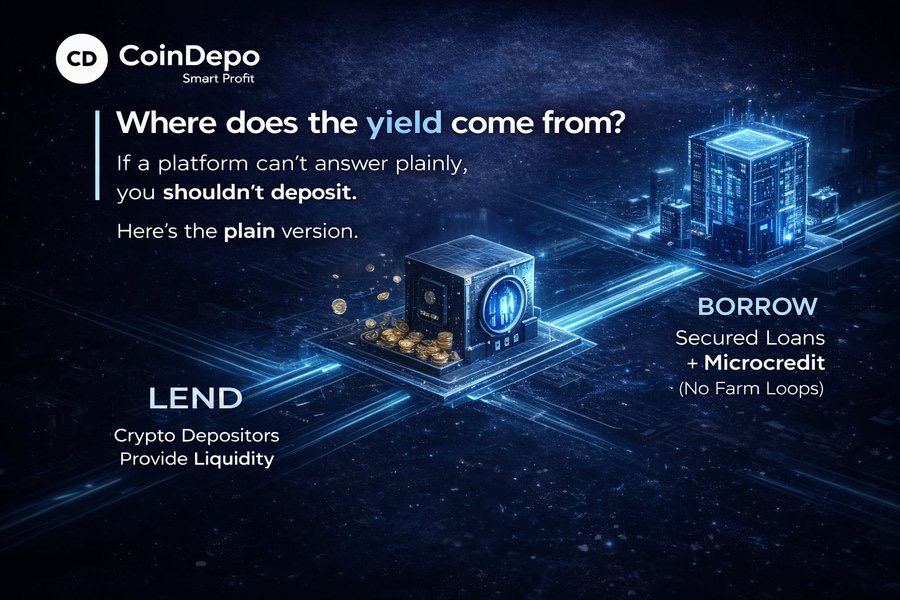
Source: CoinDepo
Coindepo offers a compliant environment; the platform obtained licenses from authorities in countries such as El Salvador and Panama while also receiving a Virtual Asset Service Provider (VASP) license from Poland.* Coindepo also releases quarterly performance and business activity reports to offer users visibility into how the platform operates.
With the governance program, tokenholders can participate in governance discussions related to product direction and ecosystem development, subject to the platform’s governance framework.
Governance that’s easy to game is cosplay.
Our voting power is based on a 90‑day average token balance (Governance Score).
Short-term rage-buying doesn’t dominate long-term users.
Details in first reply. pic.twitter.com/KwqAZysm1r— CoinDepo (@DepoCoin) January 9, 2026
Under the hybrid model, participants will vote on decisions offchain. The results are recorded onchain through snapshots, creating a transparent and verifiable voting system.
Current pipeline
Coindepo has been scaling up since its debut in 2021. According to company-reported figures, the platform has reached approximately 110,000 users and reports $220 million in assets under management.
Launched in 2025, its utility token is seeing expanded functionality with the new governance program. Coindepo also has plans to introduce a disinflationary mechanism to its tokenomics. The platform is planning to start a token buyback program in Q1 this year.
The company plans to allocate around 20% of its profits to a token supply management mechanism, including buyback and burn processes. The mechanism is designed to adjust circulating supply over time.
Coindepo has other plans scheduled for launch in 2026 as well. The platform prepares to launch crypto credit cards that do not require predeposits. Users will be able to spend with the card in a way similar to traditional cards; only debt repayments will be made in crypto.
Commenting on the developments from the company’s perspective, David McDaniel, CEO of Coindepo, said:
“We believe the next phase of crypto adoption won’t be driven by speculation, but by infrastructure that institutions and households can actually rely on. Institutions are quietly entering crypto, not for hype, but for yield, efficiency and global reach — and that shift is already reshaping the market.”
Coindepo’s 2026 plans also include exchange and instant conversion features as well as additional payment-related services. Over time, the project aims to evolve from a token-based platform into a broader crypto-native financial hub.
* These licenses apply within their respective regulatory scopes and do not constitute regulatory approval in all markets.


Subscribe to daily byte-sized crypto news from Cointelegraph
This content is part of a paid partnership. The text below is a commissioned article that is not part of Cointelegraph editorial content. The material is written by our advertorial team and has undergone editorial review to ensure clarity and relevance, it may not reflect the views and opinions of Cointelegraph.com. Readers are encouraged to conduct their own research before taking any actions related to the company. Disclosure.
More on the subject